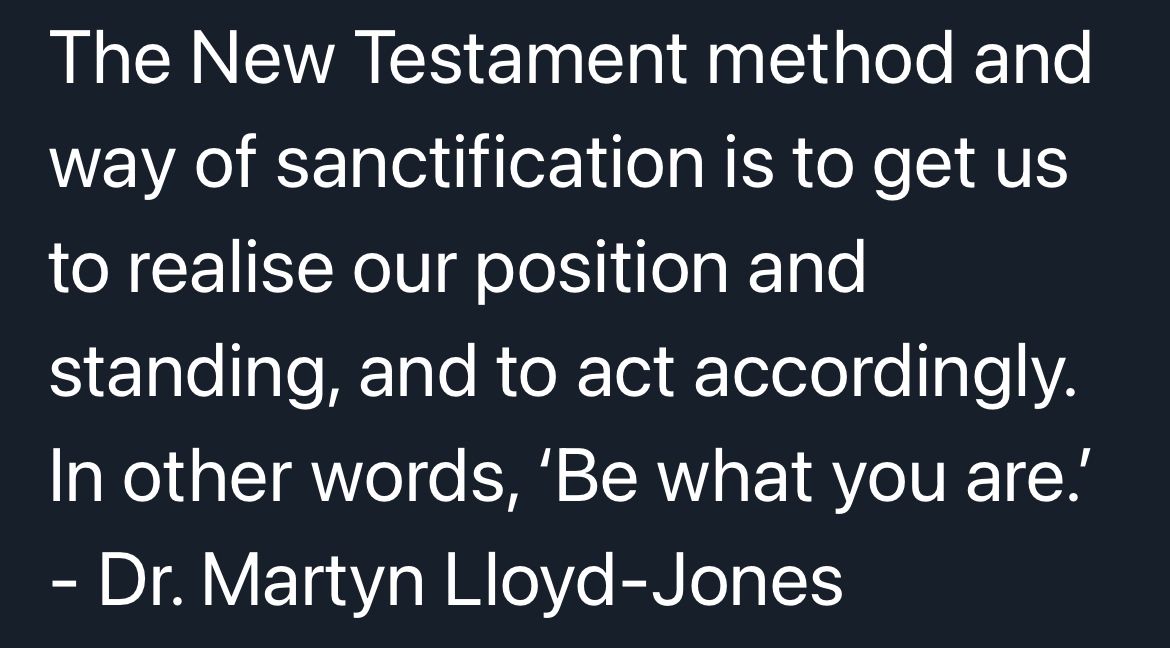
I’ve recently finished two excellent short little books that are related to the topic of this article. I highly recommend you consider reading them. The first one, Who Am I?: Identity in Christ by Jerry Bridges provides a good basic overview of what Scripture says about who we are as followers of Christ. The second book, Sanctification: Transformed Life by David Campbell is a Biblical exposition on how we grow into that which God would have us to be as His followers. Here, I will provide a brief overview of this, but I do suggest you check these books out for yourselves. The quote above is a good summary of what I want to emphasize today: Be what you are.
Much of our trouble as Christians comes from bad theology and a poor understanding of the basic tenants of Scripture. In a sense, we are spiritual schizophrenics, living and making decisions that do not align with who we are in Christ. God is not a warden, policeman, judge or gatekeeper for Christians, but is a loving Father, who provides a wise counselor in the form of the Holy Spirit in order for us to live an amazing life according to all that God has created us to be. It is to our folly when we depart from that life, pursuing a different picture of reality defined by the world, the flesh or the devil.
You would be well served each day to take time to remind yourself of the truths of God’s Word and what they say about you. In them, we find the truth of who God is and who we are in Him. In contrast to the old SNL skit with Stuart Smalley and his daily affirmations, our best source of hope for who we are is not in ourselves or in what others say about us, but rather in who God says we are and who we are to be. In your daily time with God, you can focus on the truth that our sufficiency and worth are centered in God’s infallibility and not in our own weakness. Here are just a few of the essential truths that God shares with us.
You are a created being, created in the image of God. Genesis 1:27 – God created us, but we are above the rest of creation. Of all the things He created, only mankind is created in His image. As created beings, we are dependent on our creator and it is important to remember that as we go through life. We need Him, physically, spiritually, psychologically. We were created to find our purpose in Him. When we do that, we experience the life that God intended for us as His greatest creations.
You are in Christ. 1 Corinthians 15:22 – The term in Christ is used over and over again in the NT, most frequently by Paul. Our new status as Christians is secured in Christ. All that it means to be a follower of Him is because of what He did, not anything specific about us. This status is what takes us from being spiritually dead, enslaved to sin and the objects of God’s wrath and assures our new status before God, which is defined by all of these terms, summed up by “in Christ”. Also read Romans 5:18-19.
You are Justified. Galatians 2:15-16. Justified is a legal term that means we are treated as being in right standing according to the law. The law would bring punishment and death to all who have sinned (everyone), but in Christ, we are treated as those who are righteous before God. The law doesn’t change, the punishment for breaking the law doesn’t change, but Christ paid the price for our sins, so we are now treated as if our slates are completely cleaned. Our ledger now has Jesus’ 33 years of perfect righteousness in our favor. We are justified by our faith in Jesus Christ.
You are adopted children of God. Ephesians 1:4-5. Galatians 3:26-29. God doesn’t stop with changing our status for all time to being “saved” or justified, He brings us into His family. Even if we never experienced a loving parent on this earth, we now have the most loving, caring Father that we could possibly have. God takes people from every background on earth and brings them into his family. In Biblical terms this also means that we are His heirs. We are given a future hope as people who can now look forward to the eternal inheritance that we were granted access to through God’s loving adoption of us into His family.
You are a new creation. 2 Corinthians 5:17. We are given a new heart, we are a new person. Only the transformative power of Christ through His sanctification can explain the changes brought about by the work of the Holy Spirit in the lives of people like us. In Romans 6:1-14, Paul describes the struggle on this earth as who we now are in Christ struggles with who we used to be, but the promises of God are a reminder of the change. 6:14For sin shall no longer be your master, because you are not under the law, but under grace. The power of living as a new creation on this earth is still a battle, while on this earth. Dr. Bridges described it this way, “You and I are now engaged in a spiritual guerilla warfare against remaining corruption within us, and that warfare has real consequences-for ourselves, others, and the glory of God-depending on how we engage with it…Though we have been delivered from absolute bondage to sin, we have not been freed from its presence or influence.” In heaven, it will be impossible for us to sin, but on this earth we live with full access to the ability to live as new creation’s in Christ. We should live as we are.
You are a saint. Colossians 1:11-13 – This is a word that can be misunderstood and some would only want to apply it to those existing in a special category of Christian, but as you read through the NT, you find that it is the norm to refer to all followers of Christ as saints. A saint is one who has been sanctified and we are in the process of being sanctified, but it could also mean “set apart” and that is who you are. As a follower of Jesus Christ, you are set apart as His. As the saying goes, we have been bought with a price. This does not make us slaves, but rather free men and women, our freedom was bought with a price. We are now saints living our lives for God’s glory. 1. Corinthians 10:31. Our sainthood “does not come in its fullness in a once-for-all experience. It is an ongoing experience with a beginning, an end and a long in-between.” (Campbell)
You are servants of Christ. Colossians 3:22-24 – We are now followers of Christ and we find our truest joy in serving Him and the purpose of God. This doesn’t mean that we all leave our jobs and become full time ministers, but it means that wherever we are and whatever we do, we serve the purposes of God. We are serving the Lord Christ when we work at our job, serve in our church or minister to our family. We serve in each of these roles according to who we are in Christ, not who we are in the flesh and by this we bless all those who regularly interact with us. In every endeavor, we have the opportunity to serve the purposes of Christ, thus we can be called as Christians to any vocation, as there are opportunities to act as His servants in any of those positions.
You are not yet perfect. Philippians 3:12 – We are to stay in touch with our own imperfection. In this life, we will still struggle with sin and makes mistakes and yet we glorify God through our imperfections. As we openly and honestly reflect on and deal with our continuing imperfection, we reflect the power of a redeemed life in reality and demonstrate the power of Christ all the more as we confess our need for His help. We preach the Gospel to ourselves daily, reminding ourselves that we have no justification for feeling self-righteous, but only righteous before God through Christ. This helps us to remember that we are not performers, but frail creatures of dust that will only be perfected in Christ in heaven.
You are loved. Romans 8:37-39 – Many passages tell of God’s wonderful love for us, but this passage assures us that nothing can separate us from that love. In spite of our imperfection, in spite of our sin, God loves us and our testimony to the world is of confident adopted children who should never doubt the continuing, never finishing love of our Heavenly Father. We live as those who are loved by the one who understands who we are at a deeper level than any human ever can.
You are blessed. 2 Corinthians 9:8 – We are spiritually blessed. God has given us many wonderful gifts, the greatest of which is our salvation, but He has also given us each other, in the Church. He has given us wonderful spiritual gifts and resources to use to accomplish His purposes. Spiritual gifts like: Ephesians 2:10, 1 Peter 4:10-11, and Romans 12:4-8.
Our call today is to live as Christians who believe the truths about what God’s Word has said about us. We are not defeated. We are not prideful. We are not despondent. We are no longer slaves to our sin. We are not dependent on our own strength. We are not hopeless in the face of a culture without God. We are sanctified sinners who serve the All-Mighty King of all creation and in Him we find our life and hope and have our being. You are a child of the King, you are an Heir to the Kingdom. You are the Saints of your generation, carrying forward the faith of previous generations on the strength of His wings. Live like that today and every day and start each new day with this reminder.
In a time not so long ago, and in a place not so far away there was a great grand piano. It was a magnificent piano from which beautiful music flowed for all time. Within this piano lived a large family of mice. For the mice, the piano was all of their entire world. They were born, raised and lived their entire lives within this piano world. Their lives were filled with the wonderful music that penetrated every corner of their world.
This family of mice was much like any of your own families, and they had a very loving, very old, very sweet Grandmother that like to tell the children stories. The most treasured story of all for them to be told was the story of the Great Player. On nights when the piano had grown slightly cold they like to snuggle up close to Grandmother in one of her quilts and listen to this story told over and over again.
Now three of these young mice were especially inquisitive and they were constantly drawing near to Grandmother to hear the story. Their names were Charles, Newton and Lewis and they were brothers.
“Now settle down children,” Grandmother would start, “I’m going to spin you a story ’bout how things were long ‘for any of us is born.” This would instantly draw them quiet, because it was this story that they had waited to hear. (I say quiet, but what I mean is quiet for these little mice, for we all know that being totally quiet just isn’t part of being a child.)
“Way back yonder in the olden days, before any of us mice was ever around, there was no music to fill the world. All was silent and quiet, unlike anything any mouse has ever heard. The whole of this world was empty, with nothing to see and nothing to hear. Ya’ll never known a world quite like that one. In those days, the world was a lonely place, with nothing but darkness and emptiness.”
“It sounds so scary,” exclaimed Lewis, “I sure wouldanna wanted to live then!” Lewis was the youngest of the mice and he was the one who loved Grandmother’s stories the most.
“Now hush up and listen,” Grandmother began again. “Sure it sounds scary, but all of that is what makes what happened next so wonderful. For you see it was into this world that the Great Player came, and with His coming came the beautiful music that is all that you have ever known. The Player and His music drove away all of that emptiness and darkness and filled the world with warmth and happiness.”
“But where did the mice come from?” asked Charles, for he was the type of mouse that always wanted to know the reasons behind everything.
“Well child, I’ll tell ya. For you see it was after the music had filled every corner of the world that the first mice were born. The music that had brightened up all of the dark places also gave them life. They arose at once and began to dance to the harmony of the sound. Wonder filled these first mice as they marveled at this new world that they had been born into. It was a true joy just to be alive, and they knew of and were in awe of the Great Player, who produced the music.”
“How did the Player make the music?” asked Newton, for he was a very practical mouse, always wanting to know how things worked.
“The important thing is that the music came from the Player, Newton. The Player can choose to make the music anyway He desires. Anyway, back to the story. This new family of mice grew and lived here before us, raising their children and grandchildren under the music which the Player continued to play. This music not only filled their halls with warmth and light, it was a great comfort to them. The music was a constant reminder of the Great Player who continued to play out of His great love for them.”
“But how did they know about the Player?” asked Newton, “Did they ever see Him?”
“Well child, no, they never did see the Player, but I can tell you about Him because I’m just as sure of Him as you are of the music you hear every day of your life. The Player was a part of their lives in the beginning and He’ll be a part of our lives ’til the end. You see, it is the Player that makes the music. You can never see Him, but He’s always close to you. He’ll never leave you because all He wants is what’s best for you. The music’s the proof. Without the Player, there would be no music, and without the music there would be no life.”
As Grandma said this last, she settled back into her rocker again and smiled. All of the little mice were quiet now as they considered all that they had been told. It seemed so much to think about that it made them all quite tired. It was starting to get late and they slowly began to break away and go to bed, but Lewis did as he often did at these times. He crawled up into Grandma’s lap so she could rock him to sleep.
“Oh Grandma, I’m so happy to have the Player to watch over us,” yawned Lewis softly as he closed his eyes.
“Me too child,” whispered Grandma into his ear, “me too.”
Charles’ Quest
It was the very next morning when the three little mice awoke to the familiar sound of the music. Even the hardest and most bitter person would have to admit that this was a wonderful way to start your morning. It was very difficult to have any bad or angry feelings with the joyful sound of the music constantly surrounding you. You couldn’t help but feel a sense of peace and contentment as you went about your daily life in this place.
Though all held true to the belief of the Great Player, there were some to whom He was a little less real. Not all of the adults and children held so strongly to their beliefs about the Player. Sure, if you had asked them about Him, they would have responded with all the proper and right responses, but the joy of the music did not fill their hearts, as it was blocked by other thoughts.
It was on this wonderful, lovely day that Charles, Newton and Lewis arose to the music and set out to finish their daily chores, so they might have the rest of the day to play. This was what they did almost every day because, like most children, they liked to play more than anything else. Usually they played lots of fun games like chase, hide and seek, and cowmice and cats, but today Charles had a different idea.
“I’m tired of playing all of the same old games we always play, I want to go on an adventure!”
“What’s an add venturr Charles?” replied Lewis, for he was ever so young and had never heard of such things before.
“It has excitement and danger and you fight dragons and find gold and in the end you win a princess!” said Newton. Newton had read many books of adventures since he was first able to read and often dreamed of being a knight himself one day.
“Not that kind of adventure,” Charles told them, “I mean a real adventure that we can do right now in real life.”
“But what kind of adventure can we do,” frowned Newton, “we’re just little mice and there is no danger here.”
“I want to go on a quest for the one thing no one has ever seen,” said Charles.
“What’s that?” they replied.
“I’m going to find the Great Player and see Him for myself!” cheered Charles, and with that the other two mice all but fell down, for such an idea had never occurred to either of them, and they didn’t know quite what to think. This was an idea that Charles had thought long and hard on and he had been hoping to try for weeks. Now with all the talk about the Player the night before, he finally had the nerve to try it.
“But Grammy always said we didn’t need to see the Great Player to believe in Him.” stammered Lewis. “He’s just there and no one has to see Him.”
“But just imagine what it would be like to actually see Him Lewis,” exclaimed Charles, “then we could know for sure and tell everyone what we have found and we will be famous.”
“Well, it doesn’t sound like a good idea to me,” said Lewis, “I don’t want to go.”
“Suit yourself,” said Charles, “you coming Newton?”
“Well, I don’t know,” answered Newton, “I would like to find out where the music comes from. Why don’t I wait here and you can tell me what you see when you get back. Then I could go and see for myself after you know the way.”
“Okay, but you guys are really missing out by not coming,” said Charles, and with a nod he turned and was off on his way to find the Player, the source of the music they heard.
Now there are some things you should know about Charles before I tell you about his journey. Charles was a very smart little mouse. He had always been able to figure things out quicker than any of the other little mice. He learned quickly and he was always hungry to find out new things. He always dreamed that one day when he got older he would be a scientist and would be able to discover many things that no one else had ever known.
He did this for two reasons. First, he really did have a legitimate desire to know things that might help out, but secondly, Charles liked to know more than others so that he could do a bit of showing off. He thought that finding the Player would make him famous and important and every one would like him the best. This was the bad thing about him searching for the Player. Even though Charles was a good little mouse, he wanted to be better than his brothers.
Since Charles had thought about this moment so often, he knew immediately the path that he must take in order to go on his search. It led away from the village and towards the place where the music was loudest. From this hole above poured a pleasant light that filled you with a warmth that was better than a cup of hot chocolate on a cold winter’s day.
Charles had ventured close to the hole before and he knew that there were little holes which he could use to scamper up into it. He now placed his paw carefully in the first hole, preparing to start his climb to the top.
What lay ahead was something that he knew nothing of, a place that was only a part of his imagination that was about to be added to his reality. It was the unknown. Now, it might not seem like much for you and me. We know that it was a piano that was their world and we have a pretty good idea about what lay ahead, but for Charles it was just like every time you looked in a dark cave, or visited a haunted house. The fear was real, and it took a great deal of courage before Charles was ever able to take that first step.
He finally raised up his courage and ran quickly up into the hole. Once he was finally there, the warm, pleasant feeling overcame a little bit of the fear that had filled Charles. He had to push through, because he had developed a round little body from sitting out too many of the mouse games. It wasn’t that tight though, and soon enough he was getting to the end of the tunnel where it opened up.
Charles cautiously peeked his head out of the hole, and found nothing but the sound of the music floating to him down a long hallway. Slowly he crept out of the hole and stared down into the shadowy, glowing light. It was brighter here, and much more mysterious. Not like any of the light that he had ever seen in his village. Still, he couldn’t help but enjoy the wonderful feeling that seemed to be coming down the tunnel towards him. Further along, he could see that the tunnel continued on a ways into the darkness.
It was an easy choice as he headed out, down towards the light. After all, his journey was to find the Player, and if Grandma were right, the best way to do that was to follow the light. The tunnel seemed to carry on for quite a ways and it was slow going as Charles wouldn’t allow himself to move very fast. He took his time and enjoyed the trip as he moved towards the ever increasing sound of the music. By now, it was very loud, and the sound seemed to vibrate through Charles’ entire body. He delighted in the sound and it really made him forget about any dangers which might lie ahead.
At long last, he reached the end of the tunnel. This end curved up and around into another area above. It was from here that all of the sound seemed to be coming. Charles braced himself for the long awaited encounter with the Player. This was something he had dreamed and hoped for, and finally it was going to happen. Slowly, he peeked his head up and around this last corner, but just as quickly he darted it back.
It was an amazing sight! He moved all the way back around to get a better look. There were the most beautiful strands of gold, and it was from these that the music flowed. Charles was dazzled by the beauty and the power of the sound. He leaned up against the wall and looked back and forth at the many different strands. For they were different, Charles saw that they were all of different lengths and a slightly different sound vibrated from each one. “Oh what a wonder!” thought Charles, “I shall have to tell everyone the truth of the music.”
Charles sat there a bit longer in awe of the beauty and majesty of these magical gold strands. After a while, he picked himself up and rushed back the way he had come. He couldn’t wait to get back and tell all the others. He could even tell Grandma what he had seen and how there really was no Player after all. It was all in the magic of the strands that the music came from. “Now, I’ll be a hero for sure,” thought Charles, and he dreamed of all the wonderful things the others would say and do for him after he told them his secret.
Newton’s Quest
Now it was nearly time for bed again when Charles came storming in with his big news. He was all out of breath and couldn’t speak when he ran up to the room he shared with his brothers. Instantly, Newton was at his side wondering whatever it was that could make his brother run so hard to get to them, for Charles was not known to run unless it was to the call of dinner. “What happened Charles?” asked Newton, “Did you see a dragon?”
“Did you see Him?” squealed Lewis, “Did you see the Player?
“Hold on, let me catch my breath,” panted Charles. They stood beside him and waited, though the excitement within them was almost more than they could bear. Finally, after what seemed like forever Charles began to tell them his tale. He spoke slowly as he worked his way back over the entire journey, adding details that he knew would scare and impress his brothers. Newton and Lewis interrupted often, not wanting to miss a single thing.
Charles eventually made it to the huge room filled with golden strands. His brothers were amazed. It was like nothing they had ever seen or heard of. Charles ended by saying, “Now we know the truth. There is no Player. The music comes from the strands of gold. They are magic that brings us heat, light and life.
“But that can’t be it!” cried Lewis, “Grammy said that the Player made the music!”
“I saw it with my own eyes, Lewis!” replied Charles. “You know that no one has ever seen the Player, but the strands of gold, those I’ve seen. What do you think Newton?”
“I’d like to see for myself before I say,” said Newton.
“Then you will see Newton,” said Charles. “I’ll tell you how to get to them and you can travel there tomorrow.”
“Can’t you come with me Charles?” asked Newton.
“Don’t be silly,” answered Charles, “It isn’t that far and there is no real danger as long as you go the same way I did. What about you Lewis? Don’t you want to see where the music comes from?”
“I don’t care what you say,” cried Lewis. “There is a Player, and He is where the music comes from. I believe Grammy. She knows the truth and I do to.” And with that, Lewis rolled over and cried himself to sleep. Newton and Charles stayed up later planning Newton’s trip to see the golden strands the next day. Even after all the rest of the house had gone to bed, including Newton, Charles could not sleep. He could only think about all the grand things that would happen tomorrow when he shared his knowledge with the rest of the village.
When sleep finally claimed him, Charles dreamt dreams filled with great rewards and honor. All the adult mice and their children came before him to tell him how wonderful he was, even Grandma came to him and said, “I’m so proud of you boy, it is because of you that we finally know the truth.”
The little sleep that Charles had the night before kept him in bed a little longer than his brothers, so by the time that he got up, they had already finished the daily chores and Newton was preparing to leave.
“Aren’t you gone yet, Newton?” said Charles. “You should really get going so you will have lots of time to enjoy looking at those beautiful golden strands.”
“I’m going right now,” said Newton, “I was just waiting for you to get up so I could say good-bye.”
“Don’t worry Newton,” said Charles, “you’ll get back all right and then you can help me tell everyone about what I found out.”
Newton headed out down the path that Charles had told him about and followed along the same way that he had told him to go. It still took him a good deal of time before he was walking along the tunnel towards the light, because it is one thing to be told something is safe, and quite another to have to believe it is safe enough to put your own tail on the line. Still, it wasn’t too long before Newton was ducking his head around that final bend that led to the room that contained the golden strands.
Newton, just like Charles, was amazed at the dazzling wonder of the golden strands. He stood hypnotized by their enchantment, unable to avoid the loveliness and power of the music that emanated from them. After who knows how long, Newton began to look around the gigantic room which contained these marvelous golden strands. He saw that there was a slim ledge that ran all the way around the room, leading from the point at which he was standing and continuing away as far as he could see.
Newton thought, “Surely it is not just magic that makes these wondrous strands work, there has to be something to strum them to get them to vibrate like they do.” Newton was a very practical mouse and his curious nature demanded to find out what it was that made these amazing golden strands vibrate the way they did.
Newton began to edge himself out around the ledge, and as he did he saw that is was actually wider than he had thought. He soon was making his way at a quick pace around the rim of the room. Still the music and power filled him as the giant room was unable to contain so much sound. The pleasure was so great, Newton thought he might burst, but he continued, led on by his great curiosity. He soon saw a great row of gigantic things beyond his description. It seemed to Newton that it was these things that held the golden strands in place, and perhaps it was them that caused the strands to vibrate.
When Newton moved closer, he could see that the ledge he was on did not end at these great things. It carried on underneath with just enough room for Newton to slide under. As he did, he felt a great rumbling and the vibration was as much as it had ever been. He looked up and saw that the golden strands continued on this side of the barrier, but that wasn’t all he saw. There, to his bewilderment, were great hammers which plunged down upon the strands, sending vibrations throughout them.
This was the key to the music! The hammers hit certain strands, and those strands produced the different notes of the melody. What a spectacular mechanical device this world was that they live in. It wasn’t magic after all. It was a machine, the most wonderful machine there ever was or ever would be. Newton couldn’t wait to tell the others what he had discovered.
He was so happy to have found out the music was made by a machine, because he loved machines himself, and one day hoped to build great ones. Newton examined this machine closely, then he hurried back the entire distance. He knew it must be getting late and he dared not be home later than bed time. How surprised the others would be to hear this stupendous news that he couldn’t wait to share.
Lewis’ Quest
What Newton didn’t know is that all day long while he had been away, Charles had been telling everyone his news. Everyone in the village knew what a bright little mouse Charles was, so they were not quick to dismiss his story, as adults often are. Some believed in the Player above all else, and they dismissed Charles’ findings. They all agreed it was a wonderful story whether it was true or not, and many of those to whom the Player was not so real began to accept the news.
They liked his idea. They felt it more sensible than the story of the Player, and by the end of the day, they were ready to believe in the golden strands that Charles had seen. These seemed so much easier to believe in than in the Unseen Player. Strands of gold were something that was real. They knew about such things in their own world and they understood how they could create music.
By the time Newton came running into the Town Square, most of the family had gathered there in the evening to listen to Charles tell once again of his journey and discovery. Newton came rushing into the group, urgent to share his own discovery. When he did, the crowd accepted it all the more. “Of course!” they thought. “How simple! How could we have ever believed in something as foolish as the Unseen Player.”
This was not all the village, but there were a growing number who were coming to believe in these theories. It was something that seemed more real to them than the story of the Player. A solid core of believers remained, among these were Grandma and Lewis. As Lewis watched the crowd, he vowed to find out for himself and not stop until he had seen Him.
Lewis left that very night, as soon as everyone had settled down for bed. This might be seen as a very foolish thing for a little mouse to do, but he couldn’t wait until morning. He had to find the Player now. He knew the Player was real, and he couldn’t stand it that so many of the others were turning away from Him. He would find the real Player, and when he had the proof, he would come back and tell them all that the Player was real and it was from Him alone that the beautiful music flowed.
Lewis crept out of the room and down to the front door. Silently, he slipped out and headed towards the soft music and dim light that always came with the night. He had heard all of what Charles had told Newton, so he knew the way that would lead him to the golden strands. It was darker at night, and this made for an even scarier journey up to the hole that led to the tunnel. Lewis was much smaller than either of his two brothers, but very agile. He was able to scamper up into the hole very easily.
When he leaped into the tunnel a warm and powerful burst of air and music that was more like a wave rushed over him. As this washed over Lewis, he was filled with a sense of calm and peace and was no longer afraid. He knew that the Player was real, he just knew it. He walked quickly down the tunnel heading for the light that he knew would lead him. As he reached the end, he had to pause before moving on. The excitement was great in his heart and he could feel it pounding against his chest.
He moved around the turn and saw it. There in all the glory and splendor were the golden strands. “How beautiful,” said Lewis to himself. He sat down to experience the music as it floated down to him from above. The soft melody reached his pounding heart and calmed it. After a time had passed, Lewis realized this was only the first step in his journey. He looked and found the ledge that he had heard his brother speak of almost instantly. Then he was racing, flying around the ledge, with the beat of the music increasing and driving him on. He was near his goal now. He could feel it!
Lewis slowed as he reached the great barrier. This whole room, everything, was bigger than he could even imagine. It was a vast landscape that spread out before him, and here was the barrier, right ahead. He slipped under it and found himself in a smaller room. This room had a noise that was both grand and mysterious, and then he saw them. There, above him. There were the hammers that Newton had spoken of. Truly, they were magnificent, really too big to be called something as simple as a hammer.
Still, the music was there for him, but now it slowed once again, and grew soft. Lewis froze and looked around. Despite its softness, the music seemed to penetrate still deeper within him. He sat in awe of all that was around him. It was all so wonderful, and yet still he must journey on further to find the Player. Lewis saw that the ledge he was on ran into a wall, which seemed to lead up to a place where the light shined at its brightest. He started to walk carefully over to the light. Moving to the slow beat of the music now.
The light grew brighter the closer he walked, yet he could still see everything clearly, more clearly in fact. The colors of the light diffused into a thousand rainbows all around him, all of which seemed to be reaching out to him. It was like looking at the world through a perfect crystal. All things grew clear, not only in the world around him, but in his mind and in his heart. Lewis stopped and stared into the light. He was soaked with the music and the light and the feeling. It was all there for him.
Then suddenly, softly at first, he heard a new sound. This sound was different than the music. It had a different texture and it filled the air even more. Joy hit Lewis like a tidal wave. He fell to his knees and began to cry. Not little mouse tears, but great tears of passion and happiness. Lewis knew what the noise was. The Player had begun to sing. It was a song of such majesty that it could be from no other. The song seemed to carry more meaning than words could hold. It was more like a feeling than a song, and a feeling that surpassed all others.
Then the music and the voice began to pick up pace. This tune was one of celebration. Lewis arose and began to dance. It was a dance that came from the music. He danced and sang and lived, and he knew for sure what he had never doubted. “The Player is real!” yelled Lewis, “You’re real!” Lewis danced on and on until the Player’s voice went silent.
As the song ended, Lewis sank softly to the ground and slept. It was a sleep that was filled with the song. The feeling and understanding that the song brought rested with Lewis throughout his sleep. He slept and rested as well as anyone has ever rested. Dreaming of the Player and all that was the Player. It seemed as if this happy sleep might go on forever, but then the morning came.
“Wake up Lewis, wake up,” said Grandma. “What are you doing down here on the couch when you ought to be up in your bed?”
“What?” said Lewis sleepily.
“I don’t know what’s gotten into you boys,” she said. “You’re always running off these last few days, and your brothers got the town all stirred up with all those stories.”
“He’s real Grammy, He’s real!” said Lewis.
“Who’s real?” said Charles and Newton, who had just walked in.
“The Player’s real!” replied Lewis. “I’ve seen Him!”
“Where? asked Charles. “I’ve been to the golden strands and I haven’t seen Him.”
“Where? asked Newton. “I’ve been to the great hammers and I haven’t seen Him. So tell us Lewis. Where did you see the Player?”
“Don’t you see, “exclaimed Lewis, “you’ve both seen the Player. It is just like Grammy told us. He’s in the golden strands, and He’s in the great hammers. He’s everywhere! Can’t you see it. I have seen Him and so have you, you just haven’t really looked. I don’t guess I had either until I heard His song. That is when I first saw Him. He’s real, right here, right now. The music is from Him and is about Him. The golden strands and the great hammers are just the means that he uses to bring it to us.”
“You do see child,” said Grandma. “Now you truly see. So many are never blessed with what you have, hold on to it tight and never let it go. That is the truth that is in the telling, and that is the truth that makes this life worth living. The music will never end, and it is all because of the Player who never leaves us.”
With this last statement, Charles and Newton walked away, now with more to think about than ever. They didn’t know what to believe now. Grandma knew they would have to work it out on their own between them and the Player. As Grandma sat down in her rocking chair, Lewis ran and climbed back up into her lap.
“Isn’t it all so wonderful Grammy,” said Lewis.
“Yes it is child,” replied Grandma, “yes it is.”
So the mice lived on in their little piano world, with many following Grandma and Lewis in their belief in the Great Unseen Player. Many others chose instead to believe in the power of the golden strands, or in the great hammers. Throughout it all the music continued to flow throughout the piano, both day and night, without end, and the Pianist continued to play.
I wrote this story in 1994 for a class in graduate school. It was adapted from an article printed in London, England more than a century ago. You can see the original text here.
In addition to the many other things in the headlines this year, pro-life/pro-abortion issues have been at the forefront of the news with several events spurring that on. A seemingly pro-life leaning Supreme Court has many on the left feeling quite nervous about the possibility of the Roe vs. Wade decision being challenged or overturned. This last week, this led a Democrat-controlled House to pass legislation that, if it were adopted, would lead the United States to become just the third country worldwide to allow abortion without a gestational limit. They would join China and N. Korea as the only countries in the world to allow the termination of the infant up to the moment of birth.
For China and N. Korea, this is sad, but not surprising. The governments of those countries have consistently demonstrated how little they value individual human rights, but if this were to happen, it would be a shock to see the United States join them in this limited club. Even though some countries in Europe have often led the way in various streams of progressivism, in some ways the US is beginning to surpass them in areas like abortion and the pervasiveness and export of identity politics. For some in the US, they may see this as a triumph of the modern age, but many American Christians find themselves wondering how we arrived at this destination and confused by how to navigate the many human rights issues that are thrown at us on a daily basis, often with a very carefully sculpted political slant.
In this short article, I hope to examine a Christian view of the sanctity of human life and compassion as well as review some of the specific areas that human compassion is often limited by ideology. If you are a non-Christian reading this, I welcome your interest, but given the lack of a common moral/ideological foundation, I don’t expect your agreement. Human life is valued quite differently by different tribes and nations of humans, which is why we find vastly different laws related to the treatment of the unborn, women, special needs children, the old and infirm and minorities of all sorts. By contrast, human life is defined by the Bible in very specific ways that should unify all those who hold to the Truth of God’s Word.
Biblical Definition of Life
Mankind was created in the image of God – Genesis 1:26 – All life has value, but human life has been ascribed greater value than animal or plant life because of this fact and murder was considered a particular horrific crime, as an attack on life and the image of God.
In Genesis 9:6 – the Bible ties murder to the image of God in this way and establishes the principle of the death penalty for murder. “Whoever sheds the blood of man, by man shall his blood be shed; for in the image of God, God has made man.”
Human life is present in the womb. Most commonly this is referenced to Psalm 139:13 – “For you formed my inward parts; you knitted me together in my mother’s womb.” Other verses reference our humanity beginning at or even before conception. Jeremiah 1:5, “Before I formed you in the womb I knew you.” Paul says in Galatians 1:15 that God “had set [him] apart before [he] was born.” For a Christian, the human soul exists at or even before the beginning of biological life in the womb. This life is a gift from God.
Our physical bodies will perish, but our souls are immortal. 1 Corinthians 15:50-55
In Hebrews it talks about our desire for “a better country, that is, a heavenly one“(11:16) and “for here we have no lasting city, but we seek the city that is to come.” (13:14) We are created for eternity, and are not created to find satisfaction with our life on earth.
In summary, humankind is the special creation of God, made in His own image. Individual human life begins at or before conception and though our physical bodies will perish, who we are as human souls is immortal.
God’s Compassion and Christian Compassion
In addition to looking at a viewpoint of life, I believe it is important to look at the compassion of God and the compassion that we are called to as His followers.
God’s greatest example of compassion is Jesus’ sacrifice on the cross for our sins. By this sacrifice, we are able to come into right relationship with God and no longer fear eternity separated from our creator, but instead can joyfully look forward to a never ending fellowship with Him. (Romans 5:6-9)
Jesus compassion is noted for the masses – Matt 9:36 – “When he saw the crowds, he had compassion for them, because they were harassed and helpless, like sheep without a shepherd.”
He healed people out of compassion – Matthew 14:14
God’s nature is compassionate – Psalm 86:15 – “But you, O Lord, are a God merciful and gracious, slow to anger and abounding in steadfast love and faithfulness.” Psalm 78:38-39 – “Yet he, being compassionate, atoned for their iniquity and did not destroy them; he restrained his anger often and did not stir up all his wrath. He remembered that they were but flesh, a wind that passes and comes not again.“
These are all reminders that God knows our weakness, our sinfulness and how much we need Him, and He acts in compassion towards us, beautifully illustrated in the story of the Prodigal Son – Luke 15:20 – “And he arose and came to his father. But while he was still a long way off, his father saw him and felt compassion, and ran and embraced him and kissed him.”
Following God’s example, we are given direction to function in compassion towards one another. Ephesians 4:32 – “Be kind and compassionate to one another, forgiving each other, just as in Christ God forgave you.”
1 Peter 3:8 – “Finally, all of you, be like-minded, be sympathetic, love one another, be compassionate and humble.“
Colossians 3:12 – “Therefore, as God’s chosen people, holy and dearly loved, clothe yourselves with compassion, kindness, humility, gentleness and patience.”
Zechariah 7:9-10 – “This is what the Lord Almighty said: ‘Administer true justice; show mercy and compassion to one another. Do not oppress the widow or the fatherless, the foreigner or the poor. Do not plot evil against each other.’”
God values human life. Every human life is precious. He looks upon human suffering with compassion. God acted in the greatest way possible to meet our most pressing need by providing salvation when we could do nothing to earn it. As followers of Jesus, we are to be people of compassion as we interact with this world, but when we look around the world and deal with human issues, we often are shown different values. Let’s look at these principles applied to different issues in the news today.
Abortion
God’s viewpoint: All human life is precious and created in the image of God and every individual life involved in the situation is worthy of compassion.
Man’s ideas which may limit compassion:
The most obvious limit is that the unborn child is not worthy of life or compassion. This is a clear violation of the created order and violates God’s commandments. The unborn child is only shown compassion if they are wanted, otherwise they are discarded.
Some would show a lack of compassion upon the mother, pushing a mother with an unwanted pregnancy into the margins of society and refusing to show compassion on both the women seeking an abortion and those who are struggling after having an abortion. These women have sometimes found the church to be a community hammer coming against them rather than an agent of mercy.
Some of the architects of the modern abortion advocacy movement operated out of a value system that encouraged abortion in order to reduce the number of births in minority populations, a group which is overly represented in abortion statistics. Some scholars estimate that just among the black community, over 19 million babies have been aborted since 1973.
In many countries and to a growing degree in the US, babies are aborted upon the parents discovering they would be born (or have a high chance of being born) with Down’s Syndrome or other potential limitations. Thus, it is deemed more compassionate to spare the family the complications of a special needs child.
Some would say that legalized abortions limit the number of abortions more than when abortions are illegal and make them safer for the mother. The data on whether it actually decreases the numbers is inconclusive, with each side presenting their own statistics, but regardless of the data, the number of abortions are extremely high in all cases.
Christian response: Since all human life is of equal value, regardless of the race, sex, economic status or health of those involved, followers of Jesus act to preserve life and support life. They invest heavily in ministering to whoever is in their community. They support and encourage all babies to be born and loved and all mother’s to find grace and mercy in the Church. They love those who have had abortions and lead the way in providing support and counseling. The Church acknowledges that we are all sinners and that the only hope for any of us is salvation through Jesus Christ.
Victims of violence – In recent years, some crimes have been highlighted because of the circumstances surrounding them, including the race of the participants, who committed the crime and whether or not the crime fit a narrative that serves a political/societal agenda.
God’s viewpoint: All human life is precious and created in the image of God and every individual life involved in the situation is worthy of compassion. It is just to punish those who act in violence to take another human life, regardless of their station. The government has been appointed to serve in that role as the administrator of that justice. No human life is worth more than any other.
Man’s ideas, which may limit compassion:
Because of injustice, some deaths are more noteworthy than others, and it is felt that it is important to highlight those deaths and leverage them to initiate social change. This is complicated by the fact that some of these victims may in fact be criminals themselves and highlighting them often shows a lack of compassion on their own victims. It also minimizes other deaths, in which lives are lost which do not serve the cause of special interests. Example: minority deaths originating from street/gang/criminal violence are often minimized and ignored, despite the devastating impact on their communities. See this thread of children killed in street violence this year.
Corrupt police or courts may allow police who are responsible for injustice to escape punishment and to reinforce fear and mistrust in those communities, thus leading to growing discord and despair. Hopelessness may exists in communities where this has become a pattern.
Generalization of events can bring radical changes to communities that would otherwise not have been directly impacted by these tragedies. With hopeful reform and cooperation on both sides, perhaps future tragedies might be prevented, but often the attention brought by special interest groups and the media can lead to escalating conflict between authorities and suspects or overall disengagement at the expense of the most vulnerable in the communities.
Christian response: Since all life is valuable, regardless of who is involved, Christians should stand for justice where all loss of life is found. When there are victims in our neighborhoods, churches should be the first ones to reach out in compassion to help those victims or their families. Churches should be active in working in their communities to prevent violence, initiating and participating in programs and leading the way of pointing others towards peace. Christians should be staunch defenders of justice and advocate for the government to fulfill their role as the arbitrators of God’s justice for victims and the innocent. This justice should be applied fairly to each person regardless of standing or station in the community. Christians should recognize that those without Christ will often act in selfish, evil ways and realize that the greatest need of all involved is salvation through Jesus Christ.
The Refugee Crisis – refugee immigration has been around as long as I can remember. Christian friends of mine were helping refugees resettle in DFW when I lived there from 1993-96, but in recent years it has become increasingly politicized.
God’s viewpoint: All human life is precious and created in the image of God and every individual life involved in the situation is worthy of compassion. God’s love for the orphan, the widow, the needy and the foreigner is documented throughout scripture. God has appointed for nations to have responsibility for their affairs, including their borders and the management of their borders. In Scripture, the community of faith is primarily responsible for caring for the needs of others, not the government.
Man’s ideas, which may limit compassion:
Acting to end injustice as a government by military action may often create more long term suffering if the impact of those actions is not taken into account. Most refugees are refugees due to the actions of governments, both their own and others.
Helping refugees requires a longer term commitment than many people are willing to give. Many want to give funds or volunteer once at a program, but the long term help that is needed is in short supply and intermittent or fading help can leave refugees dependent on help that is no longer there. Helping them establish themselves in a new community is much more difficulty and time intensive, but more helpful in the long term.
Governments can offer help that they are not equipped to give. Sometimes refugees can become political pawns between governments and political parties within a national government. Because of changing policies, refugees lives can be completely changed on a politician’s whim.
Generalizing refugees as terrorists or with other labels because of their ethnicity or passport country is unfair to the majority of refugees, who are often fleeing from terrorists and other bad actors in order to avoid suffering at their hands.
Refugees often come from countries with a high standard of hospitality and the lack of compassion towards them upon arrival leads to isolation and in the worst cases, radicalization.
Christian response: Since all lives are valuable, regardless of race, ethnicity, sex, economic level or country of origin, Christians must act with compassion to be on the frontlines to help wherever there is suffering. Christians should be the first ones in their communities to welcome refugees and should be leading and cooperating with others to both meet the many physical needs of those refugees upon arrival and to show them the love of Christ through word and deed as long as they are in our communities. Christians should recognize that the Great Commission may be fulfilled in their generation by God bringing immigrants and refugees into their communities from the least reached corners of the world. Christians should advocate for compassion and justice for refugees from others, including the government, but should not abdicate their Christian responsibility to others to help those the Lord brings into their areas.
In all of these areas and more, Christians lead the way to be defenders of the sanctity of human life and bringing compassion to bear wherever possible. For many of us, the best thing we can do is set aside our right and desire to argue about these things on the internet and instead start asking, “where can I help?” with those who are suffering in our town. We are “salt and light” and that doesn’t happen with our votes or with our likes, it happens with our hands, our feet and our voices.
I would guess that some of you grew up in large families. My dad grew up in a large family, with 8 brothers and sisters. Our family has 3 kids, 1 girl and 2 boys, and I can testify that they didn’t always get along. I never fought with my siblings, but that’s because I’m an only child, so I never really experienced what it was like to have a sibling. I had cousins that I spent a lot of time with, but cousins are definitely not the same as brothers and sisters.
One of the greatest miracles of the Bible is one that we don’t often talk about, but I think any of you who have brothers and sisters can probably appreciate it more than I can. This miracle is the conversion of James, the brother of Jesus, into a follower of his half-brother. If you think about your brothers and sisters, can you imagine what it would take for you to believe they were God or the Messiah? The same brother and sister who you might have fought with over things around the house, is now being proclaimed to be the son of God, the Messiah, the hope for all people. Now, I’m sure Jesus was a perfect brother, but that might have be an issue all its own. We don’t have details about what that might have been like, we can only imagine, but maybe we shouldn’t be surprised that Jesus’ brothers were skeptical at first. John 7 tells us the following:
1 After this Jesus went about in Galilee. He would not go about in Judea, because the Jews were seeking to kill him. 2 Now the Jews’ Feast of Booths was at hand. 3 So his brothers said to him, “Leave here and go to Judea, that your disciples also may see the works you are doing. 4 For no one works in secret if he seeks to be known openly. If you do these things, show yourself to the world.” 5 For not even his brothers believed in him.
John 7:1-5
This doesn’t seem to imply active opposition to Jesus, but more of a disagreement with his methodology and a lack of understanding of His true purpose, which was common among many of Jesus’ followers at this point. It does seem clear that Jesus’ brothers were not fully Jesus’ followers at this time. They saw Jesus, as their brother and as a teacher, do many amazing things, miracles even, but as far as we know, they were not His followers even up to the time of Jesus’ death. So, the greatest miracle in history is Jesus’ resurrection from the dead, conquering death and providing victory over sin and death for all who believe in Him, but another miracle at that time is that James accepted this and became His follower.
What changed James’ mind? In 1 Corinthians 15:7 – Paul tells us, “Then he appeared to James, then to all the apostles.” Paul is referring to the resurrected Jesus. James either saw Jesus crucified and buried or would have heard about it directly from their mother, Mary. He would not have doubted that Jesus had been dead. He knew that as a definite fact. So, when Jesus appeared to James, walking around, alive as anyone else that no doubt had a profound impact. Most likely, that was the moment when James fully believed in his own brother as the Son of God, the Messiah, His Savior.
James, like Jesus’ other disciples, would have heard Jesus talk about many things, including predicting His own death and resurrection. In Mark 8:31, Jesus says, “And he began to teach them that the Son of Man must suffer many things and be rejected by the elders and the chief priests and the scribes and be killed, and after three days rise again.” It is one thing to hear someone teach something like that, but quite another to believe that Jesus would actually be able to pull it off. After seeing Jesus do just that, James was one of many who believed.
James must have been like the other followers of Jesus. We have it recorded that they were scattered, scared and in hiding after Jesus’ crucifixion. From a human standpoint, this makes perfect sense. They had put their hopes in Jesus, the great teacher, the one who did miracles and they may have had many different ideas of what would come next. Some might have thought He would be more of an earthly King, leading Israel to overthrow Rome. Others might have believed that his teaching was so powerful that soon everyone would believe and turn their lives to Him, as they had done, but that isn’t what happened.
Jesus was crucified and they went into hiding. It was only after He was resurrected that their perspective completely changed. That was when they went from hiding to proclaiming. That is when they became willing to give up everything in order to tell others what they had seen and heard. James was no different.
From there we know that James was with the other disciples at Pentecost and James would go on to be primary leader of the Jerusalem Church. He is referred to as an apostle by Paul in Galatians 1:19 – “I saw none of the other apostles—only James, the Lord’s brother.”
James was the one who Paul and Peter went to for wisdom on the requirements of Gentiles who were joining the faith. James was obviously a respected leader. In Galatians 2:9, Paul calls James, along with Peter and John as the pillars of the Church. He was known as a man of prayer, called in some historical documents as “Old Camel Knees” because of the thick calluses on his knees from many hours spent in prayer. He was also called “James the Just” because of his fervent advocacy for the poor.
According to church tradition, James was martyred for his faith, after testifying to a crowd that his brother, Jesus, was “at the right hand of God and would return someday.” According to a historian, many believed based on James’ testimony and the Jewish religious leaders threw him down from the temple, stoned him and he ultimately died from a blow to the head by a club thrown at him. James gave up his life to testify that his brother, wasn’t just a brother, but something much, much more.
This is why I call the conversion of James a great miracle. You have a brother of Jesus, who became a follower of Jesus’ teachings, a leader in the local and greater first century church and someone, like the other apostles, who was willing to proclaim the truth about Jesus, even though it meant his own death. When you open the Bible to read the letter written by James, the brother of Jesus, you should understand that this is not just a letter in the Bible, but a letter written by a true follower of Christ. One who seems to have begun as a skeptic, but gave his whole life for the sake of his faith in his half-brother, Jesus Christ.
When we say the Bible is true, we are not just saying that this book, written 2000 years ago is true. What we are saying is that this book, which was written by the divine inspiration of God, based on the testimonies and firsthand accounts of those who knew Jesus personally and like James, transformed from a scattered flock at the point of Jesus’ death into a bold and growing church that proclaimed the truth of this Gospel up unto the point of most of them giving up their lives for the sake of the Gospel. That is the New Testament. It is the faithful testimony of men like James, the brother of Jesus and it should be treated as such. That is what it means when we say that we have God’s very Word to us in this current time.
One of the best animated movies of recent years was the Pixar film, Inside Out. Even if you don’t regularly watch animated films, this one is worth watching for everyone. The premise is a pre-teen girl, Riley, moving across country with her family to a new city, but instead of the focus being on what is happening in her world, we get to live out the events with 5 characters living inside of her, who represent the emotions of joy, anger, fear, disgust and sadness. To some degree or another, these emotions control the way Riley responds to her environment, with each new experience generating new memories that are defined by one of these emotions.
Joy is the protagonist of the movie and she is the type A driver of Riley’s life, steering her away from experiences that would bring anger, fear, disgust and especially sadness, which often acts like a polar opposite of joy in their journey. In this film, Joy is defined by happy, fun experiences, victories and triumphs and warm fuzzy family memories. The character, Joy, drives Riley’s life consistently towards her definition of joy, but over the course of the movie (spoiler alert), she learns that joy can be more complex, sometimes mixed with other emotions, even sadness.
I mention this film because this might be the first thing that comes to mind for most people when they think about the topic of joy. Joy is not a common word in our society. The other recent most well-known pop culture reference to joy is probably from the Japanese organizing consultant, Marie Kondo, who developed a system for organizing everything from your closet to your life around the principle of getting rid of anything in your life that doesn’t “spark joy”. Spark Joy was the name of one of her bestselling books that espoused her philosophy. “Kondo’s mission is to help us identify what brings joy while simultaneously cultivating more of it.”
Before this, the most common usage was probably the popular Christmas song, Joy to the World. This song ties well into a meaning of true joy, the kind of joy defined in the Bible. Even though joy is not used frequently in today’s English, it is seen as a desirable thing. In fact, not only is it desirable, but the Christian New Testament talks frequently of the joy that Christ came to bring and that a follower of Christ should experience. So, my question of the day is, if Christians are to experience joy, why don’t we see more of it on a day to day basis? If someone followed us around in person or on social media, would they find joy demonstrated? Not necessarily the simplistic joy of an emotion or of getting rid of something you don’t need, but the true joy as defined by God’s Word? Let’s first take a look at some of what the Bible has to say about joy.
The song joy to the world refers to the birth of Christ and the angel’s message to the shepherds in Luke 2:10-11:
And the angel said to them, “Fear not, for behold, I bring you good news of great joy that will be for all the people.For unto you is born this day in the city of David a Savior, who is Christ the Lord.
This was the best news possible, the coming of Jesus, providing an opportunity for “all the people” to experience salvation for our sins. That was truly “good news of great joy.”
Jesus Himself talks about the joy we have in Him in John 15:9-11:
As the Father has loved me, so have I loved you. Abide in my love. If you keep my commandments, you will abide in my love, just as I have kept my Father’s commandments and abide in his love. These things I have spoken to you, that my joy may be in you, and that your joy may be full.
John 15 is the wonderful passage where it talks about us being grafted into Christ as the true vine. As we live in Him or “abide” in Him, then we are told His joy may be in us and our joy may be full. From Jesus, we get the picture of experiencing true joy by staying connected to Jesus and to His love. Keeping God’s commandments and abiding in that love. There is joy in living life on this earth in unity with Christ in this way. Paul talks about joy in several places. In Philippians 2:1-2 he writes:
So if there is any encouragement in Christ, any comfort from love, any participation in the Spirit, any affection and sympathy, complete my joy by being of the same mind, having the same love, being in full accord and of one mind.
Paul has a similar type of thought. He has found many wonderful blessings from his relationship with Christ and he wanted the joy of knowing the Philippian Church, who he cared about deeply, would experience the same blessings. When you invest in people, whether it is your children or someone else in your life, it does bring joy to see them doing well, especially following God. In many of Paul’s letters, Paul talks of his joy and that of his fellow believers. Often this is paired with accounts of enduring suffering for the Gospel. James’ view of joy would be compatible with this in James 1:2-4
Count it all joy, my brothers, when you meet trials of various kinds, for you know that the testing of your faith produces steadfastness. And let steadfastness have its full effect, that you may be perfect and complete, lacking in nothing.
Joy isn’t the presence of convenience and comfort or the absence of suffering, but it is living in the fulfillment and completeness of Christ. Those James was writing to were the first century believers who scattered from Jerusalem as they were persecuted for their faith. Most everyone who received that letter would have endured trials that most of us would have trouble imagining, and yet there was joy to be found in them as long as these followers were drawn closer to Christ. One last passage to look at, though I’m barely scratching the surface of all the passages of Scripture that talk about joy. This one is from 1 John 1:1-4:
That which was from the beginning, which we have heard, which we have seen with our eyes, which we looked upon and have touched with our hands, concerning the word of life— the life was made manifest, and we have seen it, and testify to it and proclaim to you the eternal life, which was with the Father and was made manifest to us— that which we have seen and heard we proclaim also to you, so that you too may have fellowship with us; and indeed our fellowship is with the Father and with his Son Jesus Christ. And we are writing these things so that our joy may be complete.
For John, the secret to joy was Christ and telling other people about who He is and what Jesus has done for him. Nothing could bring John more joy than to talk about Jesus and to follow Him. This was the pattern of the 1st century believers. They were not defined by what they had, but rather who they knew. The secret of their hope and their joy was in Christ and in telling others about Him.
Back to the original question, “if Christians are to experience joy, why don’t we see more of it on a day to day basis?” The answer is in the text. Regardless of their individual circumstances, many Christians are missing the opportunity to even know if they can have true joy because their lives are so centered on everything but Christ. Instead of knowing Christ and telling others about Him, they are too busy advocating for the world, disappearing into the world’s entertainment or finding some fight to argue in, which wouldn’t matter to any of the participants if they were to die tonight without Christ.
Compare this to the joy of growing daily in the Lord, encouraging others in His word and caring for one another’s needs. Compare it to proclaiming the love of Christ to someone for the first time or seeing someone respond to that message and be baptized. As followers of Christ, that is where you will find joy. It isn’t hidden, it just isn’t often looked for.
Everyone has problems and struggles from time to time and some people have serious problems, including mental health problems. Unfortunately, mental health issues have a stigma which is not associated with other problems like physical sickness or injury. Some even question whether Christians can have mental health problems. Mental health problems fall into a variety of areas which includes medical, clinical diagnosis like depression, mood and personality disorders, anxiety and stress disorders and ranging to more general problems such as stress, grief, persistent sadness and burnout. I want to focus on 3 questions for followers of Christ:
Do Christians suffer mental health problems?
Quite simply, the answer is yes. Christians are people and people of all sorts, including Christians, suffer from mental health problems. The Bible shows us examples of people suffering various kinds of mental health issues and there are many prominent Christians who have talked openly about their own problems. Here are is one example:
“I find myself frequently depressed – perhaps more so than any other person here. And I find no better cure for that depression than to trust in the Lord with all my heart, and seek to realize afresh the power of the peace-speaking blood of Jesus, and His infinite love in dying upon the cross to put away all my transgressions.”
Charles Spurgeon
Mr. Spurgeon is one of the most famous pastors in history, who served the Lord faithfully for many years, including leading a church in London for 38 years and yet he spoke frequently of his struggles with depression. He pointed people to God’s ability to cure depression, but also about the frequency of his depression. God cured his depression over and over again, whenever he struggled with it he learned to turn to God and find help. He is a good example of how those who serve the Lord can continue to serve Him even as they struggle with depression and other problems. Many pastors have spoken of the struggle that comes with serving the Lord and how low times of being down often follow spiritual highs.
If you read the book of Psalms, you find many different emotions. The emotions represented are not all positive. There are many Psalms of lament, more than a third of them in all. A lament is a cry out to God from a place of anguish or despair. Here are some examples:
Be gracious to me, O Lord, for I am languishing; heal me, O Lord, for my bones are troubled. My soul also is greatly troubled. But you, O Lord—how long?
I am weary with my moaning; every night I flood my bed with tears; I drench my couch with my weeping. My eye wastes away because of grief; it grows weak because of all my foes.
Psalm 6:2-3, 6-7
As a deer pants for flowing streams, so pants my soul for you, O God. My soul thirsts for God, for the living God. When shall I come and appear before God? My tears have been my food day and night, while they say to me all the day long, “Where is your God?”
Why are you cast down, O my soul, and why are you in turmoil within me? Hope in God; for I shall again praise him, my salvation and my God.
Psalm 42:1-3, 11
David shows us what “a man after God’s own heart” truly looks like. It can be someone who struggles with a soul that is cast down, who cries frequently while he waits on God’s deliverance and who is weary, greatly troubled and languishing. This may not have the same vocabulary as depression and anxiety, but as a counselor if someone were to describe their symptoms like David, I could diagnose them with a modern mental health diagnosis. Real Christians can have real struggles, including mental health struggles.
Why do people suffer from mental health problems?
Physical Issues – Does sleep impact how well you do on a test? When I was in University, I could go on less sleep for a while, but if I did it too much, I would start to notice the difference. As you get older, you will realize how important it is. If you don’t have enough rest, it also impacts the way you treat other people. You can say unkind things that you would never say under ordinary circumstances. What about your diet? Have you noticed that what you eat impacts how you feel? One of the reasons we have mental health problems is because of physical issues. This includes things like rest and diet, but also what is called a chemical imbalance. Some people are born with a brain chemistry that is or can become out of balance. This can cause psychosis, depression and anxiety, among other difficulties. Fortunately, there are doctors who can help with these issues in the same way you might have a doctor treat a broken arm or operate to help with another medical issue. God has allowed doctors and researchers to discover helpful medicine that can treat these imbalances effectively, in coordination with other therapies. For good mental health, we need to take care of ourselves physically. When we eat better and get better rest it is easier to stay healthy.
False beliefs – In John 8:31-32, Jesus said – “If you abide in my word, you are truly my disciples, 32 and you will know the truth, and the truth will set you free.” Truth is freeing and if our minds are not centered on the truth, we will experience many issues, including mental health issues. Things are either true or they are not true, but sometimes, we get out of sync with the truth. When we believe things that are not true, it puts us at odds with reality. Look at the following diagram:
Here are a few examples of how this plays out. Let’s take something simple, like gravity. If I step out the window, I will fall to the ground, right? We all agree on that truth, so we live our lives according to that truth. But if someone believed gravity didn’t exist, it would have a pretty big impact on their life right? So, gravity is true, but the person believes it to be false and that creates problems.
Here is another example. The earth is not flat. At one time, people believed that the earth was flat, but now if you believe that the earth is flat and tell other people about it, you will probably have trouble getting a job.
What about a more personal example. Here is the truth: Relationships and community are important. Generally, most of us would agree that having relationships with other people is healthy and an important part of our lives. But what if someone starts to tell themselves the lie – I don’t need anyone. That is probably mostly a lie to themselves and most likely they will end up hurting themselves more than anyone else if they believe that lie.
Let’s look at a negative example. Lying will help me have a better life. Most Christian people would agree that this is a false statement, but some people actually build parts of their life on this. For example, “people at church would never accept me if they knew about…” Or, “I really like this man or woman, but they would never like me as I really am, so I need to show them something different.”
The greatest problem with false beliefs is when we have a false belief about God. If we don’t take the promises of God seriously and accept the truth of the salvation we receive from Jesus Christ, we develop a world view based on ourselves and the things we have done, not on who Jesus is and what He has done. These are a few examples of how false beliefs can impact our mental health.
Sin – A very specific area of false beliefs is what we believe about sin. Sin can bring many different problems, as well as the consequences we might face from sin. When we have done something wrong against another person, we might suffer broken relationships. We also can experience guilt over our sins. Guilt that actually leads to repentance isn’t so much a problem, but guilt that builds up in our lives when we continue to do something we know is wrong can lead us to a very difficult place. We all sin from time to time and God has given us His Holy Spirit to lead us to repentance. If we think about our truth square, we can apply it to sin as well. When we look at the world and recognize sin the same way God does, we have a healthy view of the world, especially if we live our lives by that world view. But if we say something is not a sin that God calls a sin or vice versa, then that can lead to unresolvable guilt or destructive personal tendencies.
Spiritual oppression – Sometimes people can experience mental health issues because of a spiritual issue. In the Bible, we see mental health issues that seem to be the result of evil spirits and we see Jesus and the disciples casting demons out of people. In the US, most people have never experienced anything like this, but in other cultures, demon possession and evil spirits are a common part of their world. In my studies, I find no evidence that a Christian can be directly controlled by a demon, but some passages indicate a form of oppression or temptation that we’ll call spiritual oppression. Thus, some mental health issues may be related to this. The Bible seems very clear that through the power of the Holy Spirit and the promise of Scripture that, “You, dear children, are from God and have overcome them, because the One who is in you is greater than the one who is in the world” 1 John 4:4 We can trust that all Christians have the power to overcome this type of Spiritual oppression, they only have to make use of it.
Suffering great trials – The last area that mental health problems come from is when dealing with a great period of suffering or trial of some sort. Many people can go through life with very little mental stress or problems and with very little experience in dealing with those things. Suddenly, they have a major health crisis, a great tragedy or personal loss and they are not only dealing with the difficult situation, but find themselves struggling both mentally and spiritually. The Bible has many examples of this, illustrated in the Psalms and in the lives of individuals in both the Old and New Testaments. Jeremiah was a suffering prophet. Paul had some type of affliction that he prayed to be relieved of, but wasn’t and David despaired when he was on the run from Saul and when he was cast out of his home by his son. Trials can lead to mental distress alongside physical suffering.
How can Christians deal with mental health issues?
Trust the promises of God – We need to meditate on truth, including Biblical Truth, by Bible reading and memorization. Instead of focusing on what you think about yourself, read the promises of what God has said about you.
2 Corinthians 4:16 “Therefore we do not lose heart, but though our outer man is decaying, yet our inner man is being renewed day by day.”
Romans 7:24 “What a wretched man I am! Who will rescue me from this body that is subject to death? 25 Thanks be to God, who delivers me through Jesus Christ our Lord! So then, I myself in my mind am a slave to God’s law, but in my sinful nature a slave to the law of sin.”
2 Timothy 1:7 “For God has not given us the spirit of fear; but of power, and of love, and of a sound mind.”
Stay in community – Don’t isolate yourself, but keep close to trusted friends and Christian community.
Proverbs 12:18 “There is one who speaks rashly like the thrusts of a sword, But the tongue of the wise brings healing.”
1 Thessalonians 5:11- Therefore encourage one another and build up one another, just as you also are doing.
Ground our minds in the Truth from both Scripture and other sources. Surround yourself with truth.
Jeremiah 17:9 “The heart is more deceitful than all else And is desperately sick; Who can understand it?”
Find a trusted friend or pastor to talk to. Spurgeon, who we mentioned above, found special solace in his relationship with his fellow minister and former slave, Thomas Johnson. I highly recommend this book that talks about their relationship.
Proverbs 11:14 “Where there is no guidance, a people falls, but in an abundance of counselors there is safety.”
Don’t be afraid to bring your laments to God in true honesty – As we saw in the Psalms, David models bringing our troubles to God and we should never be afraid to do the same.
See a professional counselor when necessary and encourage others to do the same.
“Mental pain is less dramatic than physical pain, but it is more common and also more hard to bear. The frequent attempt to conceal mental pain increases the burden: it is easier to say “My tooth is aching” than to say “My heart is broken.”
C.S. Lewis
“Every Christian who struggles with depression struggles to keep their hope clear. There is nothing wrong with the object of their hope – Jesus Christ is not defective in any way whatsoever. But the view from the struggling Christian’s heart of their objective hope could be obscured by disease and pain, the pressures of life, and by Satanic fiery darts shot against them… All discouragement and depression is related to the obscuring of our hope, and we need to get those clouds out of the way and fight like crazy to see clearly how precious Christ is.”
John Piper
Christians should lead the way in seeking to have a “sound mind”, “renewed day by day” and grounded in our hope. We should recognize the struggles of mental health in ourselves and others and reach out with great compassion in order to be the first in line to provide help in all it’s necessary forms. When there are broken hearts and cloudy days, we ground our hope in Christ and with care and understanding we seek mental and spiritual healing with great humility. Our hope is not based on ourselves, but in Christ and in His promise of the Holy Spirit, who is interceding for us day by day.
“Not only so, but we ourselves, who have the firstfruits of the Spirit, groan inwardly as we wait eagerly for our adoption to sonship, the redemption of our bodies. 24 For in this hope we were saved. But hope that is seen is no hope at all. Who hopes for what they already have? 25 But if we hope for what we do not yet have, we wait for it patiently. 26 In the same way, the Spirit helps us in our weakness. We do not know what we ought to pray for, but the Spirit himself intercedes for us through wordless groans.”
Slavery has been in the news more than you might expect in recent years. My first vivid memory of slavery was as a small child, when the mini-series Roots was the most popular thing on TV and I remember people talking about it. I was only about 7 year’s old. In my education, the evils of slavery, especially as it related to the American Civil War, were taught in the classroom. Later, I read about examples of slavery around the world throughout history. Slavery is an evil that has been inflicted on many different people throughout history, but many people today choose to become slaves and it seems like more people are choosing it every day.
I’m not talking about the same kind of slavery, but a different kind that was identified by the king who was known as the wisest man of his time. King Solomon composed most of the wise sayings that are found in the Bible in the book of Proverbs. The proverb I’m talking about is this one:
“The rich rules over the poor, and the borrower is the slave of the lender.”
Proverbs 22:7 ESV
Solomon was of course, very rich. He was perhaps the most wealthy man in the world for that period of history. As the head of an incredibly rich state, it is certain that he saw the relationship between wealth and poverty, lending and debt first hand. In the culture of Israel, it was actually possible for someone to become a slave because of their debt. Regardless of whether a debtor considers themselves a slave, when we borrow money and owe someone, we enter into a type of slavehood.
A slave loses control of their freedom. They are no longer able to determine their own path, but must look to the one who controls them. This is what it is like to be in debt. Debt has a power over our present and our future. It impacts things like:
Our ability to be generous
Our freedom to respond to opportunities when they come
Our capability of dealing with a crisis
Our ability to help others in their times of need
Our flexibility to be involved in ministry
Our priorities for life and family
The lenders tend to accumulate wealth, while the borrowers end up trapped in a never-ending cycle of payments. Those who own assets that increase in value, such as property, stocks and investments grow in power and wealth, often at the expense of the masses. In America, it is estimated that the top 0.1% own more than the bottom 80% combined.
The world wants you to be a slave to those in power and wealth. Some might feel they have no choice but to give in, but the truth is the majority of the population volunteers to be a slave to those in power. Here is how you do it:
You get used to spending more than you earn – The greatest principle that contributes to this situation is also the simplest, if you spend less than you earn, you won’t have to use debt, but if you make it a habit to spend more than each paycheck, then you have no choice, but to become a slave.
See monthly payments for everything as essential – It used to be the norm that you would buy things and own things, but the preference now is to sell us access to things and services. Every month, the rich and powerful want us paying them a monthly fee, whether it is for entertainment, material possessions or access to things we consider essential. They want us paying for all of these things, just like we pay for water and electricity. Reducing our monthly payments is one way to make sure we never become a slave.
Get you to take out loans for things that depreciate – As stated above, those in power buy assets that make money. The debtors stay in slavery making monthly payments on things like expensive new cars, boats or cell phones that lose a significant part of their value as soon as they aren’t new. Taking out a loan for an asset that loses value like this is a special kind of slavery.
Borrow from the future for the present, which becomes the past. Marketing makes future payments seem like they will be painless, but it often leaves people enslaved to pay for things that they don’t even want and sometimes, don’t even have anymore. A quick way to slavery is to accumulate debt to be paid off “some day” for a passing pleasure of the moment.
Pay more for the same thing because of a brand – Speaking of marketing. Much of it is geared around getting us to pay more for certain products, simply because of the name on the label. We can become a slave to our pride and desire to own or be seen in certain brands. We give ourselves over to the whims of the marketing departments, allowing them to determine our happiness.
Accumulate credit card debt – Credit cards are the easiest way to accumulate debt for consumables and other things that will be long gone way before the debt is paid off. This category or “consumer debt” is one of the greatest slave masters in the world today.
These are some of the examples of what it means to be a slave through debt. It starts very simply for most people. They might get a credit card during University and build up a few bills that they will pay off, someday soon. When you get a new job that pays better, you might add a big new car payment right away, now that you can afford it, rather than saving for a good used car. Some get buried under a mountain of student loan debt, going to a University they can’t afford to earn a degree that will never allow them to get a job that pays enough to get out of their enslavement. Many 20 and 30 somethings are definitely feeling what it is like to be enslaved to debt these days because of these loans.
Most of us won’t ever earn enough to become what we would think of as being rich, but it is possible for everyone to find freedom from the slavery of debt. The best thing we can do is to never get into it. Do this by:
Living within your means (i.e. don’t spend more than you earn)
Live more simply
Invest time in more people, not money in more things
Save for big ticket items instead of borrowing money for them.
If you are already swimming in debt, you know what it is like to be under this bond of slavery. Don’t give up hope. There are a variety of services that exist in order to help people who are committed to being free from debt. I recommend Consumer Credit Counseling and Dave Ramsey’s free materials.
No one should desire to live in slavery. I challenge you to make a commitment to break the bonds of slavery today.
They want you to “Netflix and chill”. They want you to “Power your dreams”. They want you to “Live in your world, play in ours.” They want you to do all of these things and a million others. Distracted people disengage from reality. Distracted people focus on themselves first. Distracted people don’t pay attention. They are too busy entertaining themselves in all of these different ways. Every spare moment filled with distraction. This is a topic addressed in Chapter 4 of my book, Seeing God and throughout God’s Word.
Someone wants you to never have a moment alone with your thoughts. They would like for you to move from one diversion to the next, never disengaging until our screen finally goes dark beside our beds late at night. In the past, authors often wrote about dystopian nightmares in which people were forced to endure a type of digital programming by restraining you in a chair and forcing your eyes to stay open. In the modern age, we volunteer to receive our programming and jack into the system willingly. This barrage keeps us permanently distracted, just as someone, might specifically desire.
God doesn’t desire for us to be distracted. God desires for us to “Be still and know that He is God.” Ps. 46:10 This requires rest, peace, an absence of distraction. Psalm 127:2 says, “It is vain that you rise up early and go late to rest, eating the bread of anxious toil; for he gives to his beloved sleep.” Eating the bread of anxious toil could describe a lot of days in modern life. This isn’t what God wants for us. It isn’t God’s best.
God doesn’t want us to be programmed by distractions. He desires for us to rest our minds in the Truth. In Phil. 4:8, Paul writes, “Finally, brothers and sisters, whatever is true, whatever is noble, whatever is right, whatever is pure, whatever is lovely, whatever is admirable—if anything is excellent or praiseworthy—think about such things.” These thoughts don’t give us anxious toil, but a release from anxiety and toil.
1 Peter 1:13 says, “Therefore, with minds that are alert and fully sober, set your hope on the grace to be brought to you when Jesus Christ is revealed at his coming.” God wants our minds to be sober and alert, not numb. Going through life disengaged from reality and distracted from meaning and purpose is not the life that God makes available to His followers. God cares more for you than the companies and advertising campaigns that are fighting to keep you distracted.
Someone wants you divided
Someone wants you angry. They want you suspicious. They want you to only see other people through categories. They want you to think of those around you as something less than a magnificent creation in the image of God. They want you to put your group ahead of others. They want you to think the worst of everyone. They don’t want you talking to people, they want you talking about people. They want you divided.
A divided people are easier to keep distracted. They are easier to control. They are easier to keep in their place. They are easier to influence. Division turns against lifelong friends, colleagues and family members. It ends family gatherings. It causes people to leave churches, community groups and clubs. It keeps you in your home. It keeps you in front of your computer, phone or TV. It makes you move away from connecting with the people in your town, city or neighborhood. It turns most personal interactions negative. It cuts off communication. It robs our interactions of joy. It raises our life’s overall levels of anger, anxiety and depression and builds walls between us that are difficult to tear down. Someone wants you divided.
God wants us in community. He desires us to live as the relational beings He created us to be. “It is not good for man to be alone…” Gen. 2:18 God desires us to:
“Carry each other’s burdens, and in this way you will fulfill the law of Christ.” Gal. 6:2
“walk in the light, as he is in the light, we have fellowship with one another” 1 John 1:7
“encourage the disheartened, help the weak, be patient with everyone.” 1 Thess. 5:14
“As iron sharpens iron, so one person sharpens another.” Pro. 27:17
“Live in harmony with one another” Rom. 12:16
“Love each other as I have loved you” John 15:12
God wants us to practice these things and dozens more, as we come together in unity, not in division. God’s desire is for us to experience the beauty of community as we practice these things together. Most of all, He desires the greatest division to be healed, the one between God and man. “And all of this is a gift from God, who brought us back to himself through Christ. And God has given us this task of reconciling people to him.” 2 Cor. 5:18 NLT
God is about reconciliation, not division and He doesn’t desire for us to live in this world as those that pursue division, gossip, slander, jealousy, envy and other things that would create greater division and anger among us. God’s life for us and our communities is one of coming together in Him, not in tearing apart. Someone wants you to embrace division, but it isn’t God. God has given all of us His followers a ministry of reconciliation.
Someone wants you dependent
Someone wants you looking to them to meet all your needs. They want you further in debt. They want you to be unable to take care of yourself. They want you to put your hopes in them. They want you to be weak. They want to be the only answer to your problems. They want to give you just enough to keep you coming back for more. They want power. They want control over you. They want you to sacrifice your free will for their support. Someone wants you to give up. They want you to think that they provide an easier way, a better way, a way that they can provide and you can’t possibly find on your own.
Someone else wants you to put all your hope in yourself, in your own capabilities. They want you to give up on everyone else. They want you isolated. They want you at the center of everything. They want you not to trust anyone. They want you arrogant. They want you to turn your back, to head for your shelter. They want you to ignore the needs of everyone else.
God promises freedom in the Truth. Freedom through dependence on Him. Ultimate self-confidence because all of our confidence comes from God.
“Abide in Me, and I in you. As the branch cannot bear fruit of itself, unless it abides in the vine, neither can you, unless you abide in Me. I am the vine, you are the branches. He who abides in Me, and I in him, bears much fruit; for without Me you can do nothing.” John 15:4-5
Freedom in Christ means freedom from sin and death. It means freedom to live in His grace for as long as we walk this earth. It means complete independence from both the power and consequences of sin and all the destruction that brings to our life and relationships. Galatians 5:1 says, “It is for freedom that Christ has set us free. Stand firm, then, and do not let yourselves be burdened again by a yoke of slavery.“
Who is someone?
Someone wants you burdened. They want you enslaved. They want you to give up your whole life to a life of distraction, division, and dependence. They want you living according to something much, much less than everything that God offers us. Who is someone?
“And you were dead in your trespasses and sins in which you previously walked according to the ways of this world, according to the ruler of the power of the air, the spirit now working in the disobedient. We too all previously lived among them in our fleshly desires, carrying out the inclinations of our flesh and thoughts, and we were by nature children under wrath as the others were also.” Ephesians 2:1-3
Someone is the world. The world would have you worship itself. It would have you give all power to its policies and structures. It would have you give all your time to frivolities and emptiness. It would have you give everything without even thinking about it.
Someone is the “ruler of the power of the air”. It is the enemy of God, begging you to join him in a thousand different ways. He is the king of lies and deception in all its forms. He knows our weaknesses and is committed to using them against us.
Someone is the flesh. The man/woman in the mirror. The selfish instinct that lives out the worst of who we are at the expense of everyone else. It is prison that we build ourselves.
But God…
“But God, who is rich in mercy, because of his great love that he had for us, made us alive with Christ even though we were dead in trespasses. You are saved by grace! He also raised us up with him and seated us with him in the heavens in Christ Jesus, so that in the coming ages he might display the immeasurable riches of his grace through his kindness to us in Christ Jesus. For you are saved by grace through faith, and this is not from yourselves; it is God’s gift— not from works, so that no one can boast. For we are his workmanship, created in Christ Jesus for good works, which God prepared ahead of time for us to do.” Ephesians 2:4-10
But then there is the rest of the story. Someone does want the worst for all of us, but God wants His best and we have here His perfect promise to each of us. We are:
Made alive
Saved by grace
Raised up to the heavens
Receivers of immeasurable spiritual riches of grace and kindness
God’s workmanship
Created for good works
All of life can be diverted from the truth if we aren’t careful. The world is filled with everything that would pull us away from Him. But God has provided a better way. He doesn’t promise it will be easy. He doesn’t promise an absence of all hardship or heartache, but He does promise life, salvation, grace, kindness and a plan and purpose that we can give our lives to that will rescue us from the distractions, heal the divisions and free us from deadly dependence.
Right now, you may be distracted, divided or dependent, or you may be completely focused on those who are distracting you, trying to divide you or make you dependent. Whether you know it or not this does not bring about the righteous life that God desires. If you are a believer, God has set you free from such things. Read the passage above and see who God says you really are. Abandon the path of the world, the flesh and the enemy and learn to live in the Truth of immeasurable riches of God’s grace.
The world is full of strife and anger
Clashing spirits, sometimes danger
We look without and find conflict brewing
We withdraw within and begin our stewing
Former friends are now far removed
Memories lost as reality, soothed
We turn away and walk out of the room
A closing door will mark our doom
Now we sit alone surrounded by a wall
Divisions created growing ever tall
Fuel for this separation is ever present
Screens before us ever aid our descent
It is not good for man to be alone…
Is a verse for marriage, but also for home
A house divided cannot stand
We should join together, join the band
Can the damage be undone?
A divided many become one?
The world will tell you it cannot be
The truth is, it is impossible for you and me
Our hope is not in governments, policies or the words of man
The only hope is in Jesus, and in His truths we must stand
One of the most popular and well known passages in the Bible is the section of Jesus’ Sermon on the Mount found in Matthew 7:1-5:
“Do not judge, so that you won’t be judged. 2 For you will be judged by the same standard with which you judge others, and you will be measured by the same measure you use. 3 Why do you look at the splinter in your brother’s eye but don’t notice the beam of wood in your own eye? 4 Or how can you say to your brother, ‘Let me take the splinter out of your eye,’ and look, there’s a beam of wood in your own eye? 5 Hypocrite! First take the beam of wood out of your eye, and then you will see clearly to take the splinter out of your brother’s eye.
Matthew 7:1-5 CSB
People love to pull out anecdotes from this passage: “Don’t judge!” “Don’t be a hypocrite!” “Take the log out of your own eye!” The reason for the popularity of these verses and others like them is none of us likes to feel like we are being judged. Whether we have done something wrong or not, the feeling of standing under judgement is distasteful for us all. The naughty kid isn’t sorry he misbehaved, but sorry he was caught. The lawbreaker often would have been perfectly happy if no one had noticed that they broke the law. Even in our personal relationships at home, church and work, no one likes it when it is pointed out that we have spoken or acted in an unkind manner. To be judged is to be told you are at fault and that you are “wrong”. This is something no one enjoys.
Because of this, it is human nature to desire freedom from rules, laws and accountability, at least where our own life is concerned. The irony is we don’t want that personal freedom to interfere with our own lives when it is expressed by others. If we were honest with ourselves, we would have to admit that we all have a bit of a hypocrite in us and would prefer a world where we have the freedom to judge others while they were forbidden from judging us. I’m not going to enter into the greater discussion about the laws of the land and judgement on a larger, national scale, but instead look at what role judgement should play on a smaller scale, especially in the local church.
Should Christians “judge” one another? Judge is an interesting word and I guess it depends on what definition you are using. Paul seemed to “judge” some of the churches and people in the churches in his letters. The letters to the seven churches in the book of Revelation have a degree of judgement as to the character of some of the churches. Throughout the Bible, in both the Old and New Testaments, we see people held accountable for sinful, wrongful actions and there being consequences for those actions. When you read the language used in the New Testament, the word judge doesn’t seem to fit what is being described. Here are a few examples:
Brothers, if anyone is caught in any transgression, you who are spiritual should restore him in a spirit of gentleness. Keep watch on yourself, lest you too be tempted. Bear one another’s burdens, and so fulfill the law of Christ.
Galatians 6:1-2 ESV
This is a clear situation, someone is guilty, and they have been caught, but this doesn’t sound very much like judgement. Those who are spiritual is most likely referring to spiritually mature believers in the person’s church. They go to the guilty party and restore them with a spirit of gentleness, being careful not to be tempted towards sin on their own. This is all a part of fulfilling the command to bear one another’s burdens. Guilt over wrong doing is a burden and we help those who have committed the transgression to bear it. Bearing this burden doesn’t mean dismissing the transgression as being insignificant, but rather emphasizing that the person who sinned is more important than their transgression and the first priority is their restoration.
“If your brother sins against you, go and tell him his fault, between you and him alone. If he listens to you, you have gained your brother. But if he does not listen, take one or two others along with you, that every charge may be established by the evidence of two or three witnesses. If he refuses to listen to them, tell it to the church. And if he refuses to listen even to the church, let him be to you as a Gentile and a tax collector.
Matthew 18:15-17 ESV
This passage is often used as a manual for dealing with sin in the church. This is a very relational process, you are going to the person who has sinned, not with the goal of condemnation, but with the goal of the person’s wellbeing and keeping your relationship with them and their relationship with the church intact. The passage ends with clear judgement, a professing Christian who is unrepentant in their sin, is essentially no longer seen as a part of the church community. This is commonly called today, church discipline.
My brothers, if anyone among you wanders from the truth and someone brings him back, let him know that whoever brings back a sinner from his wandering will save his soul from death and will cover a multitude of sins.
James 5:19-20 ESV
James holds up the example of someone who actively reaches out and lovingly helps someone to get back on track. This seems to be talking about someone who was a part of the church and then fell into sin. James would have been familiar with Jesus’ teaching in Matthew, so perhaps he is talking about the restoration of an unrepentant sinner, though he doesn’t spell that out.
Be on your guard. If your brother sins, rebuke him, and if he repents, forgive him. And if he sins against you seven times in a day, and comes back to you seven times, saying, ‘I repent,’ you must forgive him.”
Luke 17:3-4 CSB
This last example passage comes from Jesus and the emphasis is on forgiveness, not judgement. Again, sin is not dismissed, but rebuked. It is never loving to ignore sin. Here the sinner is willing to repent when called to account and it is our responsibility to repeatedly forgive the person who repents. Repentant sin is always forgiven. That is what Christ models for us and it is a standard for our own behavior.
In these passages, we don’t really see judgement in the way that it would traditionally be defined, but we definitely see a process for holding people accountable when they enter into sinful behavior. So, what principles can we apply in our own attempts to remove both the planks and specks out of each other’s eyes?
Community is Key. In the Matthew 7 passage, Jesus was speaking to a large crowd of people. This is similar to a post you might make on social media or an article like this one. When we are speaking to people who we are not close with, not in a local covenant relationship with, it’s best to take the advice of the Sermon on the Mount and avoid judging all together. As I wrote in a previous article, Distance is Dangerous. The further away from a problem we are, the simpler the solution appears to be. When we look at someone’s situation from a relational distance, we don’t know the details of the situation and we often will be hearing/seeing a distorted view of reality. In the other passages shared above, one very important common denominator is community. Jesus, Paul and James direct these comments to someone who is dealing with a brother (or sister), meaning someone who is a fellow believer who you are closely walking beside. We are given the responsibility to deal with the sins of those who are a part of our local family of God. It is a part of the one another commands to all followers of Christ. We take care of one another and part of that is dealing with our sins together as a local church community.
Caution is Common. Spiritual maturity means knowing our own sinful hearts and temptations and the passage from Jesus in Matthew 7 is about being very careful about that issue. All of the passages recognize that dealing with sin can be a difficult thing and it is best to exercise extreme caution. We never ignore the sin, but first we deal with our own hearts and make sure we are right with God before we move forward to confront sin in someone’s life.
Caring is Compulsory. The importance of this happening in community is for many reasons, but one of the most important is the bond of love that exists in a local community of faith. Confrontation over sin occurs within the bonds of relationship and caring. When people know how much you love them and know you have their best interests at heart, this type of correction is much more likely to both be received and be effective.
Sometimes, we have to recognize that just as only God can save people from their sins, only God can call someone who is unrepentant in their sins back to Himself and to the church. There is a time when church discipline must take place and all we can do is pray. We shouldn’t desire this or move in this direction lightly, but it is foolish to both ignore sin and false repentance. If someone continues to live their lives in this way, the loving thing is to bring them under church discipline.
If you are here on social media just for the speck and log hunting, then Matthew 7 is definitely for you. Despite what social media says, we aren’t in true community with each other and being a ‘friend’ here is not the same things as being a brother or sister. Get back into true community, invite real living people into your lives and open the door to them being the kind of brother and sister who will practice both grace and truth towards you. That is a better life and that is real living.