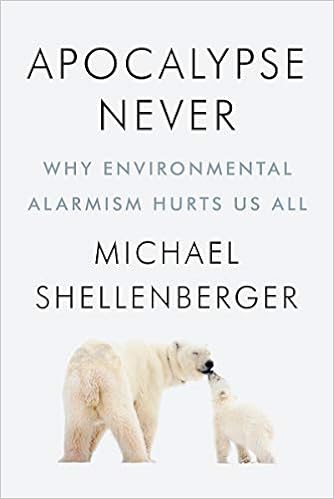
Apocalypse Never by Michael Shellenberger – Book Review

As you might have guessed from the title of his book, Mr. Shellenberger, does not believe in a coming environmental apocalypse, but what you might not guess is he is a lifelong environmental activist, who has given the bulk of his adult life towards saving the environment. He hasn’t changed his desire to save the environment and to have a cleaner, greener earth, but after years of seeing bad data, deceiving documentaries and news reports and ineffective, expensive strategies, he has had enough. The Green New Deal is only one of the most recent faulty, unworkable plans in the news that he cites in his book.

This book documents him taking the time to look at the complex world we live in and come away with a different viewpoint. Unlike some environmentalists, Mr. Shellenberger is not anti-human. He has seen the good and the bad that humans have wrought on our planet and believes in the ability of mankind to solve many of the problems that they create. He sees human progress as moving forward in a way that provides varied outcomes for the environment. Because of this, human outcomes which are positive are encouraged and applauded by the author.

In an article that originally appeared in Forbes, shortly before the launch of his book, Mr. Shellenberger offered an apology for his years contributing to overstated environmental alarmism. “Climate change is happening. It’s just not the end of the world. It’s not even our most serious environmental problem.” What he discovered was the type of unfounded, apocalyptic end times scenarios being pushed by celebrities, the media and those who earned their living from this type of hysteria was damaging real world efforts that had a chance to be effective in helping the environment in tangible ways. As someone who deeply cared about solving environmental problems, he couldn’t be silent any longer.

Some highlights from the book:

  • Factories and modern farming are the keys to human liberation and environmental progress 
  • The most important thing for saving the environment is producing more food, particularly meat, on less land 
  • The most important thing for reducing air pollution and carbon emissions is moving from wood to coal to petroleum to natural gas to uranium 
  • 100% renewables would require increasing the land used for energy from today’s 0.5% to 50% 
  • We should want cities, farms, and power plants to have higher, not lower, power densities
  • Vegetarianism reduces one’s emissions by less than 4%
  • Greenpeace didn’t save the whales, switching from whale oil to petroleum and palm oil did
  • “Free-range” beef would require 20 times more land and produce 300% more emissions
  • Greenpeace dogmatism worsened forest fragmentation of the Amazon
  • The colonialist approach to gorilla conservation in the Congo produced a backlash that may have resulted in the killing of 250 elephants
Photo by Markus Distelrath on Pexels.com

The author spends much of the book addressing some of the false beliefs that have been spread regarding nuclear power. As a native Californian, he gives detailed accounts from the front lines of these battles there. The author points out how former governor Jerry Brown worked actively to kill and defund nuclear power projects in their state, all while he was receiving funding from oil and natural gas companies. Tom Steyer, who ran for president in 2020, is cited as having done more to kill nuclear efforts than almost anyone else. Mr. Steyer’s wealth is mostly derived from fossil fuels. Modern nuclear power is noted as the most “green” power source available and Mr. Shellenberger is an advocate of accelerating the adoption of nuclear power as one of the greatest potential solutions to environmental challenges.

“Environmentalism today is the dominant secular religion of the upper middle class elite of most developing Nations”

Michael Shellenberger

If there are real environmental problems with potential, tangible solutions, why are people so distracted by the extremes we see presented in the media. As stated in the quote above, this type of extreme viewpoint has become more of a religion than anything else. Religious themes are common in the modern environmental movement. Many are promoting an apocalypse and a doomsday that has been led by groups such as Extinction Rebellion, who the author refers to as, “an upper middle class death cult.” Mr. Shellenberger finds a strange blending of Judea-Christian myth mixed with secular humanism which are intended to bring environmentalists lives meaning, in much the same way you might find in conventional religions. They see a Apocalypse coming and are able to place themselves as the hero or savior of their own morality tale, all built on “science” rather than faith.

The irony is much of what they seem to be basing their religion on is more pseudoscience. The authors concern is that this use of pseudoscience and doomsday models will cause an growing number of people to dismiss legitimate concerns about the environment and climate. Mr. Shellenberger’s perspectives provide a helpful middle road for those who are willing to listen. He promotes human flourishing through what he calls environmental humanism. You might find that you don’t completely agree with him, but the road it presents is one in which it is much easier for people coming from opposing sides to have the potential to find a common ground.

In the world we live in now, whether the topic is the environment, politics or other current news items, we need more voices like Mr. Shellenberger to show us a way that is not reactionary and is seeking solutions that take the best interests of the multiple parties involved into consideration. His perspective is one that is balanced by a love of nature and a love of humanity. His desire is to engage people with stories based on science and reality and draw people together, not divide them and condemn them. It is refreshing to read a book like this that still contains some bad news about the environment, but balances it with encouraging updates on successes that have come about through the type of cooperation he calls people to.

I would encourage you to take the time to read Apocalypse Never: Why Environmental Alarmism Hurts Us All. Unlike some other movies or books about the environment, you won’t come away either hopeless or dismissive and with that I believe Mr. Shellenberger has truly accomplished his goal.

Protect the Unprotected

There are a lot of arguments these days about what is the proper response to the Covid-19 crisis. Lockdown, stay open, wear a mask, don’t wear a mask, your work is essential, mine is not. Many of these have been boiled down to short, marketable anecdotes: “Flatten the Curve”, “Stay home, save lives”, “Be a good neighbor, wear a mask.” The darker side of this is that some people don’t encourage these behaviors with these kind of cheery sayings, but with aggressive words, profanity and sometimes, violence. People have adopted a viewpoint (whatever that might be) and they feel a self-righteous fervor in demanding compliance to that viewpoint. Fist fights and shouting matches have broken out over things people had no opinion at all about when 2020 began.

Just look at this lack of social distancing! – Photo by Vera Arsic on Pexels.com

The irony is many of the people who are making the majority of the arguments and deciding the official local government stipulations for your community will be okay whatever the decision. They are like many people in that they are among the “protected” a group that has the freedom to do their job remotely. They can adjust to whatever changes are necessary for their children to continue to receive a quality education and put themselves into a bubble that will allow them to completely avoid exposure whenever they choose. This, of course, is made possible by a larger class of society, the “unprotected”, who are “essential” to our society continuing or deemed “unessential” and probably found themselves unemployed.

If you are reading this, you are more likely a part of the protected class as far as the world goes, as access to the internet, the ability to read in English and the leisure time to do so are leading indicators of being protected worldwide. One blogger described his protected experience like this: “I’ve observed the tech industry for two decades; it’s a job, but it’s hardly work: I’m a nerd; I like science, technology, and medicine. Right now, I couldn’t be more comfortable in lockdown. Amazon supplies my dry goods while a friendly driver brings my groceries. My family and I are safe. No one comes near us without a mask. I control my environment; I choose the people in whose presence I’ll work, if any.”

The growth of tech and office work has been good overall. Some may have been downsized or lost their jobs, but chances are, if they still have their job, they are able to function in much the same way as the blogger above describes. For this type of worker, they can argue for extended lockdowns and restrictions with little thought of how those changes might impact them personally.

The same blogger contrasts his lifestyle with that of what he might have become, if he had continued in his family’s working class roots: “He commutes by bus, encountering irresponsible louts who refuse to mask up. He worries about it, too. His wife, who had earned a second income, is at home supervising their kids. He lives by the lunch buzzer and the punch clock. If there’s music where he works, it’s amplified by cheap, overdriven speakers and the genre will suit him only by chance. The temperature and ambient noise and lighting were calibrated by industrial psychologists. He can’t evade disagreeable co-workers. He’s paid far less than a family wage, but he’s got no health coverage or pension. He endures daily uncertainty about his family’s needs.” This is but one example of the unprotected we mentioned earlier.

Photo by Norma Mortenson on Pexels.com

Another example is small business owners. Most small businesses were deemed nonessential during the initial days of the pandemic and ordered closed. Some of these businesses faced this even though their main competitors such as Walmart and Amazon were allowed to remain open. In some places, small businesses such as restaurants and bars still face such heavy restrictions that they must chose to stay closed or open and operate at a heavy loss. All of this has been devastating, with some estimates as many as 25% of all small businesses are considering closing permanently, with more than 100,000 already closed for good.

Small businesses fail every day during normal times, but this is different. Some of these were successful before the lockdowns and there are heartbreaking stories of multi-generational businesses closing down after decades. These represent not only the families that are the owners, but also the many people they hired in their communities. Where does a small business owner turn when they have lost the only business they have ever known.

Photo by Anna Shvets on Pexels.com

Social issues abound for the unprotected. Some families were able to enjoy the extra time together that a lockdown brought, but for others, it put their families and some family members at risk. One local government official called for people to remember the “silent victims“. He said, “Over the generations, our society weaved a fabric of safe spaces — schools, churches and community centers that created a patchwork of places that monitored the safety of children. The fabric of our society, as thin as it has been for many of our neighbors, is now failing for those who cannot afford for it to fail, and the consequences are deep, heartbreaking and generational.” At risk kids saw their risk increase dramatically when these safe spaces closed down.

Adults are feeling the effects as well, with one survey finding 44% of Californians were suffering from anxiety or depression when surveyed this summer, a 4 fold increase from a similar survey from the previous summer. Hotlines have also noted an increase in calls from those at the point of suicide or self harm. 911 calls for domestic violence are on the increase as well. We could also mention those with increased health risks because of missed health screenings or delayed treatment. In Colorado, the local paper cited increases in deaths by heart attack and cancer in addition to an increase in suicide deaths. Many think it will be years before we know the long term health consequences of delayed treatments.

All of these examples are horrible, but they pale in comparison to the impact on those around the world. We live in a Global, highly-interconnected world economy and shutdowns in the US and Europe have a ripple effect in Asia, Africa and South America. Unlike most ripples, the unprotected nature of those impacted in these countries means the ripples turn into waves, with the potential to wash them away. In an AP news report, “All around the world, the coronavirus and its restrictions are pushing already hungry communities over the edge, cutting off meager farms from markets and isolating villages from food and medical aid. Virus-linked hunger is leading to the deaths of 10,000 more children a month over the first year of the pandemic, according to an urgent call to action from the United Nations”.

In this Aug. 26, 2019 photo, mothers hold their babies suffering from malnutrition as they wait at a UNICEF clinic
in Jabal Saraj, north of Kabul, Afghanistan.(AP Photo/Rafiq Maqbool)

The article continues, “Further, more than 550,000 additional children each month are being struck by what is called wasting, according to the U.N. — malnutrition that manifests in spindly limbs and distended bellies. Over a year, that’s up 6.7 million from last year’s total of 47 million. Wasting and stunting can permanently damage children physically and mentally, transforming individual tragedies into a generational catastrophe.” We can’t ignore this. Decisions made locally have a global impact. The people making these decisions can’t ignore these ripples. They can’t ignore the unprotected in their community or around the world.

We live in a complex world. Decisions this important can’t be summed up in a meme or quick anecdote. I don’t have the answers to the problems the world faces, but when we are making decisions about what to do in the future, we have to look at them as the many-layered strata that they are. An epidemiologist will tell you how to deal with an epidemic. A virologist will give advice on how to fight a virus. An economist will give advice on how not to destroy the economy. A leader has to make a decision based on a variety of voices, but most of the people giving input are a part of the protected class. The unprotected must have a voice as well. Make sure these “silent victims” are never ignored again.

An aside for those of you who join me in the Christian faith. We are called as a part of our belief to care for the unprotected. Isaiah 1:17 calls on the followers of God to: “Learn to do good, seek justice, rebuke the oppressor, defend the fatherless, and plead for the widow.” Jesus said He came “to bring good news to the poor, He has sent me to proclaim release to the captives and recovery of sight to the blind, to let the oppressed go free, to proclaim the year of the Lord’s favor.” Luke 4:18-19 All around the world, Christians acting together and as individuals have done more for the unprotected than any other group. You personally may be a part of the protected, but there is someone in your community who needs your help and there are victims who need us to stand up for them. We are the essential, frontline workers in the fight against injustice.

Don’t Become Inoculated by the Empty Calories of Religion

Good food should be filling. It should provide nutrition and a good balance of what the body needs. When we fill up with balanced and healthy food, we don’t get that hungry, empty feeling again quite so quickly. When we look around at the world today, we can see a great Spiritual need. People are hungry for meaning and desire purpose, but just like people who are hungry often fill their stomachs with the empty calories of fast food and junk food, people today fill their minds and hearts with a different type of empty calories.

Many people are religious around the world. I lived in a country where everyone was identified on their ID cards as having a religion and most people would have said they were followers of the majority religion, but for most of them, it never made it from their ID card to their head and even fewer to their heart. A local pastor said that most of the people have just enough religion to be inoculated from feeling like they ever need anything more. They have checked that box and moved on, without enough to know God and not really enough to be dissatisfied with the empty calories it provides.

This type of thing isn’t isolated to one country. In the US, there are people who call themselves Christian, but it doesn’t seem to make a difference in the way they live their lives. They have adopted a religion, but missed a faith. Last month, I talked about this in the article, American Gospel. With this type of Christianity, it is possible to check the box that you have the “God stuff” covered, but still be left feeling empty in the end and to miss out on anything that could possibly change your life for the better.

Nothing is more empty than the message of the religious. Several years ago, I read a modern day parable, written by Rob Stennett, The Almost True Story of Ryan Fisher. This book tells the story of salesman without faith, who sees the potential to exploit religion for his own gain. He builds a “church” and an empire devoid of faith, but full of his self, for his own benefit. While this is a novel, it is unfortunately too close to reality for comfort.

Whether it is a religious, political or academic leader, our world is filled with people who use the masses for their own gain. It is to their benefit to offer a message that is filled with empty calories. Empty calories lead people to be dependent on those who are shelling them out. This can be a message of self help, something for nothing, or works-based theology. If what you are consuming does not satisfy, it is worth taking the time to test it for truth.

You can be controlled by those aribtrators of their truth as they feed you nothing but junk food. Simplistic messages that offer no real solutions and never teach you to think for yourself or make a change in your life that can really make a difference. False teachers peddle a message that always places the problems outside of your control. They point to hating and judging others and offer themselves as the answer. Faith points to changing our individual actions and not just our words. It points to the power of groups of people committed to a higher purpose, which is only really found in God, not in the faulty ideas of man.

If you claim to be religious but don’t control your tongue, you are fooling yourself, and your religion is worthless. Pure and genuine religion in the sight of God the Father means caring for orphans and widows in their distress and refusing to let the world corrupt you.

James 1:26-27 (NLT)

James writes of pure and genuine religion. His religion is not corrupted by the world, but is bound by caring for those in need, not empty words that are nothing but empty calories. James, the author of this text, was born into a time filled with empty, meaningless religion and he saw that transformed by Christ.

Jesus came teaching the ultimate antidote for the false inoculation of religion. He came teaching a true faith that saw people moving away from religious compliance to legalism and focusing on a transformed heart that made people different, not just behaving different. If you believe that our society needs to change, you will find many people who agree with you, but if you want to see real change, you have to stop looking to the empty calories of religion. It doesn’t matter if the version is the one being sold by a political platform, an entertainer or a false religious teacher. True religion, found in faith, always changes the person who has found it, before it starts demanding that others change first.

If you want to know more, I suggest reading the Gospel of John or consider watching the Chosen video series. Jesus taught the Truth. His teaching was not empty calories, but a meal that can fully satisfy. He is our hope and the hope for the world we live in today. Don’t settle for nothing but junk.

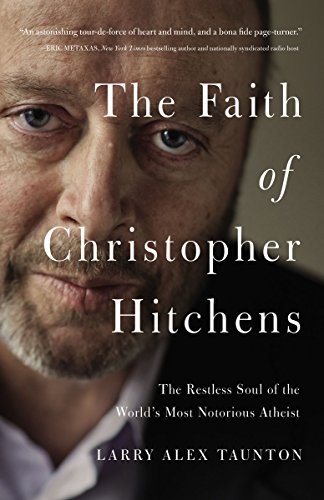
The Faith of Christopher Hitchens by Larry Alex Taunton – Book Review

While listening to a lecture recently by Larry Alex Taunton, I was reminded of this book and I remembered wanting to check it out when it first came out, several years ago. Mr. Taunton is an excellent author and this book seems to be especially relevant for our times. For those of you who don’t know, Mr. Taunton is an evangelical Christian speaker and writer, while Mr. Hitchens was one of the foremost Atheists of the modern age.

We live in a time of extremes, but life and people are usually more complex than the simplistic view presented in the latest meme or media headline. It is possible for people to hold viewpoints that are neither fully liberal or conservative. More importantly, it is also very possible for people who disagree to sit down and have a very direct conversation and come away having not changed their minds, but having become friends. That is exactly what happened between these two gentlemen. In The Faith of Christopher Hitchens: The Restless Soul of the World’s Most Notorious Atheist, we find the story of their friendship and a frank discussion of the complexity of Mr. Hitchens.

Not only can two such different people become friends, but it is possible for other unexpected outcomes. Someone who was a leader in the Vietnam Anti-War movement can become a patriotic defender of the military and police and a strong proponent for the Iraq War. One of the “Four Horsemen” of Atheism can become a Pro-Life anti-abortion advocate. In many ways, this book tells the story of an atheist heretic, who believed what he believed very vehemently, but didn’t accept the entirety of atheistic dogma.

Touring the Christian south for lectures and debates, he became friends with several evangelical Christians and found southern Christian hospitality much more pleasant than he often found the extreme left. In fact, he found that the more he got to know them, the more intelligent he found them to be and the less they were like his expectations. He was grateful that there were Christians, but couldn’t understood why they existed. One of his most famous anti-Christian diatribes came to be known as the Hitchens’ Challenge. He believed that any Atheist could be just as good as any Christian and was quick to cite examples that demonstrated this.

Privately, he had difficulty reconciling this with both what he saw in the lives of the Christians he met and in statistics that show that Christians give 10 times more to charities than charitable non-believers. When his friend the author adopted an HIV-positive child, he found a faith that his life didn’t have a category for. In time, Mr. Hitchens began to differentiate from those who taught about faith and those who actually believe it. He would aggressively attack the positions of both on the stage, but it was only those who he perceived as hypocrites that he made an effort to destroy and humiliate individually.

Mr. Hitchens kept his promise to the author to study the Bible with him on an 11 hour roadtrip they took together near the end of Christopher’s battle with esophageal cancer. As Mr. Hitchens began to read the Gospel of John, he closed his eyes and began to recite it from memory, a remnant of his upbringing in Anglican schools a lifetime earlier. He would have frank discussions with the author and other believers and would hear the message of the Gospel presented by many of them, but in the end, he died without any known conversion to the truth.

If he had lived another 5 or 10 years, perhaps he would have made it, but ultimately, it doesn’t seem as if his search found any final answers. The author calls Mr. Hitchens a seeker and a man who kept 2 books, one public, the other private. In public, he was larger than life, bombastic and always attacking. In private, the author said he was “like Nicodemus, if he had come to see Jesus by day, rather than by night.” He came as a reporter or a critic, not as someone ready to hear the truth.

As believers, we should take the lessons of this book to heart. There are people out there who are very different than us, who hold very different opinions than we do, but who still need true friends and people who will love them enough to close the distance that these kind of differences create. I recommend this book to hear a beautiful story of the author’s friendship with this complex man and a picture of what friendship can look like between those from widely varying viewpoints.

Who is that masked man…or woman?

To mask or not to mask, that is not my question. Rather my question is, what impact is wearing masks having on the way we relate to each other in society today?

If you are like me, you’ve gone out to a store and had any number of uncomfortable encounters with other mask wearers. You come around the corner at the grocery store and suddenly you encounter another masked man or woman. Both of your eyes go wide as you try to read what they are going to do. Masks make every awkward encounter all the more awkward. They also inhibit communication with each other, and some of us weren’t that great at communicating to begin with.

But there is something else they do, they make everyone we encounter a little bit more of the “other”. What is the other? It is the notorious “they”. The people who are different than us that are behind it all. The people we don’t know and aren’t sure if we can trust. This is problematic on many levels, but seems even more so when we look at the deep divisions that seem to be getting ever greater in society today. It digs into an observable psychological phenomenom called the Fundamental Atribution Error.

Who is behind the mask?

What this means in practice is that when it comes to myself, I usually give “me” the benefit of the doubt. After all, I’m a good guy who has pure motives and I wouldn’t do anything really bad. The error in Fundamental Attribution Error usually comes when we assign motives to others. We don’t give them the benefit of the doubt. We assume the worst motives because they couldn’t possibly have a good reason for their current, dumb behavior. When I cut someone off in traffic, I’m completely justified because my circumstances dictate it is necessary. When you do it? You are just a selfish jerk!

This was already an issue in many of our interactions long before we started wearing masks, but it seems like putting an additional barrier, especially one that prevents us from seeing someone’s (perhaps smiling) face, has made this even worse. By this time, we’ve probably heard our share of stories of people behaving badly over the mask issue. It seems like this is common on both sides. When we view others as the enemy and assume the worst, this is where we end up.

If you are not a believer in Jesus Christ, perhaps it is difficult to find a reason not to assume the worst of others, whether they are in what appears to be Antifa black or MAGA red, but we must be willing to see the person behind the mask. These people are your neighbors and they might not be your friends, but they are people and assuming the worst lowers our expectations and damages the ability for us to function together in community.

If you are a believer, every person is a beautiful creation of God almighty and we are called to treat them with love and respect, even when we have a good reason to disagree with them. For believers, we might call the Fundamental Attribution Error by another name, sin. Paul talks about this in Romans 8:

Those who are dominated by the sinful nature think about sinful things, but those who are controlled by the Holy Spirit think about things that please the Spirit. So letting your sinful nature control your mind leads to death. But letting the Spirit control your mind leads to life and peace. For the sinful nature is always hostile to God. It never did obey God’s laws, and it never will.

Romans 8:5-7 (NLT)

Thinking the worst of people behind the mask, does not lead to life and peace, but instead leads to a place of death that is not ruled by the Holy Spirit. A follower of Christ is meant to have peace in Him. A peace that is able to navigate a sinful world. In Paul’s time, the government could be much more openly hostile to believers than we have seen today. The Church today is for the most part facing minor inconvenience, not major persecution.

In society, masks, for most people, are a minor inconvenience as well. In some places currently, they are required. In other places, they are recommended. Wherever you go, at least for awhile, you will probably encounter some people wearing a mask. In some cultures, people have always wore masks in crowded environments. Chances are, there are some people today that will never feel comfortable being in a crowd again without a mask. I want to challenge you to not let masks be one more thing that divides us. Whether you believe they should be mandatory, or believe they are completely unnecessary, see beyond the masked (or unmasked) face and realize there is nothing to gain by casting the person you are looking at to the side as the enemy.

Things That Matter

In this life, we desire for our life to matter, to have significance. This isn’t a bad thing. We want what we do to have value. While we may be distracted for a while by doing what is fun or what is easy, none of this can give us ongoing fulfillment. 

There have been many books, talks and trainings given on these subjects, so I won’t go into detail on this. John Piper has spent a significant amount of time focusing on the topic and his “Seashells” talk and short book, Don’t Waste Your Life are highly recommended.

In my experience, the only things that we can spend our life on of eternal value are our own relationship with God and work that impacts other human souls positively for the Kingdom. It is good to meet human need and to serve the needs of others, but if we don’t impact their eternity, we haven’t truly shown them love.

Photo by Abel Tan Jun Yang on Pexels.com

When we consider how we can spend our time practically in a way that accomplishes those goals, there are three main generic paths that we might fit into:

  1. Find our life’s passion and give our life to that. This is our own personal vision statement for us working with the Father to change the world. Many pastors fulfill this as well as some significant individuals who have seen a problem or something that was a true need and dedicated their lives (or a significant portion of their lives) to solving that problem or moving in that direction. Eugene Peterson has an excellent book that talks about the value of this, Long Obedience in the Same Direction. Most of those who do this are not famous, but over the course of many years, they make a significant impact in the area the Lord has given them to serve in.
  2. The second area could be called the Experiencing God directive. Find where the Lord is working and leverage who you are with your giftings and abilities for the good of that work. This fits some people better than the first one. They are not people who are starters and they don’t have the patience and diligence to stick with something over many years, but they are good at jumping in and helping in a significant way when they see God already at work in a church, ministry or community. God uses people like this in amazing ways to help move His work forward in significant ways while these people are involved or just to fill temporary needs so the work can continue.
  3. In this third area, it isn’t about the structure but about taking advantage of relational opportunities. This is a people-first way of impacting the world. Some people seem to always have their radar up for the people around them and can sense their spiritual needs and know how to respond. This could be through providing prayer, wisdom, discipleship or good counsel. Sometimes it is seeing practical needs in the life of someone and helping to meet those needs. People with this gifting make an impact over and over again in many different lives wherever they are. It isn’t so much about their job or ministry assignment, but the people they encounter regardless of what they are doing.

These are 3 generic definitions for ways to impact the world and give your life to things that really matter. Some significant callings can fit all three. If you are a parent, you have been called to have an impact on the lives of your children that lasts a lifetime. If you are a spouse, your relationship with your husband and wife is a part of this journey and you can impact each other as well as the world together.

God knows the hunger we have to be used by Him. When you are young, it can be paralyzing to think about God’s will or call for your life. Some have a concern about whether they are giving their lives to the right thing. Whether you feel confident that you have found your passion or place to serve, or you are still looking for that, God is still at work and has something for you to do. The book, Just Do Something, by Kevin DeYoung, provides some helpful encouragement for all of us to get busy with serving the Lord through our lives, work and community.

What you do today can matter for eternity. Start today by spending time with the Lord and then go out and look for those opportunities around you to make a difference. You won’t regret it!

The American Gospel

I was a history minor in college and have enjoyed studying history almost as much as I enjoy studying the Bible. The history of America is fascinating and as Christians we can appreciate the role the pursuit of freedom of religious practice played in the founding of the country.

People came to America for many reasons from all over Europe, but especially from England and Ireland. At the peak, 38,000 people were moving to America every year from there. This was after only about 20% of the initial settlers survived. Many of those traveling to this side of the world were leaving countries where the government dictated what kind of religion you could practice, usually saying there was only one true religion, such as Catholicism or a state church. In most cases, they were fleeing situations where the state defined your religion for you at birth, based on nationality and family heritage.

What this means is if you were born some countries, you were likely to be a part of the state church, if you were born in Spain, you were likely Catholic, if you were born in the Ottoman Empire, you were likely Muslim. This way of thinking may seem very foreign to most of us here, but it dates back centuries in Europe to the time of a ruler named Constantine. Before Constantine, the Roman Empire engaged in state sponsored persecution of Christians. You can imagine the desperate desire believers at that time felt to see change.

This change happened when Constantine and his army had a vision of a cross and the emperor became a follower of Christ. He ended state-sponsored persecution and over the course of the rest of his life, he gave more and more power to Christians and the Church. In the beginning, they had new found freedom to practice their religion, but within a generation, Christianity was declared the official religion of the Empire and everyone thereafter was “born” Christian. Not born again, as Jesus told Nicodemus when he came to visit Him at night, but born Christian because of their family or nationality. That established a precedent that the Christian religion was similar to Judaism and some other ancient religions, not based on faith. Well meaning people, many of whom called themselves Christian, desired to fix the problems of their society with “good” Christian ideals.

For almost 20 years, I lived in the city that was the center of Constantine’s empire. Today, more than 99% of the people who live there are not Christian. The people who live there carry identity cards, and on those cards they have a place for religion. People are born into their religions, they are born Muslim, or they are born Christian. Some of them actually practice the faith they are born into, but for many of them, it doesn’t mean much of anything. The majority of them are Muslim in name only, but it is a part of their identity, given at birth. When they think of the United States, they consider us a Christian nation, a nation filled with people who are born Christian because of their heritage.

As followers of Jesus, we can be grateful for that Christian heritage, but you know as well as I do that it is faulty thinking to believe that we are Christian only because of our heritage or because our parents happen to be Christian. That is not what the Bible teaches and when we look around our society today, we don’t see a great deal that is worthy of the name of Christ.

In 2 Timothy, Paul wrote to a young Christian leader a warning. This warning is one that believers often turn to when they look around them and see troubling times. 2 Timothy 3, beginning in verse 1:

You should know this, Timothy, that in the last days there will be very difficult times. 2 For people will love only themselves and their money. They will be boastful and proud, scoffing at God, disobedient to their parents, and ungrateful. They will consider nothing sacred. 3 They will be unloving and unforgiving; they will slander others and have no self-control. They will be cruel and hate what is good. 4 They will betray their friends, be reckless, be puffed up with pride, and love pleasure rather than God.”

As surprising as it may seem, Paul was not talking about 2020 in America specifically. Instead, he was warning Timothy about human nature and a time that Timothy would see in his lifetime. Paul’s words were true for Timothy and they are true for us as well. Sin leads people to the destination that Paul describes. Mankind without God always finds itself in the same state and the “last days” that they saw in the first century church have been repeated throughout history. Paul wanted Timothy to understand that these things would happen and he should not be surprised, but be ready for them. It is the normal state of a human’s heart to live in rebellion against God.

Later in that chapter Paul writes beginning in verse 12:

“everyone who wants to live a godly life in Christ Jesus will suffer persecution. 13 But evil people and impostors will flourish. They will deceive others and will themselves be deceived. 14 But you must remain faithful to the things you have been taught. You know they are true, for you know you can trust those who taught you. 15 You have been taught the holy Scriptures from childhood, and they have given you the wisdom to receive the salvation that comes by trusting in Christ Jesus.”

Paul encourages Timothy to hold to the truth, especially to the truth of the Gospel. This is the key for the church whenever they face times of trouble or uncertainty. Our hope is not in figuring out a better human solution, our hope is in Christ. The only true hope for mankind is in salvation through Christ alone. That is the only thing in the entire universe that has the power to take a selfish, sinful heart and turn it towards the potential of a positive solution. That isn’t to say that the presence of Christians and Christian initiatives doesn’t have a positive impact on a large scale, even across a nation. I lived for many years in a country that didn’t have the benefit of a foundation built on Christian principles and I can tell you that the difference is noticeable.

But the power of the Gospel for transformation is local. It begins in the hearts of individual believers who have submitted their lives to Christ and it makes the greatest difference through those individuals impacting others in their community, especially through the local Church. Paul encouraged Timothy to turn to the truth and focus on the Gospel in times like this, but I think his first letter to the Church in Corinth is helpful for us as well. Let’s turn to 1 Corinthians 1, beginning in verse 18.

“The message of the cross is foolish to those who are headed for destruction! But we who are being saved know it is the very power of God. As the Scriptures say, “I will destroy the wisdom of the wise and discard the intelligence of the intelligent.” So where does this leave the philosophers, the scholars, and the world’s brilliant debaters? God has made the wisdom of this world look foolish. Since God in his wisdom saw to it that the world would never know him through human wisdom, he has used our foolish preaching to save those who believe. It is foolish to the Jews, who ask for signs from heaven. And it is foolish to the Greeks, who seek human wisdom. So when we preach that Christ was crucified, the Jews are offended and the Gentiles say it’s all nonsense. But to those called by God to salvation, both Jews and Gentiles, Christ is the power of God and the wisdom of God. This foolish plan of God is wiser than the wisest of human plans, and God’s weakness is stronger than the greatest of human strength.” (1:18 – 25)

Growing up in the United States and being a part of churches in the Midwest, it was sometimes tempting to think that we could reach our communities and grow our Church through clever strategies and even what might be called “marketing”. In the same way, it can be tempting for us as Christian people to think some of the serious problems we see today can be solved by a policy change or implementing a better moral standard. Living in a Muslim country taught me the foolishness of everything but the Gospel. Nothing I say or do has the power to change the life of anyone. That is completely dependent on the power of Christ.

Paul points to the cross as the answer, not human wisdom. He calls our preaching foolish, offensive to some and nonsense to others, except to those who are called. To those who are ready to receive the message of Christ, it is the power and wisdom of God, a wisdom that is greater than all of man’s wisdom and stronger than all human strength. We proclaim a truth that is not yet ready to be received by all, but that all need to hear. If they find it foolish or offensive, that is not our main concern. Those who have ears to hear will hear.

America, just like the world, has a sin problem and the end result of sin is death, spiritual death. If you want to fix what is wrong with America, we have to start in our community. We are surrounded by those who have no hope. Hope is not found in a policy or a politician, it is in God alone. Later in 1 Corinthians chapter 1, in verses 30–31, Paul writes:

“God has united you with Christ Jesus. For our benefit God made him to be wisdom itself. Christ made us right with God; he made us pure and holy, and he freed us from sin. Therefore, as the Scriptures say, “If you want to boast, boast only about the Lord.” (1:30 – 31)

We ourselves, followers of Christ, who are but frail creatures of dust, have been united with Him. We can be right with God, pure and holy, freed from sin. That is what we boast of and that is what we offer our friends, neighbors and communities as their own opportunity to receive. If we rely on anything else, we are fools.

J.D. Greear, in a meeting last year with the leadership of the Southern Baptist Convention said the following:

“What if the lack of money and power was a blessing… set us up for a resurgence of something simple. What if our lack of money and waning power turned us back to the simple things – relying on members intentionally sharing Jesus with others! And that’s where the power was. And, like the early church, who, without money or power or any of their people in Congress, saw a worldwide explosion of the gospel. What if that was what is ahead for us?”

Jesus is the answer. He is the one who changes lives. He is the one who changes churches and He is the one who changes communities. If you don’t know Him, you don’t know what hope truly is. He is the only hope for you and He is the only hope for America.

The Danger of Being Alone Together

We’ve never been more connected to as many people as we are today. In the past, the majority of friends from our childhood or college days would have drifted into anonymity as we moved on to another stage in life. Changing jobs and moving to a different city would have meant a new set of friends and co-workers with the others mostly staying a part of our past memories. Thanks to the mixed blessings of the internet and social media, now we continue to stay connected to our past in ways that would have been impossible for the majority of us previously.

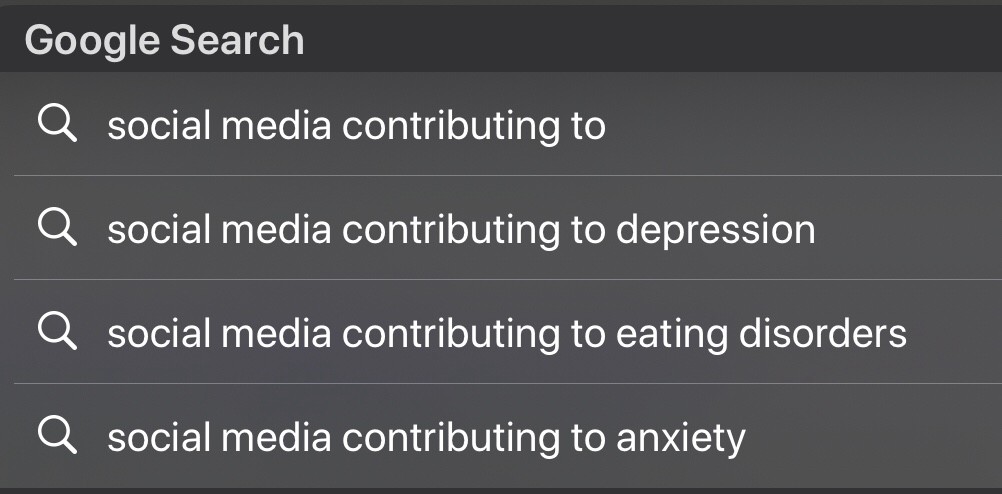
We have more “friends” than would have been possible in the past, but for some people, this pseudo friendship has become a replacement for real relationships and community. These friendships provide a false sense of community, giving us the feeling that we are connected to people relationally, but without the healthy give and take that comes from real relationships. Google searches related to the psychodynamics of social media’s impact point to major issues that people are struggling with, in spite of these “connections”.

Image for post

There are several problematic differences between virtual friendships and the real thing, which contribute to really being alone together:

  • Edited Virtual Life – the version of life that we see on social media is heavily edited. While we may have some friends who share their every up and down on social media, for the most part people keep it to the highlights. They take the best trips, eat the best food, have the best kids/marriage/dating relationship and overall their lives are far superior to yours. This, of course, may or may not be true, but by only seeing this highlight package, your life pales in comparison. This is one of the main reasons that social media is linked to so many psychological disorders.
  • Echo Chamber of Ideas – In real life, when you share your ideas or opinions, you are forced to deal with a real, living person who will look you in the face and agree or disagree with you. This forces us to learn to either have a reasoned give and take with others or just to learn to keep our mouths shut. On social media, over time we curate our newsfeeds to filter out opinions that are not compatible with our own. Friends get “blocked” or “unfollowed” in a way that we may wish was possible in real life. In the end, reading through our social media becomes a cycle of fire – gasoline – fire where our most extreme opinions are expressed to an audience who reinforces them back to us. Instead of a fading echo, we hear an amplified echo that encourages us to keep turning up the volume.
  • Uncivil interaction – Platforms that encourage more give and take, such as Twitter and Internet forums most frequently disintegrate into flame wars. Someone who tries to post a thoughtful statement in hopes of sparking a reasoned discussion is often overwhelmed with a backlash riot. Digital communication has removed tact and civility from our interactions. As someone who works with people both in person and electronically, you learn quickly the dangers of digital communication. Good communication requires work and is far easier when both people can see each others body language and hear their tone of voice. Flat text can be read completely without context and is read more through the lens of the reader than that of the writer. Digital distance encourages us to a completely self-centric viewpoint that lacks empathy and encourages disregard for others.

I could point out other distinctions, but this is enough for this text. Social media and distance relationships through the internet can be a blessing, but without a foundation built on true community, they are more likely to become a curse. We need people, and we need real friends. Friends who we communicate with face to face and who will sometimes tell us we are crazy or wrong. Coming out of the Covid-19 lockdowns, I hope that has been reinforced even more to you than it was before.

Many of us have had to experience less real, human interaction over these last couple of months than in any previous period in our lives. Don’t let that become the norm. As you are able, get out and spend time with family and friends. If all of your friends are in the virtual world, take time to actually talk to them on a video call or take the initiative to join a group where you can interact with real people. Being alone together online isn’t enough to feed the human soul. You need more than that and for sure, our society does as well.

Evil, Chaos and Deception

Marvel movies are among the most popular in the world today. Every movie seems to light up the box office with success and comic book characters that were once nerds only have become mainstream. Some of these characters are original creations, who were created for the comics out of the imaginations of the writers, but others find their source material in ancient sources. One of these is Loki, the Asgardian god of mischief. He comes from ancient mythology and had a long history before he ever appeared in Marvel comics.

Loki is the trickster, the mischief maker, the one who exists to cause chaos above else. As such, in some depictions he is played as neither good nor evil, but existing on a sliding scale in between. In the modern narrative of the Marvel movies, Loki began as a cold-blooded murderer in his earlier appearances, happy to see the destruction of everything. But as time has gone on he has developed into a sympathetic anti-hero, who in part thinks to the excellent acting of Tom Hiddleston, has grown to be one of their most popular characters, so much so that he has his own series planned for Disney +.

Why mention Loki in this article? In part because he is an excellent representation of one of the faces of evil that we see acting today, agents of chaos who are taking the legitimate protests of our fellow citizens and undermining them to see the world burn.

Evil is sometimes apparent, and unfortunately we hear of atrocities regularly which most people identify as evil. We saw this in the recent deaths of two men, one in Minnesota and one in Georgia. In both of these videos, we saw men with power use that power to take the life of unarmed men. These events were horrifying and as more people heard of the tragedies, they had a strong potential to be seminal moments, drawing disparate parties together in order to enact real change.

It would be good to see action come out of these specific situations in order to see changes brought about, not only in those 2 communities, but around our country where so much pain exists from past conflicts and abuses of power. Justice is longed for and the belief in true justice out of the rule of law is a foundational principle of our society. Unfortunately, evil is real in this world today and it is not limited to outright acts of violence. Sometimes evil is more deceptive in the way it attacks order, justice and good.

Just as it was evil for one man to keep his knee on the neck of another until he was no longer moving, it is evil for Antifa and others to disrupt protests in the way they have done these many months. Evil men, paying young protesters to cause trouble. Evil men and women breaking the windows of stores to start the looting. Evil men providing bricks or breaking the concrete in order to try and get peaceful protesters to throw them at the police. Evil, sinful people burning and destroying not out of grief, but out of hatred and a desire to see chaos reign. There is evil in this world and we have seen a lot of it over these days of protest.

Don’t be deceived and don’t join their path to chaos and destruction. We could be encouraged to believe by media reports and unthinking memes that are shared on social media that everyone is our enemy and that anyone who is different than us is not to be trusted. This is not the truth. Many honorable, just people are marching for real change. They want a better community for themselves and for you. Some of them want to be able to live in the same framework of law and justice that a person like myself has almost always enjoyed.

Evil is sometimes open, and sometimes obvious, but other times it comes in through the back door. Sin is real and temptation is real, and while the number of agitators who are causing much of the real destruction we are seeing is overall small, the number of us, who could contribute to the chaos is very large. Don’t be an agent of chaos, be an agent of change. Stop, listen and care about others. You have more in common with them than you may imagine.

I challenge you to listen to the excellent podcast below, which has some significant thoughts on how to be a part of the solution, not the problem.

Just Thinking Podcast: George Floyd and the Gospel

Integrity Declined

Growing up one of the values that was consistently put in front of me was integrity. I saw it in society, in my family and even in popular culture. “A man’s word is his bond” Deals were supposed to be sealed with a handshake because a “man was only as good as word.”

I’m not sure why all the popular quotes about giving your word seem to revolve around men rather than women, but I believe it was expected that both would conduct themselves with integrity. To be bond breaker or a liar was one of the worst condemnations you could put on a person.

As a Christian, this seemed even more important. Not only was it one of God’s commandments, but the Bible is filled with verses encouraging believers to pursue truth, defend truth, know the truth and proclaim the truth.

Jesus said, “If you hold to my teaching, you are really my disciples. Then you will know the truth, and the truth will set you free. – John 8:31–32

Anyone who has ever told a lie knows how true that statement is. Lies bind us to a prison of our own making. We must remember to keep them straight and we can find ourselves trapped by our own web. Lies repeated from others have different difficulties and condemnations. The law prosecutes them as slander and the Bible condemns gossip.

Today, truth is under attack from all sides. Relativism is common and growing. Where there used to be a concern that post-modernism would destroy our conception of truth, now it seems that all sides are showing a growing disdain for facts and integrity. Both sides yell, “fake news” when they hear anything they don’t like, but many of those who would condemn such news as fake, seem to have no concern about whether their own posts and reposts have any basis in the truth.

This doesn’t make sense to me. How can we claim to have integrity and character, but have no interest in whether something is true? Truth is real, it is not something that changes for each person. Whatever we read, whether from the left or the right, we should care if it is true, not just if it is supporting our own opinion and prejudices. If we call ourselves believers, we must be even more concerned with truth.

He will use every kind of evil deception to fool those on their way to destruction, because they refuse to love and accept the truth that would save them. 2 Thessalonians 2:10

In this letter found in the New Testament, the author is cautioning this church against the tactics of the Devil. While this verse is talking about the lost, who don’t understand the salvation offered them in Jesus Christ, I want to call attention to a phrase here, “they refuse to love and accept the truth that would save them.” This goes well with the verse above, “the truth will set you free.”

Freedom and salvation are found in truth. No one should desire to build their reality on a lie.

They exchanged the truth about God for a lie, and worshiped and served created things rather than the Creator – who is forever praised. – Romans 1:25

This verse is talking about choosing to worship idols rather than God. In their time, it was most frequently an idol made of stone or wood, but idols persist to this day. It’s possible that one of the idols you are dealing with is the desire to be right or to have your opinion seen as right, but our opinions mean little if they are not actually true.

If you are someone who sees yourself as a person of integrity, I would hope the truth would matter to you as much on social media as it does on a deal with a neighbor or a friend. If you are follower of Jesus Christ, you can’t afford to set the truth aside. To carelessly put our name on something which may or may not be true is not only to decline our own integrity but to attach our flippant disregard for the truth to the name of Christ as well.

We should all be people of conviction, who are willing to stand for our beliefs. That is an admirable quality. But I hope you will care more about the truth than being admired. We should remember the day when as a society, our word meant something and we valued truth over opinion. When we enter the public forum, whether it is in person or online, let’s have the caution to consider our words carefully and to be advocates for the truth, champions for integrity, instead of accomplices in its continual decline.

Look carefully then how you walk, not as unwise but as wise, making the best use of the time, because the days are evil. – Ephesians 5:15–16