Don’t “Other” One Another

The Bible is filled with ‘one another’ commands. As a Christian, there is an overwhelming life handbook of how we should treat one another. The Overview Bible has designed this amazing infographic of the commands: https://overviewbible.com//wp-content/uploads/2014/03/one-another-commands-in-new-testament.infographic5.png

They sort the commands into 3 main areas:

  • Unity – 13 areas of unity such as, “be at peace with one another”, “forgive one another”, “don’t complain against each other”
  • Love – 5 areas about love such as, “love one another”, “tolerate one another in love”, “be devoted to one another in love”
  • Humilty – 7 commands towards humility such as, “wash one another’s feet”, “serve one another”, “regard each other as more important than yourselves”

They have a 4th category of miscellaneous commands, such as: “don’t judge one another”, “pray for one another”, “bear one another’s burdens”

So, if the Bible gives clear teaching on how we are to treat one another, why don’t more Christians do a better job conducting themselves according to this biblical standard they say is true. After all, not only are these clear commands about how the church is to treat each other, when not practiced they also lead to the most despised trait of the church in the eyes of the world, hypocrisy. Many people outside the church are generally familiar with the claims of the Bible, and when they see the actions of the church towards each other, they find it lacking.

This is completely contrary of the intent of the teaching of Jesus. The Church started out with nothing, they didn’t have money, power or resources, but they had their faith and through faith in Christ, they could obey these difficult commands. They could look around in the room at their fellow brothers and sisters in Christ and realize that even if they didn’t agree about everything, they were in it together. They could love one another in Christ in all the ways taught in the NT, but only through His power, not through their own capability. As they did this, the testimony of the church was powerful. They preached the truth of the Gospel, Christ crucified and raised from the dead, and salvation through faith in His triumph over sin and death, but they also demonstrated that their lives had been changed for the better by that Gospel, not just for eternity, but for their community.

Today, it seems like we are missing the impact of this in many of our local churches. Here are three key reasons I think this happens:

First, there is the tendency to other, “one anothers”. I’m using other as a verb to illustrate the idea of dividing someone into a group different than our own. Maybe it is just a loose definition of the term, one another. We divide people from us so we don’t have to count them as people who need to be treated in the way the Bible defines. We make them “others” not “one anothers”. In the Bible, the community of faith is a “we”. People exist together and they treat each other as a part of their own group. In 1 Corinthians 12, Paul told the church, they were the body of Christ. They were all pieces of the same body. This was a powerful illustration of what it means to be a group of “one anothers” not others. People in your church aren’t a decoration for the body, like an article of clothing or jewelry, they are the body itself. A part of the body that serves a purpose and is connected to the whole. This is meant to change our perspective and help us see the importance of taking care of our whole body. When we see things like this, it becomes easier to carry out the one another commands.

Photo by Pixabay on Pexels.com

The second area of struggle is the overall lack of community in the modern church. It is much easier to other one another, when we don’t really know one another. The NT community that Paul and others were writing to were intimately involved in each other’s lives. They knew what was going on and practiced Biblical community by spending time together. In some cases, they may have had less available time than we do today when you consider hours worked and daylight hours, but it was a priority to make time for relationships. The transitory lifestyles that many people live these days make it difficult to build strong, lasting relationships where people are used to being in each other’s lives. But with effort, we can connect with people in our local church. Without community, it is very easy to other one another. 

The third reason we don’t practice it is our disobedience to a particular command, Galatians 6:2, “bear one another’s burdens.” We generally ignore this because we are very independent. In the modern world, especially in western culture, people don’t want to appear weak and needy. Instead they want to present themselves as the person who has it all together and is very successful. Part of this comes from living in great wealth compared to every non aristocratic class in every period of history before this one, but it is also seems to be an unhealthy dose of pride. It is much more common in churches for people to put on the Sunday morning facade of “everything is fine” than to transparently share our true burdens in life. Developing the habit of sharing our burdens with one another, encourages the church to see each other as a true body.

The irony is by disobeying the commands of Scripture in the one another’s, we all suffer. Our churches are weaker, our marriages are more likely to be a struggle, we lose access to the wisdom of the body and we become more likely to be disconnected from Christ. God has given us to each other as a wonderful gift in order to encourage one another, love one another, serve another, etc, and the greatest barrier to receiving this gift is the walls we put up when we “other” one another.

Protecting Your Children Into Adulthood

We love our children, even when they are difficult to love. Many of us do our best to protect our children from harm. This could be physical harm, such as keeping them out of a busy street, or emotional harm, such as disappointment or a broken heart. As parents, we don’t want our children to experience many of the pains that we have dealt with.

Years ago, there was a boy who suffered from a deficiency that made his immune system not function. He was known as the bubble boy and his story was told in several ways, most prominently in a movie. He was kept in almost complete isolation from the environment, in an effort to protect him. He ultimately died from complications related to a treatment he had received in an attempt to cure him. I remember at the time some parents joking that they wish they could raise their kids in a bubble to protect them from various threats or influences in society.

Most of us weren’t raised nor are we raising our kids in a bubble like this young man, but we all make attempts to protect our children from some things in much the same way that this young boy’s parents acted to protect him from disease. We place walls between our kids and potential threats. We do our best to limit risk that they face and don’t desire for them to face pain as they are growing up. This is normal behavior for parents, especially when our kids are very young, but as they get older it should be normal for these restrictions and limitations to decrease.

We build walls

Another great desire of parents is for their children to feel loved. We love our kids and want them to understand that. We start out by showing our love by taking care of the needs of a baby and a toddler. They need us and a good, loving parent wants to take care of those needs. In time, we show love for them in other ways, such as physical affection, kind words, gifts and doing fun things with them. If you have read any of the books by Dr. Gary Chapman on The Five Love Languages, you can recognize that different kids receive love in different ways.

There is balance in all things and when things get out of balance that is most often where problems occur. Protecting your children from unnecessary harm is a good goal, but setting out to protect them from experiencing any pain is not possible and would be harmful in the long run. There are times as a parent when the most loving thing you can do for your child is to allow them to experience pain and disappointment.

Love is also not giving your children everything they want. It is loving to take care of the needs our children have, both physical needs like rest and hunger and emotional needs, such as the need to feel secure or to feel cared for. Love is blended with care and instruction, so children can know the benefits of our love, but also understand their place in this world and that the world doesn’t revolve around them. Our children are important to us, but they should not be the center of our universe. That isn’t healthy for us or them.

All of these things in healthy balance will help parents to be able to experience the joy of having a continuing relationship with their children into the future. The Bible points to discipline as a foundational part of this.

10 They disciplined us for a little while as they thought best; but God disciplines us for our good, in order that we may share in his holiness. 11 No discipline seems pleasant at the time, but painful. Later on, however, it produces a harvest of righteousness and peace for those who have been trained by it.

Hebrews 12:10-12

11 My son, do not despise the LORD’s discipline, and do not resent his rebuke, 12 because the LORD disciplines those he loves, as a father the son he delights in.

Proverbs 3:11-12

God’s desire for your children is better than your own. He wants your children to know the love of Christ and your love. He wants your children to continue in truth and to experience a “harvest of righteousness”. Godly discipline is always in the context of His love. God’s discipline in our life works because of the context of His sacrificial love. Our discipline is effective in the context of our love for our children. This balance of love and discipline keeps parents on track as they attempt to balance showing love for their children with acting in ways that point them towards God, even when their children don’t often recognize it as loving at the time it is given.

When our children are grown and gone from our direct sphere of influence, they will grow even more into their own opinions and ideas. Some of these may be very different than our own. This is normal and as our children move out into the world, they have different needs than they did when they were home. The greatest need that they have throughout their life, is their need for Christ. The other need they have that will continue throughout their life is the need to know that they continue to be loved by us.

As kids become adults and become more of their own persons, it is important that we don’t allow the differences that exist between us to separate them from Christ or from our love. Teaching the truth is important, but as Christians, we always teach the truth in love. The truth was never intended to be a wall between our children and our love for them. Because of His great love for us, God provided a means of salvation for all mankind through His son, Jesus. Because of our love for our children, we desire them to know that truth and the truth of the love we have for them.

Walls are built up for eternally insignificant reasons, such as politics, finances and unfortunate personal decisions. These are man made walls and as a parent one of the main ways we can continue to love our kids is to make sure that man made walls like these never come between our children and the love of Christ or the love we have for them.

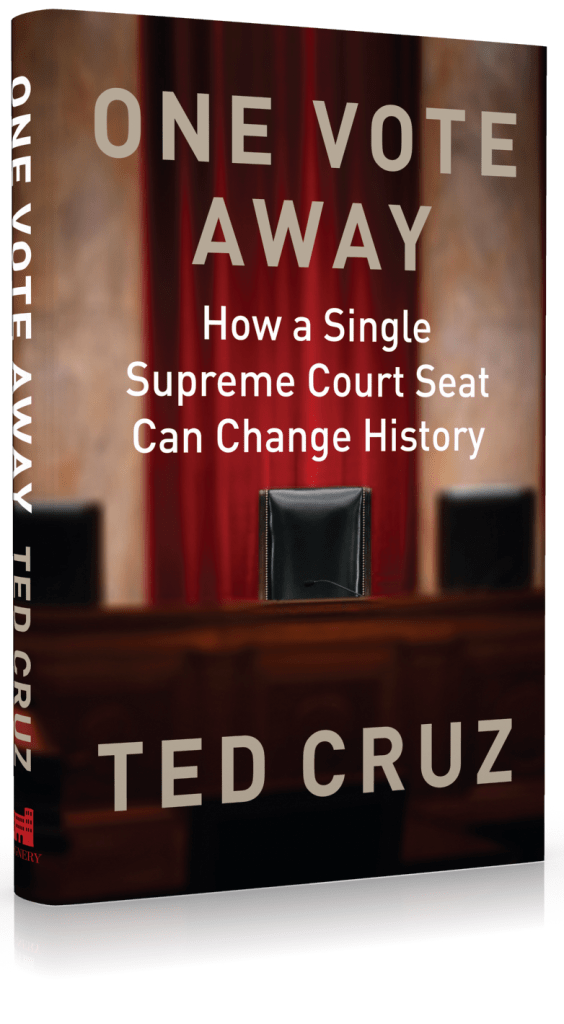
One Vote Away by Ted Cruz – Book Review

One Vote Away, available now!

The last few months saw a great deal of attention on the United States Supreme Court. The passing of Justice Ruth Bader Ginsberg and the subsequent hearings that led to the appointment of Justice Amy Coney Barrett actually distracted the nation from the presidential election cycle for a few weeks and turned the focus on the Supreme Court. This was of course related to the presidential election in that both sides recognized the significance of this selection and would have loved for a candidate of their party’s persuasion to be making the choice.

Ted Cruz had obviously been working on his new book, One Vote Away: How a Single Supreme Court Seat Can Change History, for some time before this period, but he could hardly have chosen a better time to release it. Ted’s experience with the court, both as a clerk and as someone who has argued in front of the court many times, makes him a good candidate to write a book like this. Obviously, Ted Cruz is a conservative Republican and your response to his perspective on the cases he discusses will vary greatly depending on whether your viewpoints align with his. As an evangelical Christian with Libertarian leanings, I find myself in his camp more often than not. I would encourage anyone interested in the Supreme Court to consider reading this book, as it is helpful to understand both your own perspective better and those who you might not agree with. The following is a quick summary of some of the issues addressed:

  • Religious Liberty – Is it okay for a public government building to have a monument of the ten commandments or for court rooms to have them posted in the building?
  • School choice – Does a parent have the right to choose a school for their child and does a state have the right to help subsidize those choices, even if it means they choose a school of a religious persuasion?
  • Gun rights – Do states have the right to govern their own gun ownership laws and are their limitations on a state’s ability to restrict gun ownership?
  • US Sovereignty – Do other countries and the UN have the right to enforce their laws on US residents, legal or otherwise, even when it goes against US law?
  • Abortion – Do states have the ability to restrict abortion laws freely without federal interference?
  • Free Speech – Do individuals and organizations have the right to criticize elected officials? Do you have the right to disagree with candidates for office publicly?
  • Capital Punishment – Do states have the right to set their own crime and punishment laws and execute criminals as they so determine?
  • Democracy and the Electoral Process – How do the state and federal courts interact and help interpret the laws in national elections?

Personally, I was already familiar with 3 of the cases that are mentioned in the chapters the author covers, but found the details of those cases and the others fascinating. Mr. Cruz does an excellent job breaking down the complex issues in order to help the reader understand the cases and perspectives of the opposing sides. If you would like to know more about the importance of every Justice and every vote on the Supreme Court, I recommend you give One Vote Away a try.

Masks, the Fidget Spinners of 2020

Does everyone remember fidget spinners? It wasn’t so long ago that they were everywhere. Every kid wanted one and it wasn’t uncommon to see someone fiddling with one whenever you went out somewhere. Some people argued that they served some value. Some kids even had a doctor’s permission to carry it everywhere and use it. For most people, they were just a toy. It was a thing you or someone in your family had to have. People even began to collect them and get so many that they needed a place to store them like a rack or case.

Spinners spent their time as a default outlet for capitalism that gave everyone something to buy for the kids in their life. Fidget spinners were the latest in a long line of devices or toys that have filled this role for many people. Things like selfie sticks, beanie babies and even going back to things like a Rubik’s cube or a Troll doll for your pencil top. Unique, unusual, cute or memorable things are always calling for a place in our lives and our capitalistic nature often has us buying things because our neighbors are or because it is the new thing to buy.

So, what does this have to do about masks? This is my second post about masks that isn’t really about whether or not you should wear a mask. You can read the first one here. Masks entered into the conversation in the early months of Covid. First, we were encouraged not to buy professionally made masks, as they were needed by front line workers and there were limited quantities. This birthed a cottage industry of homemade masks. We saw lots of funny pictures and memes about things that people had made into masks. I remember seeing videos about how you could make a quick mask from everyday household items, such as socks and even underwear. People showed how to make face shields out of your Krispy Kreme box.

There were many creative solutions that people came up with to provide alternatives to help deal with the unknowns about the Covid-19 virus, but it wasn’t long before the cottage industry was surpassed by real industry. Not only could you buy and order hospital masks and respirator masks online and in the stores, but capitalism and commercialism began to cash in. There were stylish masks from most clothing stores. There were masks with themes, words and memes, so people could express themselves in the same way they might with a new t-shirt. When our kids started back to University, they were issued various masks with their school colors and mascot in order to show their school spirit. You could even get a mask with your own face on it, smiling, so you can wear a permanent smile even if you are doing anything but smiling underneath.

Suffice it to say, the lack of masks are no longer the problem. We go for a walk almost every day and I regularly see masks strewn on the ground, abandoned. These can be both reusable and disposable masks. This is where the connection to fidget spinners comes in. This week, I went to the mall for one of the first and only times since this all started. Not only did every clothing store have a mask display. The familiar kiosks in the middle of the malls had been joined by mask kiosks. Whole kiosks with perhaps hundreds of different styles of masks. That is when I began to realize how ridiculous this had become. There are now more masks in existence than anyone can possibly ever need. I personally have about 4-5 reusable masks that I have used and that is plenty.

Masks have become the new “thing” that people buy. People have obviously started buying more masks even though the ones they have are still usable. Masks are now a way to express their individuality or uniqueness in the same way some other things have been. Is it possible there are mask collectors? It wouldn’t surprise me. Back to fidget spinners. Did you know that we were on the verge of a worldwide ball bearing shortage because of the increasing production of fidget spinners? There were legitimate production of components necessary for industry and society that were held up because we had so many fidget spinners being made. The bigger problem now is we have millions of fidget spinners that nobody wants. While many of the components in a fidget spinner may be able to be reused, I haven’t heard of any efforts to do that.

I haven’t heard of masks causing any similar problems, nor do I expect to, but it is time to draw a line in the sand and say, “we don’t need more masks.” We don’t know how long there will be a demand for masks to be used. Many countries have already moved beyond using masks, but even if we continued to use them into the future, we don’t need more reusable masks to be produced. Masks have become one more output for our capitalistic instincts. Another opportunity to buy ourselves and others things that we don’t need.

We are entering a time that is associated with the giving of gifts. Christmas is a holiday that is defined by the birth of Christ, God’s son. Christ was the greatest gift ever given, through Him a means of salvation was provided for all humanity. We celebrate that gift at Christmas time and some celebrate by giving gifts to others. The purpose of this article is to ask you to examine your overall stewardship in buying things. Masks are a simple example, but they can point to a greater problem of people consistently buying things they don’t need. During this holiday season, don’t celebrate by giving your loved ones things they don’t need which may one day become the fidget spinners and beanie babies of earlier years, gathering dust in some closet or garage. Instead, focus on the things that really matter, the people behind the masks and real needs that people in the world have, the greatest of which is the need for Jesus.

Calvinball and the Art of Changing the Rules

Who here has played Calvinball, or its equivalent? This is the famous game played by Calvin and Hobbes where they constantly change the rules. Playing a game where the only rule is who can change the rules to their advantage can seem fun at first, but in time, it really becomes exhausting. If you have ever played games with a grade school boy, you might have experienced this and it can be difficult to keep up.

The challenge isn’t just related to being the most creative, but also dealing with the fact that a previous concrete expectation has now been smashed to bits and replaced by something more jello or quicksand. Instead of certainity, we only find uncertainity. When you go to lean against the wall of the building, you find it is just a facade that falls right over.

This is an amusing endeavor, but it is no way to live your life. We depend on boundaries and order to live our lives. For 19 years, I lived in a different country. It may not have always played by the same rules of the country of my birth, but it did have its own rules and way of doing things. Part of living in a different country is learning the cultural norms of that country so that you are able to function there. Some of those rules need to be adopted, but they all need to be understood, otherwise you’ll find yourself living out of sync with the reality you find there.

In the United States, there are many cultural norms that we take for granted. There are laws of the land and common practices that we sometimes treat as normal as gravity. Just driving down the road, we expect people to stay in their lane (something I couldn’t always depend on in Turkey). When people move to our country, most people expect them to learn our laws and cultural norms and adapt. The video below was made by an Italian which demonstrates the challenge of living by 2 standards of cultural norms. Italians are both Italian and EU citizens.

When I’m overseas, I’m often asked about cultural norms for America. Questions like, “What do Americans think of ….?” or “What do Americans say for….?” If you have never lived outside of one small region of America, it might be easier for you to answer that question, but if you have traveled around, you have probably noticed the amazing diversity in America. We are more like the EU than a single country, such as Turkey. States sometimes have different laws and cultural norms even than their neighboring states, but they all have them.

The vast majority of society desires to live their lives by the rules and cultural norms. I studied psychology and counseling and there are actually several psychological disorders that are defined by people’s inability or complete unwillingness to follow these guidelines. For most of us, when something happens in society, we expect it to follow the rules laid out for it. There is comfort in that and people can find peace in knowing that while the outcome might not be determined, the road that leads us to that outcome are clear.

As a lifelong sports fan, I can attest that it is much more frustrating to believe you were cheated out of something than to lose because of an exceptional performance by your opponent. We want the life we live, just like the games we play, to be “fair” and “just”. We desire boundaries and right and wrong. I believe this is something that is inside of us, created by God.

The problem with this is that there are many in society that desire to play their own form of Calvinball. They either want to have the right to change the rules, or they want the rules to be so obscure and ambigious that no one knows how to intrepret them. This allows for a redefinition of conduct as we go. One famous example occurred recently during the confirmation hearings for Justice Barrett. She used the term “sexual preference” when answering a question. This term was redefined on the spot to be offensive in an attack on the candidate. Webster’s dictionary even joined the fray, by changing their dictionary defintion that same day. Link

In some ways, this is just a more sophisticated form of Calvinball. Shifting the norms and rules so fast that people don’t know what to expect even in the moment. Some people seem even more willing to be complicit in this than others. This is incredibly problematic when it comes to cultural norms, but it is even more troublesome when it comes to the laws of the land. When people go out to drive their cars, run their businesses or even cast their votes, they need to know that the rules of engagement will remain constant. If they find that they have been changed after the fact, it not only demoralizes, but over time destroys people’s willingness to abide by any laws.

As a Christian, as much as I dislike it when something like this happens, I shouldn’t be surprised. There is absolutely no reason for any man without God to behave any differently.

““The human heart is the most deceitful of all things, and desperately wicked. Who really knows how bad it is? But I, the Lord, search all hearts and examine secret motives. I give all people their due rewards, according to what their actions deserve.””

Jeremiah 17:9-10 NLT

As much as we want to focus on obedience to laws that govern behavior, God is more concerned with the heart. We may try to enforce laws that will keep things “fair” and “just”, but if we have secret, sinful motives in our heart, then we have sinned and broken God’s law.

“Everyone who sins is breaking God’s law, for all sin is contrary to the law of God.”

1 John 3:4 NLT

As Christians living in this country, we must in some ways, be like the Italians living in the EU. We are here, living our lives according to 2 different standards, the law and rules of the land, and the law of God. Only one of the those laws is of eternal significance. God has given us a new covenant.

““This is the new covenant I will make with my people on that day, says the Lord: I will put my laws in their hearts, and I will write them on their minds.” Then he says, “I will never again remember their sins and lawless deeds.””

Hebrews 10:16-17 NLT

As children of this new covenant, we are “aliens and strangers” in this land (1 Peter 2:11) and we should live our lives according to the standard of Jesus, rather than the standards of man. Many times these standards will align, but we know that God’s standard will never change. He provides us with that solid foundation that we can build our lives upon in an every changing world. In that foundation, you will found hope, peace and true justice.

Don’t Be a Fool

Wisdom is valuable. When we learn from our experiences, we gain wisdom. We avoid making the same mistakes in the future and we tend to have a better experience than we did in the past. It can apply to both simple and complex circumstances.

We learn not to burn the food, we learn to add a little more salt, we learn to get up a few minutes earlier so we aren’t late for work, we learn to take better care of our homes, our cars, and hopefully our lives. Wisdom can be a treasure of immeasurable value. Not only does it improve our lives in real tangible ways by the good practices it leads us to, but it greatly enhances everything by avoiding the foolish path.

The Bible contains many passages about wisdom, and in many cases, it contrasts that wisdom with the foolish path. Proverbs is often called one of the wisdom books and it lists not only principles but practical examples of both wisdom and foolish behavior. 2020 is a great year for wisdom. Information is flowing constantly, but discerning the value of that information is very challenging. People take information and they process it with wisdom or in a foolhardy manner. If you take the book of Proverbs and read through it, you will find relevant guidance for today that can help you avoid being a fool in your actions and in your words. Here are a few examples.

Don’t answer the foolish arguments of fools, or you will become as foolish as they are. Be sure to answer the foolish arguments of fools, or they will become wise in their own estimation.

Proverbs 26:4-5

These verses might seem to contradict each other, but they are actually 2 versions of the same principle. The difference requires wisdom. We certainly shouldn’t be drawn into a foolish argument with a fool. When you argue with a fool on their terms, you find yourself being drawn to their level. A fool that won’t listen to reason can lead you to come off looking just as foolish as they are. This reminds me of the kind of arguments we see regularly on social media, where people argue in circles, spouting one foolish platitude after another. Fools are known for to refusing to listen, as we will see later in Proverbs. On the other hand, we should be sure to collectively or privately answer the arguments of fools, otherwise their foolishness will reign as the truth of the day. Biblically, this could be a private answer that calls the fallacy to their attention, or with wisdom you may want to involve others in correction. Wisdom is the antidote to foolishness, not arguing, but that leads us to the next problem with fools.

Fools have no interest in understanding; they only want to air their own opinions.

Proverbs 18:2

Lots of people lack understanding or information. Not knowing about a subject doesn’t make you a fool. According to this verse, what makes you a fool is insisting on airing your uninformed opinion. If the goal is only for the opinion to be heard (which seems to be one of the main purposes of social media) then providing a fool with new information or insights will not be welcomed. Instead, you will find yourself on the path to becoming as foolish as they are. Many public arguments on social media head in this direction. Flamewars leave no one unscorched. Talking to someone privately or via direct message is a better avenue, but according to this verse, you will often find people who have no interest in understanding. Why?

Fear of the Lord is the foundation of true knowledge, but fools despise wisdom and discipline.

Proverbs 1:7

Fear of the Lord is a moral foundation of truth and an understanding of your place in the world God created. Those who understand who He is have a foundation that is different and should have the confidence to not be drawn into foolish engagements. Fools lack the wisdom and discipline to do the same. A fool’s confidence and self-image are locked up in their own words. This contrast comes out in chapter 12.

Fools think their own way is right, but the wise listen to others. A fool is quick-tempered, but a wise person stays calm when insulted.

Proverbs 12:15-16 NLT

To be wise is to not always assume you are right, but take the time to listen to others. To be a fool is to continue to insist you are right, ignoring contrary opinions. A fool gets ticked off at the most miniscule slight, but a wise person can endure a barrage of insults without losing it. The differences are stark between the two and it doesn’t take long to watch an interaction to identify who the fools are.

In might seem too simple to just say, “don’t be a fool”, but it really is something we should all strive for in our lives. Wisdom is valuable. When you pursue wisdom, you will have a better life. You will suffer less from your own foolishness and you will find yourself suffering less from being involved in foolish interactions. As you read through these verses, you may have been thinking primarily of other “fools” that you have seen in person or on-line, but the most important step you should take is looking in the mirror to see if you find yourself being foolish in any of the ways listed here or throughout the book of Proverbs.

It is horrible to lack wisdom and no one should desire to be a fool, but ultimately the biggest fools are those who refuse and continue to follow the path of Proverbs 26:11:

As a dog returns to its vomit, so a fool repeats his foolishness.

Don’t be the person that lives off of foolishness and builds their life around foolishness. Build your life around truth, and especially the truth that is found in God’s Word. If you are interested in knowing more about who God really is and what it means to follow Him, I wrote a whole book on that subject. It is available here. The best source of wisdom is the Bible, start reading that today and read it every day.

The Dead End of Trespassing in Other People’s Offenses

The world is unjust. Injustice will happen. Sometimes to you, sometimes to those you care about. When it happens to you, it is hard and sometimes very difficult to find the Grace to forgive, but forgiveness is freeing. In forgiveness, we can find freedom to move on with our lives. God can give us the Grace to forgive an offense, even when it isn’t made right.

When you have personally suffered a wrong, one of the best things you can do for your life and your future is to find forgiveness for that wrong. Unforgiven wrongs do not hurt the person who committed the wrong, they only hurt yourself. God loves us too much to see us continue in unforgiveness and for this reason, He spoke about forgiveness in His Word frequently.

Be kind to one another, tenderhearted, forgiving one another, as God in Christ forgave you.

Ephesians 4:32 (ESV)

Paul wrote this letter to a church. He wanted the believers to experience the freedom that this kind of life brings. Every one of us would like to be a part of a Church where these things are practiced and it begins with us and our ability to treat others in this way. In this passage, we aren’t forgiving because the person has made it right and restitution has been made or even because the person who wronged us has asked for our forgiveness. Rather, we are forgiving them because of the great forgiveness that we have received.

Pay attention to yourselves! If your brother sins, rebuke him, and if he repents, forgive him, and if he sins against you seven times in the day, and turns to you seven times, saying, ‘I repent,’ you must forgive him.”

Luke 17:3-4 (ESV)

This quote is found in the Gospels in both a general teaching to the disciples and a response to a question from Peter. The disciples, like many of us, seemed to have believed that there should be limits on human forgiveness. When someone has done something wrong to us over and over again, surely we eventually are justified in holding a grudge. According to Christ, if they express repentance, we are to continually forgive them. Why?

Let all bitterness and wrath and anger and clamor and slander be put away from you, along with all malice.

Ephesians 4:31 (ESV)

This verse, which occurs before the one above is a good context for 4:32. We’re removing these harmful things from our life, not just because of the damage they could do to others in the local church, but also for the harm we do to ourselves when we live a life of bitterness, wrath, anger and these other forms of malice. By putting these things aside or away, we have the proper perspective to love one another and forgive one another.

When you are the one wronged, this process is straightforward. You know exactly what was done to you and the way that impacted you and how you felt about it. When you are working through the process of forgiveness, it is your bitterness, your anger and your hurt that you have to be able to set aside in order to reach the point of being ready to forgive. This is something that, with the help of God, we can all reach. We can remember our sin and Christ’ forgiveness and turn our hurt over to Him, in order to forgive and be free from the burden of bitterness.

Photo by RF._.studio on Pexels.com

When we take on another’s offense or wrong we are taking on a burden that we have no control over the outcome. It is much more difficult to find forgiveness for someone who committed an offense against someone we care about. Instead of us identifying our own pain, we are looking at the pain of others and getting worked up into a place of malice over our perception of their pain. When you are the one wronged, God can give you the grace to find forgiveness, but when you take on the wrong of another, you are instead waiting for either the wrong to be corrected or the person wronged to give us the permission to let the hurt go. Essentially, we are taking God out of the situation.

While we should care for those suffering an injustice and support them, when we take their offense and make it our own, we have trapped ourselves in a maze with no clear exit. Bitterness is common where there is no forgiveness and can destroy the life of anyone who lets it. If you are choosing an offense over an injustice done to another, you need to realize that is a very dangerous path. Over the course of my life, I’ve seen situations where people were sent to prison, fired from their job, treated horribly by others and ripped off by people they trusted with their finances, as well as other great wrongs that none of us would want to suffer.

In looking back over these horrible situations, the great irony is that the person who suffered through these things often comes out better than the friends or family members who take on that offense. Those in prison might eventually get out, but if you build your own prison of bitterness over your loved one being sent there in the first place, you may serve a lifetime sentence. People fired can get a new job, but the anger over being fired can ruin future happiness, even after the person fired goes on to have a long and successful career.

If you find yourself in these circumstances or see this kind of bitterness destroying the life of someone you love, there is hope for forgiveness, but you have to choose a path out. It isn’t worth it to continue in unforgiveness. Even if the injustice still stands, you have to put it into proper perspective. We have to release our ownership of the wrong being righted. It isn’t our battle to fight. Instead, the only clear path out is by giving it over to God.

Dear friends, never take revenge. Leave that to the righteous anger of God. For the Scriptures say, “I will take revenge; I will pay them back,” says the LORD.

Romans 12:19 (NLT)

You can still love your friend. You can care deeply for them and the pain caused by the injustice. You can pray for everything to be made right and for the Lord to act according to His character, but you don’t want to end up in the dead end of “owning” their offense. You can’t afford the damage the bitterness will do to you and your spiritual life. Not to mention how it damages your ability to be a true encouragement to your friend and your community. Release yourself with God’s help from the prison of unforgiveness.


Three Lies of Sin

“For this reason deliverance is far from us and salvation does not reach us. We wait for light, but see only darkness; we wait for a bright light, but live in deep darkness. We grope along the wall like the blind, we grope like those who cannot see; we stumble at noontime as if it were evening. Though others are strong, we are like dead men.”

Isaiah‬ ‭59:9-10‬ ‭NET‬‬

“Look! Listen! GOD ’s arm is not amputated—he can still save. GOD ’s ears are not stopped up—he can still hear. There’s nothing wrong with God; the wrong is in you. Your wrongheaded lives caused the split between you and God. Your sins got between you so that he doesn’t hear. Your hands are drenched in blood, your fingers dripping with guilt, Your lips smeared with lies, your tongue swollen from muttering obscenities…. They know nothing about peace and less than nothing about justice. They make tortuously twisted roads. No peace for the wretch who walks down those roads!”

Isaiah‬ ‭59:1-8‬ ‭MSG‬‬

Periodically, various Christian leaders or supposedly moral celebrities have been in the news for the wrong reasons and their sin is celebrated by the media. There is nothing quite so comforting to the sinner than the sins of another exposed. Even Christians can find themselves joining the onlookers who are piling on via social media with their not so silent judgement.

Whether public or private, sin can be devastating. The community aspect can either help or hinder someone’s response to sin. If it is our sin, we want people to be understanding and encouraging, pushing us towards God’s forgiveness. If it is another’s, we should act the same way towards them. This passage addresses the full impact of sin as well as it’s restoration. It has the picture of the guilt of sin, the blindness of sin and the goodness of God. There are three lies represented here that can keep us from that goodness if we are not grounded in the truth.

First, we are often blind to our sin, stumbling in the darkness. This is how sin begins. In the small dark corners of our life, where things are seemingly innocent and easily justified to an all to willing heart. “There’s nothing wrong with…” Is probably true in isolation, but when you take the specific context into account, it can be the incidental un-premeditated murder of our soul. This is where sin becomes a step by step process, farther away from God and Truth. People love to point to the big, bold sins that make the headlines, but the path into darkness starts with steps that seem innocent enough, but lead us away from the Truth.

This is when we find ourselves in guilt and that is where Satan tells His next lie. “Your hands are dripping with blood, so God can’t hear you“. Our sin becomes our shame when we finally realize what has been born of our innocent dallying. In our shame, we separate ourselves further from God and our community of faith. It creates an atmosphere of denial where we believe the worst thing in the world would be the revelation of our sin. This path can lead us to despair over our condition, it can lead us to publicly despise the sins of others. It can lead us towards bitterness towards the church and God, who we feel have rejected us, even when it is our own choice to live in separation.

And this is because of the third lie that we believe, “God’s reach is too short to save us. God’s ears are too deaf to hear us.” This is the lie that leaves us trapped in the pit described by Isaiah. This is the biggest of all lies, because it is the lie about God. It is in this lie that we live in our sin, without hope. But it is a lie.

Regardless, of my sin. Regardless of your sin, God is big enough, His reach is long enough, His love is great enough. Sin doesn’t have to be a life sentence to a tomb of devastating darkness, God has made a way out.

“This is the message we have heard from him and declare to you: God is light; in him there is no darkness at all. If we claim to have fellowship with him and yet walk in the darkness, we lie and do not live out the truth. But if we walk in the light, as he is in the light, we have fellowship with one another, and the blood of Jesus, his Son, purifies us from all sin. If we claim to be without sin, we deceive ourselves and the truth is not in us. If we confess our sins, he is faithful and just and will forgive us our sins and purify us from all unrighteousness. If we claim we have not sinned, we make him out to be a liar and his word is not in us.”

 1 John‬ ‭1:5-10‬ ‭NIV‬‬
Photo by Pixabay on Pexels.com

John was honest about sin and honest about God. Sin is awful, it is destructive, we are sinners. All of those things are true, but the greater truths are these: God is faithful, He is just. He will forgive us. He will purify us. There is no doubt in these statements. He is. He will. Believe in Jesus, that He was God’s son, that He came to this earth and died for our sins and that He was resurrected, triumphing over death. In Christ, we find salvation and forgiveness for our sins.


As You Wish

by Justin Hensley

I have the right to do anything, you say

– but not everything is beneficial.

I have the right to do anything

– but not everything is constructive.

No one should seek their own good, but the good of others.

1 Corinthians 10:23-24

    There lurks in most minds the gravitation to self-interest over the attention to another’s.  It is a tendency all have from the start and our efforts ought to be against it.  We all are somewhere along this path of self-denial.  Indeed, much of the battle in our faith is the strife against gravity to overcome the self.  For cannot all sin be traced to the idolatry of pride?  This is truly a work of utmost importance that we face.  When we are absorbed in the self, we do not consider how our actions affect those around us, or else we simply do not care.  We can imagine what the alternative is, in all its excellence.  There are a variety of methods that exist to combat this inclination, though only, let us not forget, by God’s help.

    It is not uncommon for us to be placed into situations by others that are outside where we would have placed ourselves.  In this discomfort, we have the choice to either remain in our position, out of apathy, stubbornness, or something else; or we can choose to change (or make the first step to change) our stance and embrace the discomfort.  Take that it is a hot day and your friends are wanting to play a game of cricket outside, but you’re honestly quite comfortable sitting as you are.  You may choose your comfort, at the expense of the game (and more than that I’d think), or you might say to yourself, “Why it’s just heat, a little sun will be good for me.” (or whatever reasoning it might be that gets you there) and join the game.  Or say the group you are in is going out to eat but you don’t particularly enjoy what they will be having.  You might drop out of the group or cause them to reconfigure to your preferences, or you might say, “That’s not helpful!”  and decide to try to enjoy the food.   

In learning to consider others more, we can not only rid ourselves of noncontributory mindsets but also learn to match the concern that another has for something.  If you are impartial about the way a certain rule or objective will play out, and you find that another does have a preference, why should you not support them in it rather than leaving them on their own?  Or say you do have a particular preference in some manner, yet you may decide to forgo it to match another’s idea on the matter.  Either, with the proper motivation, is a step towards wholesome self-forgetfulness. 

Now, there is something to be said for standing up for your own beliefs, but in many circumstances, this is not required. If you are firm in your own identity, can you not set aside your preferences and opinions for the sake of others? The apostle Paul shows this best when he says, “Though I am free and belong to no one, I have made myself a slave to everyone, to win as many as possible.” In the interest of others, he becomes all things. The next time someone asks you to do something, take a moment to consider, what would you do if you weren’t considering yourself?

Hope in Dark Days

2020 may be the most hopeless year of most of our lifetimes. Every week there is a new meme about whatever apocalypse is happening or on the horizon. Since March, the significant changes to our lives brought about both by the Coronavirus and the response to it have rattled everyone and the impact on people’s lives is having it’s toll.

This crisis has been different than many that we face or have faced. 9/11 was an attack from the outside and brought most Americans together. Natural disasters such as hurricanes, tornados, earthquakes, and floods evoke a compassionate human response that draws many to reach out and help. A personal crisis of health or other misfortune often brings the community together as family and friends, both near and far, jump in to support the needs of the hour.

When these type of things happen and people experience this type of support, it is much easier to find hope in the dark place that circumstances have landed us in. As believers, we know that God is real and that He has promised His love for us, but we often need the tangible reminder through other people’s actions to help us see what He is doing. God has blessed us with the Body of Christ, the Church, to come alongside us and speak truth and take action.

Many things in 2020 have seemed to disrupt this normal human support. Staying home to save lives and practicing social distancing further isolated a populace that was already trending in the direction of disconnection. Restrictions on gathering left people facing additional burdens when faced with sickness and loss. Funerals either couldn’t happen or had heavy restrictions. Those who were ill couldn’t be visited in the hospital and uncertainty left people more distant than normal. “Can I bring food to my sick neighbor?” “Would a visit be appropriate?” “Is someone coming to pray for me too risky?”

Photo by Nandhu Kumar on Pexels.com

Nursing homes were the hardest hit, and just not by the virus. In most of these facilities, staff are limited in their ability to do more than the bare minimum for each resident. The residents rely on visits from family and friends and programs run by volunteers, especially churches. Without these connections, the most isolated became cut off from life giving support.

Additional challenges came in the form of divisive issues. There are always controversy, but 2020 brought us new conflicts over things like masks and Covid treatments, in addition to the items we regularly deal with, such as racism and politics. When I was growing up, we used to joke about churches splitting over the color of the carpet. The 2020 equivalent may end up being over masks.

We have less than 3 months left to go and rather than wait for the next turn of the wheel of the meme apocalypse, I was encouraged this day to focus on reasons for hope. After all, if we are in Christ, we have much to be hopeful for. It is important to remember that as bad as 2020 might seem, many of the Biblical authors were living under much greater difficulty at the time of their writing. They were displaced, often persecuted, with little resources and much need and suffering. In spite of all this, they found the time to write the words below.

May the God of hope fill you with all joy and peace as you trust in him, so that you may overflow with hope by the power of the Holy Spirit.

Romans 15:13 (NIV)

Paul wrote to a group of house churches in Rome that had no privilege in society. Christians lived on the fringes and had no power. Later, they would face great persecution in that city. He writes a message that is relevant for us today. God is a God of hope and the secret to finding joy and peace is trusting in Him. Hope come through that and the power of the Holy Spirit.

“For I know the plans I have for you,” declares the LORD, “plans to prosper you and not to harm you, plans to give you hope and a future.

Jeremiah 29:11 (NIV)

Jeremiah was a profit in a pitiful time. Israel was about to be destroyed for their sin. In other words, they were about to get what they deserved. In the face of this, Jeremiah had the task of preaching God’s judgement on the people, but also casting a vision of hope for the future. He was preaching a sermon about what he would never see, but what God intended to do, because of who God is, not because of anything they deserved. We can pray a similar prayer, putting our hope for the future in God’s hands, not in any other place.

3 Praise be to the God and Father of our Lord Jesus Christ! In his great mercy he has given us new birth into a living hope through the resurrection of Jesus Christ from the dead, 4 and into an inheritance that can never perish, spoil or fade. This inheritance is kept in heaven for you, 5 who through faith are shielded by God’s power until the coming of the salvation that is ready to be revealed in the last time. 6 In all this you greatly rejoice, though now for a little while you may have had to suffer grief in all kinds of trials.

1 Peter 1:3-6 (NIV)

Finally, we must center our hope on Christ, our living hope. Peter would soon after this face his death for his faith, where tradition records that he requested to be crucified upside down, rather than face the same death as his savior. God has promised an inheritance that will never fade. We can find our joy in His promises, which never fail. Christ is faithful to provide salvation and we can rejoice, though we suffer grief in our current trials.

Our hope is not in a vaccine, or in a president or even in a church or Christian leader. Our hope is in God alone and in His son, Jesus Christ. When we place our hope there, we can find joy and peace, even in the face of 2020. Spread that hope to your family and friends. Spread the truth of God’s Word, don’t spread fear, despair and division.