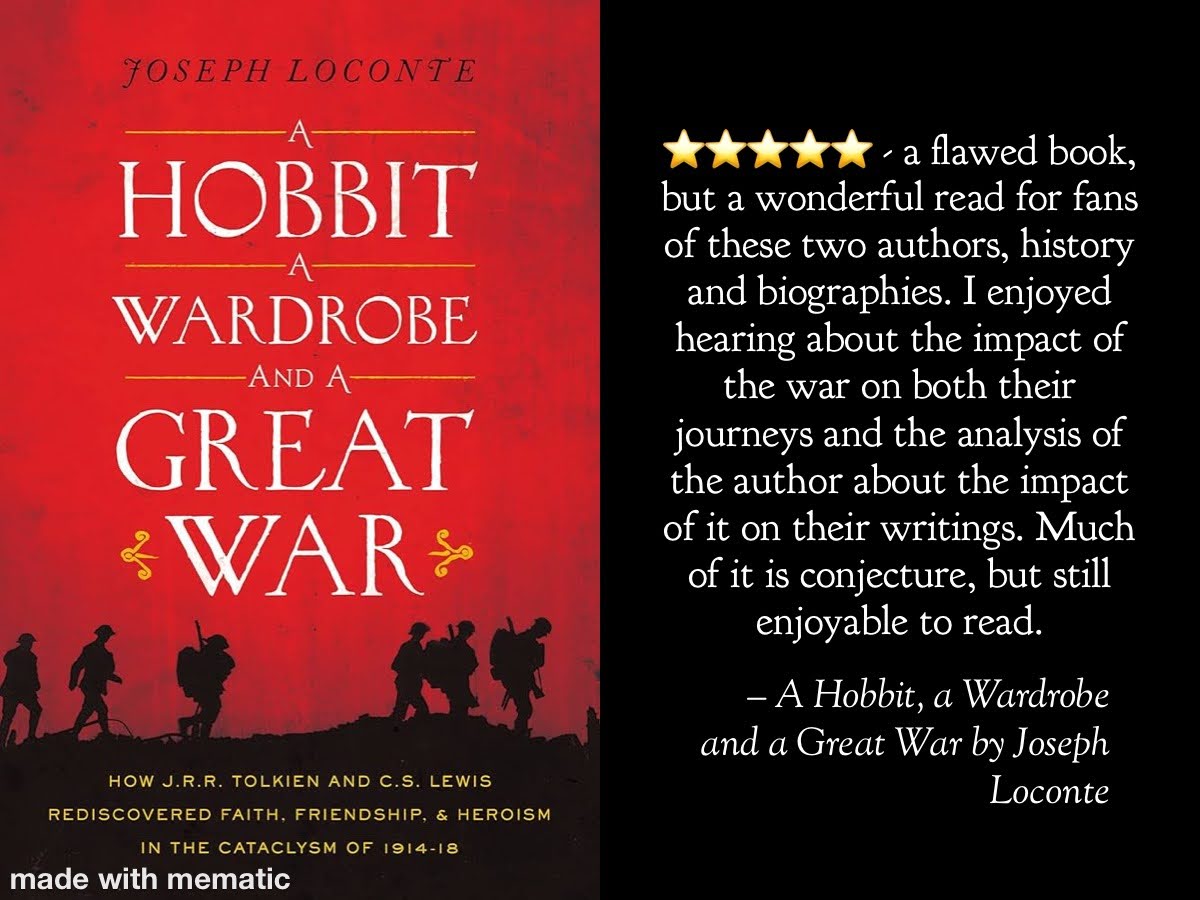
A Hobbit, a Wardrobe, and a Great War

Anyone who follows this blog, has read my book, Seeing God: For Who He Really Is, or who knows me personally, knows of my love of C.S. Lewis and J.R.R Tolkien. When a pastor friend recommended this book, I knew it would be one of my first reads of 2024. What’s not to love? This is a narrow focused biography, which reminded me most of another book I enjoyed: Steal Away Home.

While some biographies try to be all-encompassing, this one deals with a very specific point. We know that C.S. Lewis and J.R.R Tolkien both fought in the Great War (which we now call World War I), and we know about their friendship at Oxford. The author attempts to take what is written about these things and use them to form some opinions about how the war might have affected their relationship, their lives and their writings.

This is not a work of great scholarship, but it is filled with the kind of conjecture you might find in a well-researched work of historical fiction. Because of this, it is difficult to recommend the book to everyone. Where possible, the author draws upon the original published writings of the two authors and some historical sources like letters and interviews, but this book is comfortable going further than the historical record.

Personally, I enjoyed this journey, and it didn’t bother me that the author makes some assumptions along the way. He gets more right than not and through the recounting of both these authors’ war experiences and the common experiences of other soldiers in the same battlefronts; we get a very clear picture of the potential impact this might have had on Lewis and Tolkien.

“Tolkien and Lewis offer an understanding of the human story that is both tragic and hopeful: they suggest that war is a symptom of the ruin and wreckage of human life, but that it points the way to a life restored and transformed by grace.”

We can be grateful that both the religious catholic, Tolkien and the softening atheist, Lewis, found each other in the aftermath of the war. Tolkien was one of several learned men of faith who played an important part in Lewis becoming “the most reluctant convert.” And it was out of this friendship that the encouragement of Lewis spurred on Tolkien to keep working on his masterpiece, The Lord of the Rings, when he frequently was ready to set it aside for more academic pursuits.

“Part of the achievement of Tolkien and Lewis was to reintroduce into the popular imagination a Christian vision of hope in a world tortured by doubt and disillusionment.”

The author recognizes how unusual these two men’s viewpoints were when compared to the general pessimistic malaise that arose after the Great War. Somehow, in the midst of the despair, they found hope in their philosophical, faith-filled discussions.

“The best thing you can do for your fellow, next to rousing his conscience, is—not to give him things to think about, but to wake things up that are in him; or say, to make him think things for himself.”

Lewis and Tolkien were influential thinkers who demanded intellectual honesty in their discussions and arguments. Out of the discussions of them and their friends were born some of the greatest works of fiction and non-fiction of their age, many of which continue to be read today.

In reading this book, I couldn’t help but think of the challenges of our own day. Looking back on recent days from 2020 on, it would be easy to give in to pessimism and darkness. There is plenty of both to go around, but if Lewis and Tolkien can find a path towards hope out of the horrors they saw and experienced in the Great War, surely believers today can find our own truth to share in this current age.

Love Came Down

A mother so young
A Father so strong
A journey so long
They weren't expected
Who would take such a journey
To leave home and family at such a time
Anyplace, safe and warm
Little comfort, but enough for them
The waiting, almost done
Pain, blood and birth
The sacrifice of a mother
To bring a King to His throne
Fragile and tiny
Born into simplicity
There was no news spread throughout the land
Only a star, leading the way
And a choir, singing to an audience so few
All hope bound up in a babe, both for now and eternity
The most important event in history
But a mystery to all the world
They continued their lives, not knowing everything changed
God's plan
Humanity and Sovereignty
Bound up in flesh
Humble beginnings
Marching towards a violent end
What love is this?
In the proper time
All would be made known
Heaven sent, finding His way
Baby, boy, man
Born, lived, died
Alpha, Immanuel, Omega
A baby's cry
A man's anguish
A torn curtain
The story begins
We praise this great gift
We believe and receive our salvation
The author has joined the story
He lived in it among us
He cleared the way to the finish line
Celebrate Christmas
Praise this indescribable gift
Tell the Joy to all the world
Today, in the city of David,
A Savior is born
Who is Christ our Lord

What is Your Life Worth?

Merry Christmas! There’s a line in my favorite Christmas movie, It’s a Wonderful Life, where our beleaguered hero is navigating the latest crisis, a run on the banks driven by panic. It’s a beautiful scene where it contrasts two different world views, one built on community and the other built on money as an abstract resource.

In the scene, people are scared by the dire financial straits at the time, probably meant to mimic the years of the Great Depression. The way the Building and Loan operated is fascinating and a vastly different system than our modern mortgages. This article, which explains it, is worth a read if you want to know more. I won’t explain it here, as it isn’t the main point of the scene.

Instead, we have George Bailey arguing that people shouldn’t give in to the perfectly legal grab of resources the villain of the story was engaging in. “Potter isn’t selling. Potter’s buying!” George exclaims. He knows that the richest man in town is on the path to owning everything. A path not only to riches, but to power and control over everyone in town’s life.

While this type of specific financial scenario might not be something that is easy for us to understand, the battle remains and is just as common today. When you wake up and pick up your phone or turn on your computer, someone is offering a price for your life. They want a piece of you. They want to control you. The companies advertising their products and services are selling you something. They’re buying your time. They’re buying your life.

Each of us has limited life resources. Time is the most essential. We choose to trade our time for many different things. Money, relationships, entertainment. Every day we wake up and choose what we’ll spend our time on. If you’re like me, this will include moments wasted, sometimes in excess.

I remember years ago talking with a friend who was in his seventies. Over the course of his life, this man had sold his time for many important things. Because of his commitment, the New Testament was translated into two of the most difficult languages in the world. He gave thirty years of his life to that task and those people. Then, in a moment, his access to those people was taken away by a government ban.

I met him because he was looking for remnants of those people in other countries, desperate to share the Good News of Jesus Christ with any who he could find. His life amazed me and here he was, at the age when many are well into retirement, still going strong for the sake of the Gospel.

One day, as we were talking about the choices he’d made, including some difficult choices along the way, he made a comment that stuck with me.

“A man has only one life to give in service to the Lord. He shouldn’t give it away too lightly.”

That’s what life is. We choose each day how we will spend our time. Each day we sell our life for things like our career, our family or achieving the next level on a game on our smartphone. We can feel “accomplishment” because we’re rewarded with something that flashes on a screen.

All of these things that are bidding for our time are challenging us to sell bits of our life off for what they offer. The question for us today is what will you sell your life for?
 

This is the message of the movie, It’s a Wonderful Life. George Bailey’s life didn’t go as planned. He had big dreams, centered around personal accomplishments. He wanted to travel the world, build things, get rich. These were the desires of this likable young man.

What happened? Life got in the way. He fell in love, got married, raised a family. He stayed home, cared for his mother, helped his uncle and dozens of other people in the town, if not hundreds. He gave his life away for the good of others. He sold his time to build something, but something small and personal. Something that ultimately saved him in the end.

There are few things we touch in our daily lives that touch eternity. Few things that last forever.

I Corinthians 10:31 says, “Whether you eat or drink or whatever you do, do it all for the glory of God.”

For followers of Christ, this is our destiny. We will spend eternity knowing and glorifying God. Time spent preparing for that future by getting to know Him more through His word is always well spent.

Mark 10:45 says, “For even the Son of Man did not come to be served, but to serve and give His life as a ransom for many.”

Jesus Himself, gave His life away. His sacrificial death is the only reason any of us have eternal hope.

So, what will you sell your life for today? Diversions? Trinkets? Or will you sell it for eternity? Investing in your children and in those who God brings into your lives.

This is the way that George Bailey became the “richest man in town” and it is the path to a life sold for the greatest price of all.

Thankful

Happy Thanksgiving! I hope all of my American friends are enjoying this day with family and friends. Thanksgiving has always been one of our favorite holidays. Growing up, it was a gathering of family, with my mom’s large extended family gathering together. Fun times with cousins and lots of good food marked my Thanksgiving memories.

After moving overseas, we were far from our immediate family almost every Thanksgiving. In our new city on the other side of the world we spent Thanksgiving with our “found family”. Our kids learned to be grateful for their honorary uncles, aunts and cousins.

For 19 years we lived in that city where Turkey was hard to come by, carrot souffle replaced sweet potato casserole and the pumpkin for the pie had to be cooked and prepared ahead of time, since it didn’t come in a can. Thanksgiving was one of many things that were more difficult living as an exile in a foreign land.

Today, we celebrate Thanksgiving by not celebrating it. We’ll have a small gathering tomorrow with one American and a few other friends, but we now live on an island where there are very few people even aware there is such a thing. A few friends who know we’re American have sent messages and soon all of our friends in the US will be waking up, cooking and eating and most likely, posting all the pictures of their gatherings together.

Our three children gathered last weekend with relatives to celebrate (along with our two bonus children who married into the family). I was filled with joy to see them together, having fun and sharing this holiday without us. I expected I might be more sad than I was, but it really wasn’t a moment of sadness. They’ve gone off into the world and they’re all doing well. It was a blessing to see them all together. I was thankful.

Thankfulness is a powerful force that helps us keep the right perspective on life. Sometimes we receive truly wonderful blessings that are obviously far more than we deserve (like our salvation). Other times it might be just enough to provide for our needs. Finding ourselves grateful in these circumstances is good, but somewhat expected.

What defines a grateful spirit is being able to find things to be thankful for when things don’t turn out the way we’ve planned. We can choose to find things to thank the Father for, even when the thing we want the most to happen turns out differently.

We just “celebrated” the fifth anniversary of one of those events in our lives, my wife’s stroke. She documented her recovery and the experience here. That day changed our lives permanently, but we continue to walk in grace with the challenges and changes that brought. She’s still here with us, and we get the joy of continuing to serve the Father together on this earth.

Soon, I’ll have the third anniversary of the night I flew to the other side of the world, only to be detained and deported, knowing I was permanently banned from my home of the last 19 years. In the midst of that, I found things to remember and things to be grateful for. Here are a few of the lines I wrote while locked up in a holding cell before deportation:

I’m grateful for many laughs with local friends.

I’m grateful for trying to be fully present in my new home and not trying to live like I was in America.

I’m grateful for so many friendships over the years.

I’m grateful for tea and the way it’s the perfect way to sit down together with old friends and new acquaintances.

I’m grateful for the tradition of having a long local breakfast with friends.

I’m grateful for my local friends who would drop everything to do literally anything with you.

I’m grateful for friends and co-laborers who taught us how to persevere through suffering as they dealt with cancer and other trials.

I’m grateful for those who do a thankless job to make my job easier.

I’m grateful for prayer and its power to change everything. 

I’m grateful for trips to the island.

I’m grateful for public transportation and how it improved over the years.

I’m grateful for our church family, who our family loved and loved our family.

Mostly I’m grateful for a great God who uses frail creatures of dust like us to accomplish His purposes.

I was in lockup there for about 24 hours. It wasn’t what I wanted. It wasn’t what I prayed for, but it was a time to reflect on the things I was thankful for. My life has been filled with many twists and turns, but looking back there are few things I would change. The things I would change don’t take away from the facts that God has given us a joyful life and it is right for us to be thankful for the things we’ve done and seen.

In 1 Thessalonians 5:16-18, Paul writes: “Rejoice always, pray without ceasing, give thanks in all circumstances; for this is the will of God in Christ Jesus for you.”

This is the model of life I want to live. Not because it is more pleasing to God, but because it’s a better way. It is better to filled with joy. It is better to be thankful. God’s will for us is to live with that perspective. I hope you’ll take time on this Thanksgiving Day to reflect on God’s goodness in both the good times and the bad. He is faithful and we can be grateful. This is the way…

Defending the Canon

The place and authority of the Bible is a key distinguishing factor in where people fall across the Christian spectrum. In the churches I grew up in and continue to be a part of, we tightly cling to the tradition of Sola Scriptura, which began with Martin Luther and means “by scripture alone”..

This is the belief that for modern Christians, our sole infallible source of authority for the Christian life is the Bible. We see our life and experiences through the lens of God’s Word and it guides our decisions and the practice of our faith. Theological drift most commonly occurs when people begin to question this and move away from the Bible as true and authoritative.

Several years ago, I was asked to provide my input on the question of Canon. It is a common accusation that the Bible we have today is nothing but the result of the choices of a few men during a period of history. The accusation is that there were many writings available at that time, but only a few powerful individuals made the choice to include some and discard others for the New Testament.

There are many excellent resources on this topic out there and I’ll list a few at the end, but this article is my brief response to the attacks on the Canon of Scripture.

First, I want you to understand that over 90% of the books we have in our Protestant New Testament were accepted very early on as Scripture (during the lifetime of some of the followers of Jesus who knew Him). They were considered firsthand accounts from the apostles and Paul (Paul’s miraculous encounter with the risen Jesus on the road to Damascus wasn’t questioned). The early church passed these writings and letters from church to church as key foundational documents for early church doctrine.

There was some uncertainty with a few documents at this time, but most of this uncertainty didn’t become prominent until after the original authors and those who knew them personally began to die out. At that point, new “scriptures” began to appear with great frequency and it was often difficult to distinguish between what was seen as originally written by Paul and the apostles and what was false.

Many of these new documents contained helpful teachings and stories that may have been true, but their source was problematic. It was out of this difficulty that the idea of developing a list of authorized documents that could be gathered together into one collection seemed like a necessary step. This would protect those documents regarded as the most reliable and distinguish them from the rest. It also would make it easier to share those documents with the various early churches.

As mentioned earlier, most of what we see in our New Testament today was included without question and with universal agreement. A few of the books (Hebrews, James, 2nd Peter, Jude) were only finalized after extensive research and backtracking to talk to the early church fathers and determine their origin. Many documents were eliminated and early lists were very conservative before a few final books were added in as authoritative. These lists continued to be debated even after various church councils, but there were few changes.

In the end, the need was apparent for the sake of the future church to indicate what books of the Bible should be recognized as God’s Word. Only these books, which we still have today, should be read as Scripture.

The Bible we have today is one story with many pens. When we examine the multiplicity of authors writing over a great length of time, and consider the strong consistency of the message, we can see the hand of one true author. God directed what would be included.

One of the greatest arguments for this is what we find when we read the Bible. It is filled with the sinful and embarrassing actions of God’s followers. These accounts show men and women as weak and very human, failing time and time again. There is much in the Bible that a human editor would have been tempted to remove in order to make their religion and its followers look better. By God’s inspiration and protection, we can read about sinful people just like us in the Bible.

Later there were discoveries that would call into question the validity of a few passages. As Bible historians discovered older manuscripts, they found that a few verses were not in these older copies. This represents a scattering of verses across the New Testament and most modern translations have moved these to the footnotes to still include them in an appropriate way while helping people to understand their questionable provenance.

We can still read these verses, just as we can read the apocryphal books found in the Catholic Bible, but shouldn’t hold them up as the same as the rest. There are many things we read that are probably true, but are not Scripture.

Some call for a revision of Scripture. They point to the desire to update the Bible for the modern world. The reality is there are groups revising the Bible every day, editing it either formally or informally. Some churches revise the Canon by choosing to ignore much of what is found within it. Studying church history, we see this process repeated around the world, sometimes with whole denominations joining in.

But a more important lesson we learn from church history, is that wherever and whenever the church holds to the authority of Scripture, the Church is strong and growing. Where churches teach and practice this in the personal lives of their believers, people’s lives are changed and they have hope for the future. When the church turns it’s back on scripture (changing the canon), it loses its ability to exist as a living thing, putting in its place something that is hollow which will ultimately die or disappear.

We see this in the westward movement of the Gospel, where the center of Christian life is constantly moving west. In some of the earliest places where the Gospel spread, we now have an empty version of the faith that has little meaning, left behind by the remnants of Constantine’s decision to nationalize Christianity. In Europe, you have a shell of Catholicism and Protestantism, where only a faithful few hold onto the truth and most look upon Christianity with disdain.

In America, many places have given into a corrupted view of the faith where the main emphasis can be something as diverse as materialism wrapped in Christian language or nothing but social ministry, with most “Christians” practicing their faith in hypocritical social clubs. Compare this to Asia, S. America and Africa, where the church is vibrant and alive across some whole countries. Wherever God’s Word is preached as true, it is alive, regardless of location.

The Bible is the center of growing Christianity because it is the authoritative source of truth about God and Jesus Christ. It and Christ are what unite Christians with the truth. If we abandon it, then our bonds are nothing more than the paper-thin, fragile yokes of the words of people. That cannot keep the Church grounded in the truth. Only God’s Word can do that.

Some good books on the Authority of the Bible:

All Scripture is breathed out by God and profitable for teaching, for reproof, for correction, and for training in righteousness, that the man of God may be complete, equipped for every good work.

2. Timothy 3:16-17

Truly, truly, I say to you, whoever hears my word and believes him who sent me has eternal life. He does not come into judgment, but has passed from death to life.

John 5:24

Fragrant

They catch a whiff on a distant breeze
It carries to them, a memory and a dream
Penetrating the armor at the seams
Breathing deeply, it consumes them
The bouquet is free and freeing
The prisoners raising up find the shackles fall away
Others lift a fist and find their fates sealed
Sealed away in the iron will of self
From above, He sees all, knows all
Tears fall for all who inhale the truth
Tears of joy for those find life
Anguish for all others in their pride
We step in line, strolling into the future
Our sweat and stench now washed away
What's left is the free breath of hope
It's scent imbibes us forevermore
The procession in not full
Spots remain for all
Some will find their spot
Others…choose another path

This poem was inspired by 2 Corinthians 2:14-17.

14 But thanks be to God, who always leads us as captives in Christ’s triumphal procession and uses us to spread the aroma of the knowledge of him everywhere. 15 For we are to God the pleasing aroma of Christ among those who are being saved and those who are perishing. 16 To the one we are an aroma that brings death; to the other, an aroma that brings life. And who is equal to such a task? 17 Unlike so many, we do not peddle the word of God for profit. On the contrary, in Christ we speak before God with sincerity, as those sent from God.

2 Corinthians 2:14-17 (NLT)

Great Expectations

In school, you might have been assigned to read Charles Dickens’ Great Expectations. I have a feeling most new readers aren’t reading this novel by choice. Dickens’ books get a bad rap, but perhaps that’s because of the negative expectations created by the opinions of others and the size of his books, which tend to be thick with small print inside.

I’ve read several of his books over the years and while Oliver Twist remains my favorite, Great Expectations is one of the first great coming of age stories in literature and will always be a book I fondly remember, even if I never intend to read it again. The novel was original released as a serial novel over the course of almost a year and as a writer of serial fiction; I think it would probably be better received today in this form. Maybe the 2023 BBC miniseries will enliven fresh interest.

In the story, we see the transformation of the main character from an orphan with no expectations to a young man of “great expectations.” In the culture he’s born into, expectations often determine reality. While not a true caste system, such as might be found in India, the barriers are significant for anyone looking to cross between them. The same might be true at some level in your own culture.

You’ll have to read the book or watch one of the adaptations to learn whether or not the hero is successful, but today I wanted to talk about how expectations affect our own reality. It was in college when I realized that all disappointment in life comes from unmet expectations. Think about it. When you feel sadness, frustration and sometimes anger, the source is usually that you expected things to come out differently than the way they did.

So what am I saying? Expect nothing and you won’t be disappointed? No, that’s not a feasible or healthy solution. In fact, sometimes our response to the situation can make it worse.

Do you:

  • Expect the worse from those around you, living your life as a cynic.
  • Suffer in silence until you blow up or let your resentment grow until you’re overcome with bitterness.
  • Make snide, passive aggressive comments to those who disappoint you.
  • Complain to others, becoming the person known for having a negative opinion about everything.
  • Leave the situation, cutting off contact with anyone who doesn’t meet your expectations.

Functioning in any of these ways might serve as an effective survival mechanism, but it doesn’t lead to a better future where you can get things done while having good relationships with those you interact with. During my career, I’ve worked in people-centric fields where my job was related to interacting with others, both those I was working with and sometimes “customers”. If I’d functioned in the manner described above, I would never have been able to do my jobs well and I most likely would be in a much darker place emotionally.

I hope I’ve improved some over the years in how I navigate expectations. Here are a few of the things I’ve learned and wish I was more consistent practicing:

  • Communicate expectations well – this is the cornerstone of having positive experiences with expectations. If we turn it around, think about any time you’ve been working and your boss expected you to do something that you didn’t understand or knew nothing about. No one enjoys that experience. Complex expectations are better communicated in writing and clarified verbally. If you have to let people know what you expect in a conversation, make sure they repeat it back to you so you know they heard what you said.
  • When your expectations aren’t met (and this will happen sometimes, no matter how careful you are), learn to deal with it in a positive way. You may need time to cool off and take some time to think about what went wrong. If you see it as a learning experience, you’ll be able to improve what happens the next time.
  • Learn to communicate disappointment in a positive way. When people fail to meet clarified expectations, they need to know it’s problematic and you want it to go better the next time. Even if you won’t be using the service again, it’s helpful for the person or business to know why. People can’t improve if they don’t know there’s a problem. At the same time, this isn’t a personal attack. Focus on the specific point of shortfall and what you think went wrong. Ask them if they agree or have another idea.
  • Give grace. Sometimes things go wrong that are beyond anyone’s control. Sometimes people just make mistakes. When this happens, treat people the way you would like to be treated when you make a mistake. Grace is always appreciated. This doesn’t mean you ignore the mistake, but you don’t have to bring the maximum penalty just because you can.
  • Walk away from those who continually disappoint you. Some people prove themselves to be toxic. Some people don’t care. You don’t have to break off the relationship completely if you work with the person or they’re someone who is a part of your life, but you don’t have to depend on them and set yourself up for more disappointment.

One note, these points are meant for regular work/church/personal relationships. This is not a a guide for relating to your spouse and children. Some of these principles will be helpful in those relationships as well, but close family relationships come with an intensity that can sometimes cause practical tools to backfire. Your spouse is not your business associate. Don’t treat them like that. Start with grace and go from there.

What does the Bible say about expectations?

Great expectations don’t have to be a problem. If we can properly manage our own expectations and carefully influence the expectations others have of us, we can function in a way where they are truly great and not just a great burden to bear.

Truth in Fiction

In college, I studied English Literature. My English department was at the big state university, known more for its football team than anything else. To say that my English professors resented that would be an understatement. My education there wasn’t bad, but it was definitely from a non-Christian worldview. Of every professor I had in my department, I doubt if even one of them was an evangelical Christian.

That’s okay. It’s good to learn from other people and their perspectives. This would serve me well in the future when I would end up spending the vast majority of my adult life in cross-cultural ministry.

The idea of truth in fiction wasn’t a big focus, but even though they wouldn’t use this vocabulary, I did have two professors who talked a lot about archetypes in literature. The big idea behind this is there are certain types of characters that exist across world literature. Whether you’re reading something from a previous century in Asia or a modern European novel, you’ll find similar characters represented.

For example, we all know that most stories have a hero. One of my favorite novels plays on this by naming the main character Hiro Protagonist. Other common archetypes are the Lover, the Sage, the Jester and the Everyman. They usually point to 12 major archetypes common in literature.

Photo by Pixabay on Pexels.com

Christians should look at this and not be too surprised. There are common threads throughout human creation. Essential truths that tie us together. It is what allows us to relate to one another and when we read certain stories; they resonate with our being because of the truth that exists outside of the story.

I read a lot, including many non-fiction books on subjects that interest me. Non-fiction books, including the one I wrote, are helpful tools to reaffirm the readers’ beliefs and even help them grow and expand their faith in the subject matter. What they rarely do is change the skeptic’s mind.

The skeptic comes in with pre-conceived notions that act as walls to protect their beliefs from new information. We tend to read non-fiction that reinforces existing beliefs, not what challenges them. I’ve been writing for several years on various platforms (this blog, Medium, Substack, other blogs) and I enjoy the process of thinking through a topic and writing down information about it. One frustrating thing is that even if I think I’ve made a good argument about an idea, there is very little likelihood that it will change anyone’s opinion.

That’s true for me, with my miniscule following and it’s also true for those who write for millions. Mostly, we’re all preaching to the choir.

Years ago, I became convinced that a better way to talk to skeptics is through the arts. If you can submit your idea in a compelling narrative with relatable characters, it’s much more powerful. The first book to convince me of this was State of Fear by Michael Crichton. I was so fascinated by the story; I had to read the background behind it.

Crichton is one of my favorite authors and I’ve read everything he’s written. In State of Fear, we get a peek behind the curtain of environmental activism. What we learn in the story is that some of the people who are the most active in this don’t actually live their lives in a way that is environmentally friendly. In fact, many of their activities are actively harmful to the environment.

This reflected Mr. Crichton’s own experience and led him to write about it. I found it to be an interesting way to let the world know about this dark side of environmentalism. While he was alive, this author was very active in environmental causes and did his best to be pro-environment in the way he lived his life. He could have given speeches or wrote articles about that. Instead, he chose the literary form to tell us a story.

We see Jesus doing the same thing in the Gospels. He often used parables (stories) to convey the truth he wanted his audience to grasp. Whether it was the story of the Lost Son, the Wise and Foolish Servants or the Sower and the Seed, Jesus knew his audience and used fictional stories to proclaim Gospel truth.

In Seminary, I took a class on C. S. Lewis, taught by Dr. Calvin Miller. Dr. Miller is the author of The Singer Trilogy, a Gospel allegory. In the class, we talked about the way Lewis used different methods to communicate ideas, including fiction. Mr. Lewis is most famous for his Narnia series, but he wrote many other works of fiction, including his magnum opus, Till We Have Faces. Lewis was a professor of Medieval Literature and spent his life studying myths and legends. He was well versed in the concept of archetypes and Till We Have Faces is brilliant retelling of the story of Cupid and Psyche, filled with the truths of life and love.

I also wanted to try my hand at writing fiction for many different reasons, but the greatest reason is a desire to portray truth, even Gospel truth in fictional stories. I don’t claim to have the talent of the people mentioned above, but I’m committed to growing and learning and hopefully, in time, I can tell a story or two that will be effective to these ends.

I write this to encourage all Christians who read it to not abandon the arts. There are too few people of faith serving our Creator and Savior in this way. Many believers spend more time criticizing those who try than trying to create anything themselves.

If you would like to encourage and support my own efforts in conveying truth through fiction, please consider reading one of my books and sharing them with others as you so desire. You can find all of my fictional works at the Hunter Chadwick website or on Amazon under the same name.

There is power in sharing truth through fiction and the arts. Instead of complaining about the poor media choices available today, support authors and artists who are committed to the idea of truth in fiction and producing excellent stories that glorify our Creator.

Thoughts and Prayers

Another tragedy appears. Maybe it’s personal. Maybe it’s just a national tragedy in the news. People of various levels of religiosity respond with a common refrain:

Sending out thoughts and prayers…

Our thoughts and prayers are with you…

Have you done this? What does it even mean?

For some it is a mindless reflexive platitude. Bad situation – I don’t know what to do, but want to do something – Message sent – I feel better and move on with my life.

If you are a ‘thoughts and prayers’ practitioner, I hope this isn’t the gist of what you’re doing when you write that message, but even if it isn’t you, there is some truth to this pattern.

Not knowing what to do in a crisis or a painful situation is a common human trait. Unless you are a professional counselor, pastor or chaplain, you probably have only had limited reps with providing comfort for those who are suffering.

This lack of experience is one of the main reasons the most common response is one of two paths in dealing with another’s pain.

  1. Saying something, but not necessarily anything helpful
  2. Fleeing the situation and hiding out until it’s over

Admit it, you’ve probably been in a situation where someone was dealing with trauma or emotional pain and you’ve done exactly one of these responses. They are tools in a limited tool box. You’ve heard the expression that if all you have is a hammer, everything looks like a nail. This is the problem. We don’t know what to do, so we end up doing nothing or something that isn’t helpful.

Of the two options, nothing is probably the better one, but I want to talk about some other alternatives. Your friends deserve better than these kinds of thoughts and prayers.

  • First off, there’s nothing wrong with really having people in our thoughts. For example:
    • When people say thoughts (i.e my thoughts are with you), it could be true, but what does that mean. Here are some examples
    • “I was thinking of you today and wanted to know how you’re doing. Do you want to talk? I have time.”
    • “I know all of this is really hard, but I can’t fully understand it. When you’re ready, I would like to try when you want to talk about it.”
    • “I’m here for you if you need anything, anything at all”
    • My mom was the queen of cards. I learned after my mom’s death that she sent a distant relative who was homebound a card every week for over 20 years. That lady’s daughter shared how much it meant to her. Know who you’re sending something to. Some will like cards, others a short audio or video message.
  • So what about prayer? Are you a praying person, if so here are some general rules.
    • Don’t ever say you’re going to pray for someone without doing it. That’s just rude.
    • Instead of saying, “praying for you”, why not write out a short prayer for the person right then. Better yet, ask if you can call and pray with them. Most people will really appreciate it.
    • Don’t camp on “everything is going to come out perfect prayers”. While it is fine to pray for healing or the resolution you want, the world is an awful place. People die, many times things don’t work out like we want. Regardless, God directs us to take our requests to Him (Phil. 4:6)
    • Praying for comfort and peace is always appropriate.
    • Continuing to pray for people as trials continue is encouraging to them. It lets them know they are not forgotten and not alone.
  • Speaking of not being alone, when possible skip the social media post for direct interaction. A short call, a short visit or even a personal chat is better than just a comment on their post. We’re relational beings and we need human interaction. As mentioned above, many times everyone pulls back when there is a crisis. Don’t join that crowd, instead be the one who moves towards those who are hurting.
  • When appropriate, offer tangible help
    • A meal either brought in person or sent via something like Door Dash can be a blessing when people don’t have the time to think about such things.
    • Offering to run errands or help watch children. It might even be appropriate to help do things around the house like laundry or cleaning.
    • Some people would never ask for help for themselves, but as a close friend you could take the lead with organizing crowd-funding for a financial need or a mealtrain so many people who don’t know how to help can me mobilized in practical ways.
  • Be mindful of the need for professional help. There are some situations where the real need is for someone more qualified to be brought in. People such as:
    • Counselors
    • Pastors
    • Substance abuse counselors
  • Maybe it’s a tragedy in your community and people you don’t know are impacted. There are helpful ways to respond and some that are less helpful. I dealt with that in an article a few years ago on Action, not Activism

There is so much more we can do than just sending our thoughts and prayers in a crisis. If you truly consider someone to be a friend. If it is someone you love, care enough to see the real needs of the situation and respond appropriately in a way that helps directly with the situation or lets them know that they are important to you.

The High Calling of Motherhood

These are very emotional days as I near the approach of my first Mother’s Day without a mother living on this earth. Mother’s Day is not enough to honor my mother, and probably not all of yours. The Bible talks a lot about the blessing of children, but all children are blessed to have a mother.

While I was an only child by birth, many people were blessed to have my mom as their ‘mother’. She didn’t stop showing mother-like love and compassion towards anyone she met and she opened her home up to a long string of children, teenagers and friends who needed help or encouragement.

I will never forget her and we should all seek to fill the absence she left behind as we have the opportunity. Keeping your eyes open, but more importantly your heart and arms open is all it takes to make the kind of difference she made in the lives of so many. Her love was driven by her relationship with God. She loved because He first loved her.

Motherhood is under attack in many ways today. Even though it is a calling of singular importance, the value of being a mother and especially a mother who prioritizes her children over other things is increasingly deemphasized.

It is common to say they aren’t her children or the parents’ children, but everyone’s children. You’ve heard the mantra, “It takes a village”. It’s a truth that community is powerful and helpful in the education and development of children, but parents can be perfectly equipped to provide everything children essentially need. Rather than honoring a woman’s commitment to “raise” her own children, it’s despised. Women are encouraged to return to work as quickly as possible, shipping their kids off to daycare or the sitter. But why? Why should parents be so eager to hand over their children to someone else?

  • Economic Reasons – One of the most cited reasons is that the family needs the money and if they are going to give the child everything he needs, it’s necessary for the mother to work. This is definitely what the capitalists want. A push for economic growth was part of what started pushing women to join the work force and leave their work at home. My grandmother “worked” very hard on their farm raising nine kids over a 30+ year period and she added to the prosperity of her home with that work. I’ve read historical studies where businessmen focused on recruiting more women to work in factories and other businesses so they could take advantage of the economic productivity of women. After all, when she was only working at home, it only benefited her family. No one made a profit off of her and no government tax benefit was earned. More people might benefit economically by a speedy return to the workforce after the child is born, but not the family.
  • Career Achievement – Many women enjoy a vibrant professional career and stepping away from that for a significant amount of time is seen as detrimental, or at the worst, career suicide. Some point to this as a reason for lower pay for women and attempt to use it to justify such policies. This is blatantly unfair. Women who are pursuing a career should not face discrimination because they become pregnant. Investing in children is every bit as worthy as investment in a career. Long after we’re gone, our career and the money we’ve earned will fade away, but our children and their children will continue with whatever values they’ve had invested in them.
  • Childhood Socialization and Academic Development – Putting children in pre-school and day care is often seen as path to helping them get ready for school and advance developmentally early on. This dismisses opportunities to develop through direct parental investment, which can serve the same role, but is done through the investment of the people who care for them more than all others. 

A Biblical view of motherhood holds the role up as of first importance. Parents and especially mothers are given the responsibility for the daily rearing of their children. This isn’t a burden, but a blessing and an honor. The future of the world is given into the hands of mothers and this is no little thing.

I’m grateful that my mother made raising me and staying in my life throughout my upbringing  a priority. She ‘worked’ in a variety of jobs over many years and was willing to make changes when it suited her role as a wife and mother better. She taught me that relationships with real people and ministry is what was really important.

After her passing, notes came flooding in from the many people she loved over the years. She was a mother to my friends and me. She was ‘mother’ and friend to many while working at the hospitals and the school. Towards the end of her life, she mostly demonstrated her motherly love through her local church. Wherever there was an opportunity, she took it.

My world was changed because of my mother. Her love helped me understand the love of Christ and her ability to keep her eyes open and see the needs around her is something I hope I will continue to try and do to honor her.

It’s now been four months since she passed into eternity and not a day goes by that I don’t think about her. Those who love her continue to grieve, but we would do best to honor her with our actions. I’m so grateful my mom took her calling to be a mother seriously. She was a great example of what is written in Proverbs 31:25-31.

25 She is clothed with strength and dignity, 
and she laughs without fear of the future.
26 When she speaks, her words are wise,
and she gives instructions with kindness.
27 She carefully watches everything in her household
    and suffers nothing from laziness.
28 Her children stand and bless her.
    Her husband praises her:
29 “There are many virtuous and capable women in the world,
   but you surpass them all!”
30 Charm is deceptive, and beauty does not last;
    but a woman who fears the Lord will be greatly praised.
31 Reward her for all she has done.
    Let her deeds publicly declare her praise.

Proverbs 31:25-31

Mother’s Day is Sunday, a day to honor our mothers and their memory. One day is too small a thing for such a great honor. There is no higher calling in this world than to be a mother. To pass on love and faith to your children is the great work of the age. I wouldn’t be what I am today without the influence of my mother.

Thanks again Mom, I love you!