Are Books Being Banned?

It’s Banned Book Week! As an author, every year during October, my feed is flooded with posts about banned books. The vast majority of the books highlighted in the posts are books an avid reader may have read.

Books like these are often prominently displayed as “banned books”

  • Charlotte’s Web
  • Harry Potter
  • The Lord of the Rings
  • 1984
  • Animal Farm
  • The Catcher in the Rye
  • The Color Purple
  • Their Eyes Were Watching God
  • The Hunger Games
  • The Giver
  • The Handmaid’s Tale
  • A Wrinkle in Time
  • To Kill a Mockingbird

I’ve read every one of those books. When we see those books, we are supposed to have a strong reaction to the post. Based on the responses I’ve read, these types of posts tend to be very effective.

As an author, I stand against book banning. I’ve lived outside of the United States since 2000 and have lived in countries where banning of information is very common. What’s more, I’ve met people who’ve lived in oppressive communist regimes where it was illegal to possess any book except the very few sanctioned by the government.

In one country, I owned a book publishing company. Every book we published had to be sent to the government censor board. If it passed the board successfully, we were given stickers to put on our books, showing they were legal to sell. Again, this applied to every book.

In that same country, there was a law that said it was illegal to insult the culture of the country. During my time there, many authors, including the two most widely read authors from that country were given criminal charges for things their fictional characters said in novels. All it took was a complaint from a reader to open a case like this.

Even in an environment like this, where access to websites like YouTube were banned for years at a time, the overall list of banned books remained low. In 2017, 300,000 books were gathered up by that country’s government and destroyed, but that was mostly about politics and the connection of those books to one group.

Behavior like this is common around the world. There are still many countries where the government tightly controls all book publishing. The most common books banned from sale and distribution are the Bible (In atheistic regimes and some Muslim countries) and the Satanic Verses (only Muslim countries). These books are truly banned in those countries, illegal for publication, sale and distribution. It is a criminal offense to be found with one of those books.

This fits the definition of book banning: “banned books are books or other printed works such as essays or plays which are prohibited by law or to which free access is not permitted by other means.” As you can probably guess, this is not the type of book banning highlighted by Banned Book week in the United States.

In fact, I’ve never seen anyone complain about the true book bans taking place in countries around the world during this week where we’re supposed to be so concerned with book bans. Curious. Isn’t it a crisis that far more people than the entire population of the United States live in countries where their governments are preventing them from reading most things freely? Because these situations involve government censorship, they are much more effective than bans of old. Some of the countries provide only a limited internet to their citizens to prevent them from accessing any restricted material.

The American Library Association runs a website of what they called banned and challenged books. They are the #1 supporter of Banned Books Week, though many participate now. Their website has been my go to resource for information on book restrictions. When you go through their lists of challenged books, that is usually what you find, restrictions. Even though the words “ban and banned” are used prominently in all the promotional materials, they list few books that have actually faced bans and none that meet the definition listed above.

As you probably know, most attempts at challenging or restricting books come from parents. They usually fall in one of three categories:

  • I think the book is not appropriate for a school or public library and access to it should be restricted according to age or parental permission (in years past, this is by far the most common type listed).
  • I think the book is not appropriate for a school or public library and it should be removed. (the closest thing to a ban as it would remove the book from all circulation in one specific library)
  • I think the book should not be on a required or suggested reading list because I feel it is inappropriate.

In schools, these requests usually go through the school board meetings or other public venues for the public school. In communities, it is not uncommon for the locals to act poorly and threaten their local library’s funding if the library is not responsive to the request.

Every one of the books that I saw listed on a list or meme are available for sale on Amazon, the largest book retailer in the world. The vast majority of the books can still be obtained for free by joining one of the many libraries making their catalogs available to people outside of their normal jurisdiction.

Regardless about how you feel about all of this, I’m in favor of an honest conversation regarding the issue. It is not truthful to promote books as being banned when they are only being restricted. Wide scale bans carried out by governments and powerful book publishing companies are much more dangerous than what is being promoted during this week.

In general, I’m in favor of local conversations about these issues. Reasonable, rational conversations. If a parent wants to have a say in what their minor child reads, I believe they should have that say. As a Christian, I don’t think I have the right to force minors to read Christian material if their parent doesn’t want them reading it. I wouldn’t want my children reading things against my value system without my knowledge and respect other parents’ right to hold to their standards for their children.

The closer these conversations happen to the books and the children, the better they will be. If a book is being restricted, not much ground is gained by an angry, national campaign based on misinformation. It would be much better for an advocate of that book to engage in face-to-face conversation about the merits of the book.

Just a note, I did find one example of a book ban in the US in recent years. Amazon has banned one book permanently from sale on its website. I was able to find the book from another source when I listened to it this summer, so even that is not truly a banned book. What is it? When Harry Became Sally by Ryan Anderson. I bet that book won’t be showing up on any of the lists you see this year or in the future.

Ordinary by Michael Horton – Book Review

Ordinary > Radical

That’s my two word review of the best Christian book I’ve read this year. A pastor friend of mine recommended this book to me earlier this year. It’s been out for almost a decade, but this was the first I’d heard of it. It’s an important message for the church today, especially the American Church.

14 years ago, the American Church was taken by storm by Radical: Taking Back Your Faith from the American Dream. It was a message that resonated across the generations. I’m Gen-X and I incorporated several key ideas from the book into a few sermons I preached in the years after that. It was a message on value realignment, challenging the American Church to pursue greater things, a departure that might seem radical to many.

This message has been received. The last generation came up into their faith with this big idea banging around every conference, campus ministry and missions initiative. The impact is undeniable. Millennials and Gen Y are choosing a more radical path in many ways. Unfortunately, sustaining such a life has proved daunting for many.

I’ve been in ministry for over thirty years, and burnout has always been a problem. Now, more so than burnout ending people’s passionate pursuit for this radical lifestyle, a new issue has emerged. Call it boredom, lack of focus or disappointment when radical results are slow to follow radical pursuits, but many of the most radical among us are abandoning their calling and some, their faith.

Just as Radical offered some valuable perspective for a section of the church, I would suggest this book offers a healing balm to those suffering from radical redux. Ordinary: Sustainable Faith in a Radical, Restless World by Michael Horton is the everyman (and woman)’s book on the Christian life. It can help all of us recenter from “the cult of perpetual novelty.”

“Ordinary isn’t mediocre. It’s not a call to do less, but to not give up on things that we give up on, when we don’t see an immediate return“

Real life is lived in the trenches. The author cites a famous quote that says, “Everyone wants a revolution, no one wants to do the dishes.” If you’ve ever functioned in the daily grind of ministry, you know there are a lot of dishes to be done, chairs to be arranged and meals to be cooked.

It was C.S. Lewis who reminded us that, “The truth is of course that what one calls the interruptions are precisely one’s real life—the life God is sending one day by day: what one calls one’s “real life” is a phantom of one’s own imagination.” Ordinary also reminded me of another influential book, Long Obedience in the Same Direction, by Eugene Peterson. Both of these books help normal Christian people to understand the inherent value of the little, faithful things in this life.

“Only the worthiness of the object can sustain long term excellence.”

If the outcome we’re looking for is to “change the world” through our own impact and actions, it will be easy to become discouraged if we struggle or narcistic if we somehow find success. Instead, we should keep our focus on our Savior. If He is the object of our faith and of our passion, we will find our satisfaction in faithfulness.

Then, instead of using the people around as props or NPCs in the movie of our life, we can see them instead as objects of eternity, dearly loved by our creator. To quote Lewis again, “There are no ordinary people. You have never talked to a mere mortal. Nations, cultures, arts, civilizations – these are mortal, and their life is to ours as the life of a gnat. But it is immortals whom we joke with, work with, marry, snub, and exploit – immortal horrors or everlasting splendors.”

Ordinary calls us to move away from being “a generation of deluded narcissists” trying to use God as a “tool in our lifetime achievement award.” Instead, we are called to walk deeply with Him, to live well and sacrificially, and to be ready to die well when the time comes. Our goal is His glory, not our own. In the early pages, it might seem harsh, but those chapters serve as a reality check, designed to bring conviction to those who might have been sucked into one of these dangerous paths.

I appreciate that the second half of the book is instead focused on building. Helping people to understand what a faithful, consistent, ordinary life might look like. We still do good works, but not for salvation, but because even though “God doesn’t need our good works, our neighbor does.”

I can’t recommend Ordinary enough. It is a message I want my kids to read and all those who I care deeply for who want to walk faithfully with the Lord Jesus Christ. It’s a short book, but well worth your time. Some Christians need to be called to a more radical Christian life, but we all are called to live and walk faithfully with Him in the small, quiet moments that fill the majority of our existence. Be encouraged. This has eternal value.

An Abundance of Life, Peace, Love, and Joy

The Gospel of John is a rich and deep book to dive into. My professor said it was so deep an elephant could swim in it, but so easy to start reading a child could wade into it. It is loaded with word pictures to help us understand who Jesus is and the message He brought to us.

In John 10, Jesus gives a teaching about the Good Shepherd and his sheep. Jesus compares Himself to things in the real world his audience was familiar with. In John 6, He’s the Bread of Life. In John 8, He’s the Light of the World. There are actually two in John 10. Jesus is the Good Shepherd, but He’s also the door.

We get a beautiful description of Jesus and His love and care for us as our shepherd in the beginning of the chapter. He knows us and we know Him. But in verses 7-10 of that passage, Jesus says He is the door or gate for the sheep. In verse 9, He says, “I am the door. If anyone enters by me, he will be saved.” Then in verse 10, Jesus contrasts His purpose with that of Satan, “The thief comes only to steal and kill and destroy. I came that they may have life and have it abundantly.”

Jesus is offering not only life, but abundant life. A life that is more than we even need. A life that goes beyond ourselves and allows us to live as both a blessing to others and a testimony to the truth of who God is. We are called to a full life in Him, and not just full, but running over the edges. Abundant life, life that has an impact wherever it goes, not because of ourselves, but because of Christ in us, the hope of glory. It’s a life we want. We should all want an abundant life, but how do we obtain it and what does that look like?

To understand that, there is another passage in John that is helpful, in John 15:1-17

I am the true vine, and my Father is the vinedresser. 2 Every branch in me that does not bear fruit he takes away, and every branch that does bear fruit he prunes, that it may bear more fruit. 3 Already you are clean because of the word that I have spoken to you. 4 Abide in me, and I in you. As the branch cannot bear fruit by itself, unless it abides in the vine, neither can you, unless you abide in me. 5 I am the vine; you are the branches. Whoever abides in me and I in him, he it is that bears much fruit, for apart from me you can do nothing. 6 If anyone does not abide in me he is thrown away like a branch and withers; and the branches are gathered, thrown into the fire, and burned. 7 If you abide in me, and my words abide in you, ask whatever you wish, and it will be done for you. 8 By this my Father is glorified, that you bear much fruit and so prove to be my disciples. 9 As the Father has loved me, so have I loved you. Abide in my love. 10 If you keep my commandments, you will abide in my love, just as I have kept my Father’s commandments and abide in his love. 11 These things I have spoken to you, that my joy may be in you, and that your joy may be full.

12 “This is my commandment, that you love one another as I have loved you. 13 Greater love has no one than this, that someone lay down his life for his friends. 14 You are my friends if you do what I command you. 15 No longer do I call you servants, for the servant does not know what his master is doing; but I have called you friends, for all that I have heard from my Father I have made known to you. 16 You did not choose me, but I chose you and appointed you that you should go and bear fruit and that your fruit should abide, so that whatever you ask the Father in my name, he may give it to you. 17 These things I command you, so that you will love one another.

If you’ve ever tried to grow a plant, you know how important proper soil, water and sunshine are. Vines are no different, but sometimes they can be deceiving. In America, we have different types of Ivy, which can take over an entire wall or the side of a house. You might see a thick mass of green larger than the room you’re in. In Jesus’ analogy, you would be looking at the branches.

It is easy to look at the healthy growth of the branches and assume that what is visible is the most important part of the plant, but that’s not right. The branches aren’t the vine. They only look healthy and strong because of their connection to the source, the vine planted in the earth. Without that vine, the branches will wither and die. Without the vine, they will not be healthy. They won’t bear fruit. To abide means to stay connected to the vine. To remain in Him. To remain connected to Jesus. That is the secret to abundance of life. We abide in Jesus. We rest in Him.

By abiding in Christ, we’re promised this abundance of life that Jesus talked about in John 10. This is illustrated in three verses John 14:27, 15:10, and 15:11.

14:27 Peace I leave with you; my peace I give to you. Not as the world gives do I give to you. Let not your hearts be troubled, neither let them be afraid.

This is the first fruit. The peace of Christ. This is not the peace of the world. It is something far better than that. It is a peace that is eternal. When we abide in Christ, we have His peace. The peace that cures a troubled heart and removes the fear of this world. It’s a peace we can share with a world that is desperately afraid of what they see and what is to come. A peace that flows out of a life abiding in Him.

John 15:10 –  If you keep my commandments, you will abide in my love, just as I have kept my Father’s commandments and abide in his love.

When we abide in Christ, we have His love. That sacrificial love. A love that goes beyond human emotion. Jesus ties abiding in His love to keeping His commandments. He’s removing the pressure of knowing what to do. We live according to the rules the creator of the universe established. Clear commands that guide our lives in abiding in Him. It’s a love we can share with a world hungry for true love. A love that flows out of a life abiding in Him.

John 15:11 – “These things I have spoken to you, that my joy may be in you, and that your joy may be full.”

We can have access to Christ’s joy through the word of God. Fullness of joy. A joy that doesn’t run out. Something so much greater than happiness. We aren’t bound by the daily ups and downs of our life on this earth, but by the truth of a security with our creator. A joy that we can share. A joy that flows out of a life abiding in Him.

The fruitfulness of having Christ’s peace, love and joy in our lives is the impact on the world. As we live as repentant beings, fully humbled in Christ so that it is His peace, love and joy the world sees, we can bear the blessed fruit of seeing people respond by coming to know Him. They become the fruit we have the privilege of introducing to the vine, to Christ.

The world doesn’t forgive. The world doesn’t know peace in the face of chaos and difficulties. The world only loves in return or out of selfish motives. The joy of the world is fading or often comes at the expense of others.

But as we live this life, abiding in Christ. As we exchange our old life, the life of the flesh, for a new life that is Christ’s, we show the world the message that we proclaim. That our only hope is in Him and that their only hope is to believe and give their lives over to Him.

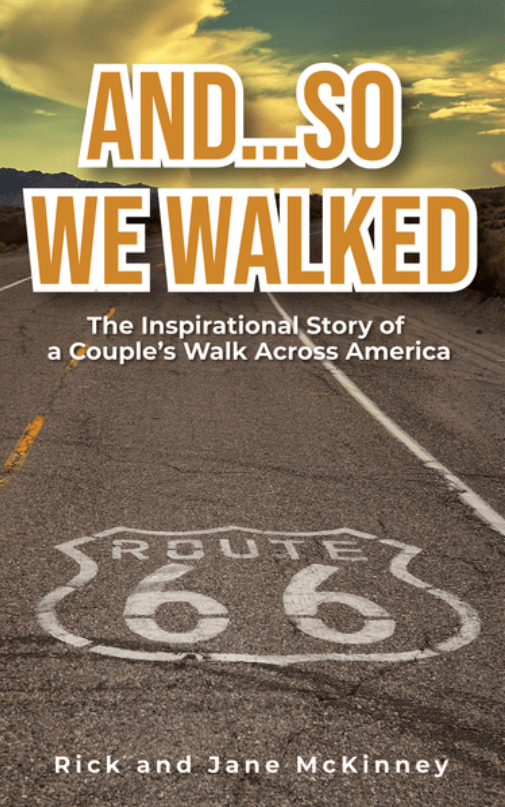
And So We Walked – Book Review

Most of the books I review on this website are major releases from the biggest publishers, but occasionally I like to share an Indie book I’ve enjoyed. I came across this author when I was promoting my book, Seeing God – For Who He Really Is, and it sounded interesting.

The authors are a Christian couple from the Midwest. Jane attended Oklahoma Baptist University and Rick has served in a variety of roles, from pastor to traveling evangelist. He’s most recently served as a professor at the College of the Cumberlands and continues to write and speak around the US.

And…So We Walked is the true, autobiographical story of their call and journey to travel from California to Washington D.C. on foot, walking across the country. A journey that would take them over 2770 miles, wearing out 20 pairs of shoes and taking six months to get there.

Rick and Jane’s passion for people and Jesus shines through in the pages of the book as every day was filled with encounters in which they were able to ask people the most important question in life, “Do you know Jesus?” Throughout the journey, they suffer many setbacks, some of which were as simple as logistical challenges, but more serious physical challenges as well.

The story is a testimony not only to God’s sustaining grace and power, but of the Body of Christ, as many stepped up to help in unexpected ways to make their journey possible. When Rick and Jane began their journey, they were about the same age as Deanna and I are now, and I couldn’t help but consider what it would be like for us to consider a similar endeavor. (Don’t worry, we have no intention of walking across Europe or the US)

The most telling part of their journey were the lives touched and the message they came away with, which was, to quote Rick’s speech from the end of their walk on the steps of the Supreme Court in DC, “We have come to understand that if we can help to change one life at a time, one step at a time, that we have a chance to change America.” What he’s talking about is the hundreds of face-to-face interactions with people during their journey. Sometimes, they were able to pray with people. Other times, it meant giving someone a Bible or money for food.

They experienced God’s provision by the hands of strangers and He allowed them to minister to others almost daily. Most of us should never consider something off-the-wall like walking across America, but we all should be more willing to go out into our communities and find the needs around us. We are called to be the hands and feet of Jesus to a world in need as well as the voice that proclaims the way to salvation. Rick and Jane McKinney embodied that well during their journey. I would encourage you to pick up their book and be challenged by it as well.

While you’re here, you might as well check out some Christian audiobooks that are available. 🙂

Discernment

Spiritual discernment is a big topic. I’m currently reading Megan Basham’s book, Shepherds for Sale. The main indictment of the book is that bad actors who desire to influence the electorate target well-meaning Christian leaders to influence them and those under their spiritual leadership. Megan is from the same denomination as myself and she speaks boldly out against this influence on our own leaders as well as other prominent evangelicals.

I’m through most of the book, and I don’t read it as an indictment of the faith of the men and women mentioned, but of their discernment. As Christians, we want to believe people who present themselves as wanting to help. We want to trust those identifying themselves as fellow Christians. This is normal, and it is usually a good thing. But if you’ve ever worked in benevolence or refugee ministry, you also know that people will say almost anything to get what they want. We learn that over time. I had to learn it, and sometimes it was through foolish choices I made along the way.

In chapter 5 of Megan’s book, she deals with the Covid Pandemic. This chapter is a follow up on some reporting she did the last few years, including this article. In this reporting, Megan documents how a supposed Christian, Francis Collins, worked with Anthony Fauci to push or even guilt churches into following pandemic restrictions on church closures, masks and the vaccines. Mr. Collins met with prominent pastors and Christian thought leaders to push the idea that loving our neighbor meant we had to do what the government said. Those who ignored these restrictions were painted in a poor light as uncaring and, in some cases, Un-Christian.

Like many believers, I had questions about these policies. In another article, Megan documents how Fauci and Collins used the same strategy to encourage church leaders to discredit medical professionals and scientists who didn’t go along with their script. If I’d been more vocal and had a larger platform, I could have been targeted. I agreed with men like Dr. Jay Bhattacharya, professor of medicine at Stanford and others who signed the Great Barrington Declaration, opposing further lockdowns. Most of what we were being told didn’t seem to make sense, whether according to logic, reason or scientific inquiry.

As Christians, we should be discerning. We should strive to have integrity in our interactions. Outside of God’s Word, we shouldn’t just accept what we’ve been told. The truth isn’t relative. We should test things against the truth, especially God’s Word. We should be compassionate, but we shouldn’t be foolish. As Charles Spurgeon once wrote, “Discernment is not knowing the difference between right and wrong. It is knowing the difference between right and almost right.”

As I write this, it is another election year. I despise election year politics, and really, all politics. Politicians always lie, but the lies flying around in a presidential election year reach extreme levels. It is a challenge for a Christian to exercise our responsibility as members of the community to vote with discernment. Some of the choices are clear, according to the Word of God, but others are more difficult.

To add to the challenge, we don’t just have the words of the candidates, but we have the words about the candidates. We’re told in millions of dollars of campaign ads, who the candidates are and what they said. Often, what is presented isn’t reality, but a parody of reality. In earlier days, these parodies existed mostly in campaign ads and in political satire like SNL, Bloom County or Doonesbury. Today, with the majority of the media being controlled by billionaires and corporations, such things are pushed at us in the headlines.

In the classic film, Mr. Smith Goes to Washington, the majority of Washington DC is filled with those who appear respectable, but who are actually controlled by organized crime and business. Our hero, played by Jimmy Stewart, has the curtain pulled back by a variety of people and slowly comes to understand what he’s up against. I sometimes feel like “Mr. Smith” when I pay attention to politics.

Today, most politicians are more like serfs doing the will of the rich and the powerful. Lobbying groups that live 24/7 in Washington DC are ready to push their policies even as the people in Congress come and go. We should be able to vote on the policies of the candidates, but too frequently, the candidates run on talking points that they never intend to implement.

With friends all along the political spectrum, I’m fortunate not to live in the echo chamber of one side. When you work with social media in a campaign year, you see every kind of political post. These go far beyond the campaign ads. Memes, videos, soundbites and links to articles that prove the point of the poster flood every feed. Again, most of these are a caricature of their opponent and their policies. Very rarely do you see an honest debate about policy issues. Instead, they’re trying to create a monstrous or comedic version of the opponent that they will convince you to vote against.

Each side wants you to feel it is impossible to vote for the opposing candidate. They want you to feel bad just thinking about voting for them. They don’t want you thoughtfully considering the issues. Our elections grow more like a high school popularity contest each day. They don’t want you to have discernment.

In the face of such a whirlwind of propaganda and mis-information, what is a Christian to do as they seek to be discerning?

  • Don’t Panic! – You need to know yourself. Politics is not essential for life. If your peace of heart and mind are being threatened by the political tidal wave, step out of its way and take a time out. It’s not worth it.
  • Where possible, listen to what the candidates actually say, not what is said about them. The media and social media are powerful tools, but most of what we see on them these days is misrepresented. I’ve had more luck with small, independent journalists than the traditional outlets.
  • “Trust in the Lord with all your heart and lean not on your own understanding; in all your ways submit to him, and he will make your paths straight.” Proverbs 3:5-6 – Discernment is not based on our own understanding, but on our connection to the truth. God is true. His Word is true. Our thoughts may be, but they may also be deceived.
  • “And it is my prayer that your love may abound more and more, with knowledge and all discernment, so that you may approve what is excellent, and so be pure and blameless for the day of Christ,” Phil. 1:9-10 – Pray for one another to have discernment and for yourself.
  • “Do not be conformed to this world, but be transformed by the renewal of your mind, that by testing you may discern what is the will of God, what is good and acceptable and perfect.” Romans 12:2 – Don’t get your discernment from the world. Don’t look for hope in political parties, who do not have your best interests in mind. Instead, renew your mind daily, in Him.

The world will try to program you for their outcome. We saw that in 2020 and we see it today. Don’t fall into their trap. Megan’s book is proof that even of the wisest may be influenced from time to time in the wrong direction, if they’re not careful. Be very careful and remember, real life is lived in your community, with your church, family and friends. That is what we’re put here to do. It is important how we vote, but far more important is how we love, serve and share the truth of the Gospel with those we interact with on a daily basis.

Living with Cretans

Cretin isn’t a word we use much today. We have our own insults, many of which sound much worse to our ears. If you look up the word in the dictionary, you’ll see definitions which point to an intelligence deficit. In my day, we might have called someone a “moron”. Previous generations called such people a “dunce”. And if you go back far enough, cretin was a common insult.

Not to be confused with cretin, is the word Cretan, meaning those who live on the island of Crete. In the NT, Paul writes to Titus, who is a minister on the island. According to Paul, the Cretans of that day are far worse than cretins. They weren’t ignorant or slow-witted. Paul describes them in Titus 1 in the following way:

“Even one of their own men, a prophet from Crete, has said about them, ‘The people of Crete are all liars, cruel animals, and lazy gluttons.’ This is true.” (1:12-13a)

From among such people, Paul gave Titus the task of appointing elders for the churches. His goal was to find men who “live a blameless life”, and who “lives wisely and is just, living a devout and disciplined life”. 

Quite the opposite of the description of Cretans. These were the kind of people needed to lead the churches of Crete. These elders would call the people of God to live pure and good lives among people who are “liars, cruel animals and lazy gluttons.” Regarding dealing with such people, Paul gave Titus the following wisdom:

Everything is pure to those whose hearts are pure. But nothing is pure to those who are corrupt and unbelieving, because their minds and consciences are corrupted. Such people claim they know God, but they deny him by the way they live. They are detestable and disobedient, worthless for doing anything good. (Titus 1:15-16)

The people of God in Crete weren’t to go out arguing with those who didn’t follow God. Like most of the teaching of the New Testament, Titus is ultimately concerned about how the church acts towards one another, even in the midst of a world filled with those who are corrupt, detestable, and disobedient.

This is because Paul knows that we can’t argue with the Cretans of this world. Their reality is centered around a different perspective and worldview that isn’t submissive to God. Christians live their lives according to God’s Word. The world lives according to their own selfish whims, described well above.

It’s hard living with Cretans. If you hold to the truth of the Gospel, you will stand out as worthy of spite in the world you live in. They won’t agree with you. They won’t think well of you. They will hate you because of Christ. Paul gave Titus the following advice to pass along to the believers in Crete:

For the grace of God has been revealed, bringing salvation to all people. And we are instructed to turn from godless living and sinful pleasures. We should live in this evil world with wisdom, righteousness, and devotion to God, while we look forward with hope to that wonderful day when the glory of our great God and Savior, Jesus Christ, will be revealed. He gave his life to free us from every kind of sin, to cleanse us, and to make us his very own people, totally committed to doing good deeds. (Titus 2:11-14)

Our ultimate hope is in the future, not in this world. While here, we should live with “wisdom, righteousness, and devotion to God.” We are His people, committed to doing good deeds, and our words and actions should reflect that. 

Good Foreigners

For the last 24 years, I’ve lived as a foreigner in two different countries. Foreigners can have different reputations, but for the most part, the term is used as a negative. I’ve heard the term spoken about me and other friends, almost like it was a curse word. Sometimes, this was because of a foolish violation of cultural norms, but other times, I don’t think I deserved to be spoken to with such derision.

Foreigners are defined by not belonging. They are different from the locals. I grew up in a small town and people could be suspicious of foreigners or unknown travelers who came into our town. This is a common reaction to anything different.

According to the New Testament, I actually became a foreigner much earlier in life, long before I moved overseas. It was over 40 years ago when I made the decision to follow Christ. According to 1st. Peter, this made me a foreigner in this world. 1 Peter 2: 9-12 talks about who we are as Christ-followers:

But you are a chosen people, a royal priesthood, a holy nation, God’s special possession, that you may declare the praises of him who called you out of darkness into his wonderful light. Once you were not a people, but now you are the people of God; once you had not received mercy, but now you have received mercy.
Dear friends, I urge you, as foreigners and exiles, to abstain from sinful desires, which wage war against your soul. Live such good lives among the pagans that, though they accuse you of doing wrong, they may see your good deeds and glorify God on the day he visits us.

As this “chosen people, royal priesthood, and holy nation”, we will always be different from the people around us. We are now the people of God, holy and set apart. We are called to live differently, but that doesn’t mean we are supposed to be a bane on the existence of those we live among. By contrary, we’re called to a better purpose.

In verse 12, it says, “Live such good lives among the pagans that, though they accuse you of doing wrong, they may see your good deeds and glorify God on the day he visits us.” Notice it didn’t say to live a good life and do good deeds so that we will be praised or that our church’s reputation will improve. We’re not to do good deeds so we’ll get more likes on social media or our church will get 5 star ratings.

Instead, we do these things so that God will be glorified. Followers of Jesus should live such good lives that people in your community will give glory to God for the way you live and interact with them. When you think about your actions over the past week or month, as you go to work, school or out into your community, did you behave in a way that is likely to lead others to glorify God? What about your online presence? Do people come away from your interactions thinking God is worthy of worship?

This doesn’t mean that we deny the truth to avoid offense. The message of the Gospel is offensive too many. We are foreigners, after all. We serve a different purpose and live according to a different culture and standards. The same passage challenges us to abstain from sinful desires. We are “called out of darkness.” The implication of verse 12 is that any accusations of wrongdoing will seem ridiculous because we have given our lives over to Godly character.

None of this is likely to endear us personally to everyone we meet. In contrast, many will find reasons to attack us. It doesn’t say the wrong accusations won’t come, only that when they come, the good deeds done in faithful service to the Lord will draw people to worship God. As it says in verse 15, “For it is God’s will that by doing good you should silence the ignorant talk of foolish people.”

You have been called out of darkness and into God’s glorious light. It’s time to live like it. We are aliens and strangers, foreigners and exiles in this land. We now live as the people of God. Those who’ve received mercy and we proclaim the mercy of Christ available to all who believe by both our words and our deeds. Live for His Glory and to lead others to glorify Him.

The Kingdom, The Power and The Glory – Book Review

I became aware of Tim Alberta’s book, The Kingdom, the Power and the Glory: American Evangelicals in an Age of Extremism shortly after its release. It was going around on social media and I added it to my TBR list, hoping to get to it, eventually. In the last month, a number of people in my circles had read it, posting snippets, recommendations and concerns on their own accounts, and I decided it was time to bump it up to the front of the line.

It is a deeply flawed book, filled with personal stories, some good journalism and research and an overarching perspective that the author finds difficult to escape. The book opens with his father’s funeral as the author recounts a painful event in which he is personally attacked at the funeral because of his previous book, American Carnage.

The author’s father was a conservative pastor, and like many pastors, he’d found himself struggling to balance conservative politics with Biblical values and viewpoints. In the previous book, which I have only read a summary of, the author offers a highly critical view of President Trump, his supporters and what he sees as the destruction of the Republican Party.

The sequel is meant to be a similar overview of Evangelical Christianity and an analysis of the impact of politics in general and specifically, the MAGA movement led by President Trump on Evangelical Christianity. The Spector of Trump looms large over the book, but most of the focus is on Evangelicals who compromised their beliefs to support Trump and other political causes.

If you are a Christian or an Evangelical, you’re probably aware of many of those he will target. Parts of the book remind me of a sermon I preached back in 2020, entitled The American Gospel. There is some good analysis in this book and there are a few voices the author highlights who preach a similar message to my own sermon, calling people back to the Gospel truth.

I’ll start with the good of the book. First, there is a well researched evaluation of the history of Liberty University, the Falwell family’s involvement in politics and the Christian Coalition. Most of the content in this section is accurately presented and provides a good framework for the argument. There is much to criticize here and the reporting is fairly straightforward.

Second, as a Southern Baptist, I found the coverage of the problems of the SBC to be fairly unbiased and hopeful. The author represented the good and the bad honestly and any mistakes were more from an absence of information than misinformation.

The further the author gets away from his own personal experiences, the better the book becomes. He has some talent for interviewing individuals and capturing their perspective to tie it together with his greater themes. By interviewing some of the key figures who became the worst offenders of the problem he’s trying to diagnose, he humanizes them without agreeing with them. The author gives some of these men ample space in the book to explain their perspectives.

What I didn’t like. From the first chapter on, there is a condemnation of “these people”. The targets of this book are lined up and shot down, one after another. Some are given a voice, as mentioned in the paragraph above, and others are reduced to a caricature of a few quotes.

Some Christian leaders are criticized for losing their relevance, which is defined as refusing to follow the dictates of the political leaders the author respects and supports and for holding non-Biblical viewpoints with which the author disagrees. Many of these criticisms are far afield from the legitimate criticisms that come at the end of the book when the author interviews some of the good examples of those pastors who are engaging their community for the Gospel.

The author has difficulty seeing the same problem on the left. The Senate race in Georgia was the perfect opportunity to present a non-partisan criticism which points out the misuse of religion by both the right and left, but though he spends many words on the Republican candidate, there is nary a mention of the Reverend Democratic candidate’s mistakes in this area. This would have been a wonderful opportunity to build a bridge to both sides, by treating the race fairly, instead it is completely one-sided.

This is a pattern throughout the book. The Catholic faith of prominent politicians on the left and their moral failures are ignored, while the author keeps coming back to both the failures of the former president and using that as a sledgehammer to condemn any who would support him. Because of this, the author loses some credibility in his criticism. Shouldn’t any Christian who argues that the morality of their political leaders doesn’t matter face the same backlash? The book would have significantly more power if it had taken that into account and shone the same lens on so called “religious” politicians of various political persuasions.

There is a section that starts to talk about the pro-war policies of politicians and the problems these policies have brought. Again, the author ignores that this is no longer a position solely tied to conservatives, but is pushed aggressively by both sides in Washington.

In one section, he puts forth the following statement, “Once a segment of the populace is convinced that they’re under siege, what is to stop them from being radicalized?” This is a fair question. The author is right to criticize those who use a narrative to manipulate Christians, but we’re currently seeing other “religions” radicalized. The terminology “This is the most important election in your lifetime” is used by both sides. Aggressive use of a persecution complex mentality is used by many groups, not just those the author targets, but like most of the book, he limits this only to religious conservatives.

It is difficult to recognize your own biases. Many of the people the author targets for criticism are presented as living in a bubble that reinforces their ideology. It is obvious this is also true for the author. He pushes several “facts” that have already been debunked and some of which have proven false since publication of the book. His perspectives on DC Politics, President Trump and the Pandemic are exactly what you will find if you are informed by opinion pages of Mainstream Media.

Another quote from the book says, “That vocal minority will always push around a timid majority” – this is the problem he sees in churches and as the author interviews the pastors who are struggling, this is the challenge he wants to help them with. The author defines the “crazy” 15-20% that he sees controlling many churches. This does occur in some churches, but strong Biblical leadership and solid discipleship is the best antidote. The author illustrates this when he revisits his father’s church and the pastor there, who, over time, has completely transformed the congregation.

Celebrity pastors who lead cults of personality are a large part of the problem, but really we’re talking about those who move away from the Bible, whether they lead a congregation of 50 or 5000. Pastors who focus on preaching the Gospel and avoid pushing politics and non-Biblical content from the pulpit are the ones who have the least issues today. Even those who dabble in this area continue to struggle. Strong Biblical leadership by qualified pastors is ever the best antidote for churches losing their way. That was the solution in the first century and it continues to be the solution today.

The author almost gets that. He definitely interviews some men who do and much of the last 20% of the book is given to these voices. The book starts out lumping Evangelicals into a big bucket. The heretics and the saints are slapped with harsh labels, especially if they vote in a manner the author doesn’t agree with. Some of the Christian leaders are condemned for this reason alone. At least two godly men of character are treated harshly because they changed their minds between 2016 and 2020.

At first, I wanted to hate this book, and the more I read, the more I wanted to like it. In the end, I found some good ideas, but the execution was lacking. Too many of the arguments were poorly formed and amounted to beating straw men on the head. I suspect he never would have written this book if his father were still alive. It is filled with far too many generalizations and not enough nuance. At times, I thought he was almost there, but the author never quite spelled out the main point of the pastors he interviewed at the end, who are held up as exemplary models.

So, if I were to write my own summary of these ideas, it might go like this. Practical truths that may not be spelled out in this book, but can be gleaned along the way:

The Bible, the Gospel and the Church are more important than politics. Christians lives should reflect that and the way the Church services are conducted should reflect that.

Church services should be centered around the worship of God, the encouragement of the saints and the proclamation of the Gospel.

Christian people should focus far more on grassroots Christian life on life impact in their communities than projecting their opinions on the internet. The Church should lead the way in this kind of local influence and care.

Our ultimate hope should be in Christ and eternity, not in this world or our country.

If this book had been less political, less biased against conservatives and more honed to focus on proclaiming this kind of central message, it would be something I could recommend without hesitation. It could be the kind of book to unite us around true Christian ideals. As it is written, it only serves to further divide the Church, as the author and his friends look down on too many of their fellow believers and judge them as “these people.”

Cultivating Good Soil

In the Gospel of Matthew, in chapter 13, we find what is commonly referred to as the Parable of the Sower. The sower, who could also be called a farmer, is sowing or planting seeds in the parable. In Jesus’ time, it would have been rare for anyone not to be familiar with planting seeds. His audience had seen everything he’s telling them, played out in nature.

There are four groups represented in the parable, or four categories. The parable is both descriptive and prescriptive. Jesus is describing the way things are and will be, but there are also applications and lessons to be learned.

From a descriptive point of view, we can look at the world or at the church or ministry we’ve been involved in and see the truth in what Jesus is saying. When the truth of the Gospel is spread into the world, it lands in different places, coming up against different types of people.

Years ago, I wrote an article about the history of the work in Turkey. As you know, there are few protestant Christians there, less than 10,000. Many “seeds” have been scattered there. People have prayed. They’ve shared the Gospel with people. Bibles and New Testaments have been sent out. Over the years, a lot of seed has been spread. Still, less than 10,000 Christians.

Many more than that have said they want to be a Christian. The best guess is somewhere between 25-40,000 people have professed a belief in Christ in the last 40 years. So, why are there less than 10,000 in the churches?

This parable helps explain it. Some of the seeds fell on the path, some on the rocky ground and some among the weeds. But some was sown in the good soil, and that represents those who believe and continue to walk faithfully with Christ to this day.

You might think about friends you know. People who at one time said they were a follower of Christ, but who now seem to be far from Him. Jesus talks about the problem. He explains why this might happen. He also diagnoses the problem.

When we get to verses 18-23, we see Jesus’ own explanation. This gives us the opportunity to think through Jesus’ words in light of our own lives and to ask the question, “Am I good soil?” As Jesus puts it, “This is the one who hears the word and understands it.” That’s what it means to be good soil. To have the Holy Spirit and have your life aligned with God’s Word. That is how we understand it and how we become “good soil.” There are four different landing places for the good seed of the Gospel in the parable and only one that produces growth in righteousness and spiritual fruit.

Before we look at these four categories, I would note that if you are not a follower of Jesus, you are in great spiritual risk. Jesus is offering you eternal life, but also a life on this earth where you have access to His guidance. These are great gifts. The Bible says, “If you confess with your mouth Jesus is Lord and believe in your heart that God raised Him from the dead, you will be saved.” Today can be the first day of your new spiritual journey. You can give your life to Him and start this new path. Don’t wait. Don’t hesitate. Bet your life on the safest bet there is in this world.

As for those of you who have already given your lives to Christ, we can learn a lot by looking at this parable. Jesus gives examples that can serve as warnings to us all. If we want our own life to turn out the way God would have it. To see our lives transformed by the good of the Gospel and the Truth of God’s Word, we would do well to read this parable and Jesus’ interpretation and apply it.

  1. Be careful about what you’re listening to. There are voices in our lives. We live in a digital world and the people I know have more virtual voices than real voices in their lives. This is one way that living today is much more complicated than the world that these first century followers of Jesus were living in.

    In the first example, Jesus says the seed fell on the path. He tells us the people on the path don’t understand the word of God. They receive it, but the evil one comes and snatches away the truth that was sown in their hearts.

    So, in this example the truth of God’s Word is falling on a place that isn’t suitable to retain it. The soil of the heart of this person is dry and without the nourishment the plant needs to grow. In the end, because it never really takes root, it is easy for the lies of Satan to overcome it. To replace it.

    Why would the heart of the person be like that? Why would some of your hearts be like that? What dries up the soil of your hearts. In today’s world it could be what you consume. What are you putting into your life every day? What kind of information passes in front of your eyes and into your ears?

    This makes a big difference in how your heart receives truth. You cannot grow in Christ if the seed of God’s Word is just a tiny little kernel in a sea of garbage. In the world we live in today, we can consume media every waking minute. Music, videos, games, and people talking to us about everything. Not just information, but how to think about such information.

    If you cultivate a heart like that, it will become a dry place. An unwelcoming place for God’s Word. By filling your life with every voice, but the truth, we make our heart into the path that is ready for Satan to snatch away whatever remnant of truth that remains.

    What are you filling your mind and heart with? Are these things drawing you closer to God or away from Him?
     
  2. Be careful about where you spend your time. In the next part of the parable, Jesus talks about the rocky places. Jesus gives a warning to the person who receives God’s Word with joy and believes it, but doesn’t take care to continue to build it into their life so it takes root. There’s something there, some belief that is real, but the problem is instead of living in the good soil, it’s surrounded by the rocky places. In the parable, the sun comes out and there is nothing to protect the plant and allow it to survive. If you’ve grown plants, you know that sunshine is essential for most plants. In this scenario, you have a plant that isn’t equipped to deal with the sun.

    Why? Because the sun that gives life and light can also burn things up. Jesus specifically mentions trouble and persecution coming. When this trouble comes, the person among the rocky places quickly falls away. They don’t survive the trouble.

    This might be illustrated in the person who grew up in a church family or came to church and heard the word and believed it, but then lives their life outside of the family of God. Maybe they still come to the church meetings occasionally, such as once a month or for a special event, but they are not a part of God’s family.

    God loved us and gave us His word and He established His church. When we live with God’s Word as a part of our daily life and we remain in the Body, learning from one another and growing together, we are well equipped to survive trouble when it comes. Even grow through it.

    The encouragement and support of our fellow believers is often the tangible presence of God’s Love for us during those difficult times. However, when we don’t live connected to the Body of Christ, we make our lives more difficult at all times, but especially in times of trouble. God intends for us to live in Biblical community and when we do, we will grow together through the good and the bad that this world brings.

    Where do you spend your time? Is it drawing you closer to God or away from Him?
     
  3. Be careful about who you spend time with. The third example is seed scattered among the thorns. In this one it says the thorns choked away the life of the growing plants, making it unfruitful. Jesus says they received the word, but the “worries of this life and the deceitfulness of wealth choke it.”

    These thorns could represent many things, including who you spend your time with. A sociologist said that we are the average of the five people we spend the most time with. If we spend our time with people who are obsessed with money, we will become more obsessed with money. If the people we spend time with are concerned with personal fame, we will soon demonstrate the same traits.

    This doesn’t mean we shouldn’t be friends with unbelievers or spend our time reaching out to those who do not yet know Jesus, but who do you spend the majority of your time with? Are they people who love the Lord and are consistently pursuing a growing relationship with Him or are they those who are consumed with the world, the worries of this age? It matters the kind of people we are with every day. Some people speak truth into our lives. They give us God’s Word and their lives are a beautiful illustration of the Word lived out.

    When we are surrounded by those who worship the world, then we will slowly change to become more concerned with the things of this world.

    Who do you spend your time with? Are these relationships drawing you closer to God, or away from Him?
     
  4. The last example is the inverse of all these things. The good soil. We are saved for a purpose. We don’t come into the Kingdom of God to sit and do nothing. The Gospel isn’t about obtaining fire insurance to prevent ourselves from going to Hell. Instead, we are saved to be fruitful. Fruitful = living, growing and bearing fruit. Spiritual fruit. We receive the truth of God’s Word and it grows in our lives and out of that growth, we share fruit.

    This could be the fruit of the spirit. Love, joy, peace, forbearance, kindness, goodness, faithfulness, gentleness and self-control. It could be Godly character traits. That doesn’t just happen because we proclaim it. It happens because of good soil.

    The fruitfulness also relates to the growth of the Kingdom. As the Gospel is lived out in your life through word and deed, you share a powerful call to a new life. We tell people the Good News of salvation through Christ. We show people the Good News of a transformed life, given over to Him. This is fruitful. It is the fruitful life. A life that can yield a crop 100, 60 or 30 times what was sown. Something that is only possible in Christ.

    This is the life God has for you. It is what Jesus was looking ahead and wanting for His disciples and unfortunately, it is the life that many miss out on because they refuse to hear the word of God and understand it.

    They refuse to make good decisions about who they spend their time with, where they spend that time and the influences they allow into their lives. All of these things have the potential to derail us from the righteous life that God desires. Every day, you make choices that draw you towards Christ or away from Him. Today, and every day, you have to choose.

So that is the question for us today. If you are a follower of Christ, will you build your life around Him? Will you willingly choose to immerse yourself in truth in a world full of deception? Will you remain faithful to being a part of Church Community, in a world that refuses to commit? Will you build deep, Godly friendships in the Body of Christ, or live out your life among the thorns?

To put it another way, in the words of Joshua, as God’s people prepared to enter into His promise:

14 “Now therefore fear the Lord and serve him in sincerity and in faithfulness. Put away the gods that your fathers served beyond the River and in Egypt, and serve the Lord. 15 And if it is evil in your eyes to serve the Lord, choose this day whom you will serve, whether the gods your fathers served in the region beyond the River, or the gods of the Amorites in whose land you dwell. But as for me and my house, we will serve the Lord.”

God is the Hero of our Story

In the novel, Snow Crash, Neal Stephenson makes the unusual decision to name the main character Hiro Protagonist. Which is either brilliant or a bad joke depending on the persuasion of humor you find compelling. Hiro is the hero of the story, of course. A hero cut very much from the modern anti-hero cloth. This work of fiction predated and predicted much of modern tech culture.

Hiro is a hacker who lives two lives, one as an elite free-lance hacker in the world of the Metaverse, a technologically advanced version of the internet that resembles many modern implementations of virtual worlds. Off-line, Hiro is a pizza delivery driver, working for a Franchised-Organized Quasi-National Entity known as Uncle Enzo’s pizza. It is weird and wonderful, but the story isn’t for everyone.

In real life, we often see ourselves as the hero of our story. It’s not something we talk about, but we envision that the story we’re living revolves around us. This is normal. We are inherently self-centered. It’s comical if you take a step back. There is no way we’re all the great mover of a grand scheme of which we’re the center. The world doesn’t work if everyone views their lives as if the world has to revolve around them.

That’s okay. We’re not NPC’s either. We have a real life. It has meaning and purpose. None of us are wallpaper. We don’t have to be at the center of everything to make a difference. It’s actually more mentally healthy for us if we can keep our life in balance by pursuing a purpose that is bigger than ourselves. 

About a year ago, a conversation I had online led me to consider thinking through my own spiritual origin story. Questions like: “How did I come to believe?”, “How did the aspects of my faith develop over time?”, and “What is it that causes anyone to believe in something?” Big questions and important questions. Questions on which life hangs.

In the process of thinking about these things, I decided it would be interesting to write what I called a “Spiritual Autobiography.” This was not about my life as much as it was about my spiritual life. I wanted to examine the way different events impacted my own spiritual development. As such, I made the conscience decision to omit specific details including proper names and places. The point of this being that the story wasn’t really about me, but about God in me. God is the real hero of my story.

I first published this story on Kindle Vella, finishing it up in September of 2023. It was a fun and engaging experience and I loved sharing it with my kids when it was done. They mentioned how they learned several things about me that they never knew. Some people read it online as well, and for the most part, it seemed to be well received.

Most people don’t read on Kindle Vella, but via eBook or print book. Because of this, I decided to release this story as a book and it came out at the end of last month. Getting There From Here is of course a play of words on the old saying, “You can’t get there from here.”

The meaning of the title is to contradict that saying, because, in fact, with God you can get there from here. When you make God the hero of your life’s story, you can find a way through the darkness. He’s the way out of the wilderness. He’s the hope for the hopeless and He’s ultimately the secret to finding true meaning and purpose in our lives.

God is the hero of my story and if you’re interested in reading about it, you can pick up a copy here. If you don’t have the spare change it takes to purchase it, just let me know and I’m happy to give you a free copy.