The Desire to be on the Inside

Let’s be real. You’re navigating that chaotic, exhilarating, and often insecure decade or early adulthood. You’re building your career, figuring out relationships, and desperately trying to cultivate an identity that screams, “I’m someone who gets it.” And in this quest, there’s a sneaky temptation, a magnetic pull towards what C.S. Lewis, in his essay “The Inner Ring,” brilliantly dissected. Only, for us today, it’s less about Victorian high society and more about the curated world of online influence, niche expertise, and being “in the know.”

Lewis talked about this universal human desire to be inside the “Inner Ring”—that exclusive group, that clique, where the real conversations happen, where the important people are. Fast forward to today, and these “rings” have morphed. They might be the tight-knit group of founders at that buzzy startup you’re trying to break into. Or the circle of creators on social media whose insights feel so much sharper, so much more enlightened than the mainstream. Maybe it’s the cohort in your grad program who effortlessly drop complex theories and make you feel like you’re always a step behind.

The allure is powerful. To be part of that inner circle feels like validation. It whispers promises of belonging, of finally being seen as someone who knows, someone who’s elite, someone who’s truly enlightened. You imagine the conversations are just more… intelligent there. The opportunities, more meaningful. The people, simply better.

Think about it. How often have you subtly shifted your opinions to align with someone you admire, someone who seems to be “in the know” about the latest trends or theories? Have you ever laughed a little too enthusiastically at an inside joke you didn’t quite grasp, just to signal that you’re one of them? Have you meticulously crafted your social media presence to project an image of intellectualism or insider knowledge, hoping to attract the attention of that coveted circle?

Lewis warned us about the danger of this desire. He pointed out that the “inner ring” isn’t necessarily about shared values or genuine connection. Often, it’s about exclusion. The very definition of being “in” relies on others being “out.” And the price of admission? It can be steep. It might involve compromising your own values, biting your tongue when you disagree, or even subtly putting others down to elevate your own perceived status within the group.

The irony is, the satisfaction you seek in joining these “inner rings” is often fleeting. Once you’re in, the mystique fades. The people you once idealized become just… people. And the conversations might not be as groundbreaking as you imagined. You might even find yourself looking for the next, even more exclusive ring to conquer, stuck in a perpetual cycle of chasing an illusion.

So, what’s the alternative? Lewis suggested a radical idea: focus on the work itself. Become genuinely good at what you do. Cultivate real skills and knowledge, not for the sake of appearing enlightened, but for the intrinsic satisfaction of mastery. When you dedicate yourself to your craft, you’ll find yourself connecting with others who share that same passion, forming genuine bonds based on mutual respect and shared purpose, not the fleeting allure of an “inner ring.”

The Bible is filled with relevant passages that talk about this type of authenticity. We are called to be people who live immersed in the truth and filled with integrity. Here are a few examples:

Matthew 23:1-12 (Humility and Avoiding Hypocrisy): In this passage, Jesus critiques the religious leaders who love places of honor, titles, and public recognition. He emphasizes that true greatness lies in service and humility: “But the greatest among you shall be your servant. Whoever exalts himself will be humbled, and whoever humbles himself will be exalted.” This directly contrasts the desire to climb into an “inner ring” for status and aligns with Lewis’s warning against seeking empty accolades.

Philippians 2:3-4 (Selflessness and Considering Others): Paul encourages believers to have a selfless attitude: “Do nothing out of selfish ambition or vain conceit. Rather, in humility value others above yourselves, not looking to your own interests but each of you to the interests of the others.” The pursuit of an “inner ring” is often driven by “selfish ambition” and a desire to elevate oneself, directly opposing this call to prioritize others.

1 Corinthians 1:26-31 (God’s Choice of the Unlikely): This passage highlights God’s tendency to choose those considered weak or foolish by the world to shame the wise and powerful: “But God chose the foolish things of the world to shame the wise; God chose the weak things of the world to shame the strong.” This challenges the worldly notion that being part of an “elite” or “knowledgeable” inner circle equates to true value or God’s favor.

Galatians 6:3 (Avoiding Self-Deception): Paul warns against thinking too highly of oneself: “For if anyone thinks he is something when he is nothing, he deceives himself.” The desire to be seen as part of an enlightened “inner ring” can easily lead to self-deception and an inflated sense of importance.

1 Peter 5:5-6 (Humility and God’s Exaltation): Peter echoes the theme of humility: “Likewise, you who are younger, be subject to the elders. Clothe yourselves, all of you, with humility toward one another, for ‘God opposes the proud but gives grace to the humble.’ Humble yourselves, therefore, under the mighty hand of God, so that at the proper time he may exalt you.” This suggests that true exaltation comes from God, not from climbing the social or intellectual ladder of worldly “inner rings.”

Matthew 6:1-4 (Sincerity in Actions): Jesus speaks against performing righteous acts for the sake of being seen: “Beware of practicing your righteousness before other people in order to be seen by them, for then you will have no reward from your Father in heaven.” This principle applies to the pursuit of appearing “knowledgeable” or “enlightened” simply to gain entry into a desired group. True value lies in genuine intention, not outward show.

True belonging, true knowledge, true enlightenment – these aren’t badges you acquire by proximity to a select few. They’re built through genuine effort, curiosity, and a commitment to your own path. So, as you navigate your way into adulthood, be aware of the siren call of the “inner circle.” Instead, focus on building your own solid foundation, brick by intellectual brick, connection by genuine connection. The real “in-crowd” is the one you build yourself, based on authenticity and a shared pursuit of something real.

Taming the Tongue

Unless you’re a monk who’s taken a vow of silence, you’ve experienced the damaging power of the tongue. The old adage that sticks and stones can break my bones, but words can never hurt me is only true if you’re talking about physical pain. Even if you have the skin of a rhino and are able to bear up under any verbal abuse and insults, you can still be hurt by gossip and slander.

Every day, relationships are destroyed, churches are split and people’s careers are held back by unfettered tongues wagging about something they shouldn’t. The Bible is filled with advice about taming the tongue. Let’s look at a few different passages and talk about what God’s Word has to say about dealing with this mortal enemy.

James is the writer in the New Testament who expands on this topic the most. As the brother of Jesus and the pastor of the first Christian Church in Jerusalem, I’m sure he had ample opportunity to see the deadly impact of the tongue unleashed. He saw His brother crucified based on false testimony. He saw Saul and others persecute the church and drive many away based on half-truths about Jesus and their movement. But the most dangerous and destructive outcomes were when those in the church were using their tongues against each other. It is to believers that he writes in chapter 3:

  • “The tongue is a flame of fire. It is a whole world of wickedness, corrupting your entire body.”
  • “It can set your whole life on fire, for it is set on fire by hell itself.”
  • “It is restless and evil, full of deadly poison.”
  • “Sometimes it praises our Lord and Father, and sometimes it curses those who have been made in the image of God. And so blessing and cursing come pouring out of the same mouth. Surely, my brothers and sisters, this is not right!” 

Another translation takes this last phrase and simply says, “my brothers, this must not be!” Strong words all around. In fact, if you read through the entire New Testament, it is difficult to find many warnings stronger than these. That little piece of flesh in your mouth is dangerous, my friends. You have been warned.

The book of Proverbs is full of comments about our words, usually contrasting the good with the bad. These sayings, written by the wisest man to ever live, emphasize the use of the tongue. Here are just a few from Proverbs 16:

  • “A troublemaker plants seeds of strife;
        gossip separates the best of friends.”
  • “Scoundrels create trouble;
        their words are a destructive blaze.”
  • “Kind words are like honey—
        sweet to the soul and healthy for the body.”
  • “From a wise mind comes wise speech;
        the words of the wise are persuasive.”
  • The wise are known for their understanding,
        and pleasant words are persuasive.”

We see the contrast. Wise and kind words have a powerful positive impact, but gossip separates friends and the words of scoundrels are destructive. The funny thing in all of this is very few people set out to be a scoundrel or a gossip. There are some truly rotten people who live for that sort of thing, but I doubt you know many of them and you probably aren’t choosing to hang out with those people.

Instead, the danger comes from those closest to us. Our friends and family. Our brothers and sisters in Christ. They have the most power to spread destruction in our lives. They are the ones undermining their pastors and splitting our churches. The truth is, sometimes the person stirring things up and causing problems is the same one you saw when you were brushing your teeth that morning.

We are all sinful. We are all frail creatures of dust. It is to us that James wrote the words above. You have been warned. Your tongue is dangerous. It can corrupt your entire body and destroy your relationships. Not only that, we can often justify it. Our hearts are deceitful and it is entirely possible that we can trick ourselves into believing that we’re in the right, even as we act to destroy the unity that we are commanded to pursue.

These verses are a challenge to all of us. We can’t assume we aren’t above using our tongues for the annihilation of Christian unity. Beware, Christian! Don’t assume you’re better than that. In almost forty years of Christian life and ministry, I can assure you that you aren’t. Take time to check yourself. Seek the Lord daily. “Be quick to listen, slow to speak and slow to become angry.” If you want to avoid falling into these dangerous paths, heed Paul’s great request that he begged the church in Ephesus to follow in Ephesians 4:1-3:

Therefore I, a prisoner for serving the Lord, beg you to lead a life worthy of your calling, for you have been called by God. Always be humble and gentle. Be patient with each other, making allowance for each other’s faults because of your love. Make every effort to keep yourselves united in the Spirit, binding yourselves together with peace.

How to Have a Good Day

A few months ago, I came across this short video. I’m the wrong generation to know who Forrest Frank is or to recognize his music, but I appreciated the simplicity of the encouragement in this video. We’ve all been there, dragging through a difficult day or time in need of someone to give us a little joy or universal truth. As a follower of Christ, we have the encouragement of God’s Word ever present in our lives and hopefully in our hearts and minds, but we also benefit from the encouragement of people around us.

In 2025, I purposed to pray for God to grow joy in my heart over the course of the year. Last year, I prayed for hope and saw Him answer that prayer in numerous ways. Despite the negativity in the headlines and on social media, there is reason to have hope and joy. To quote the song:

The God who made the universe
Knows me by my name
So it’s a good day

This is something that no one can change. We know that God knows us and loves us. These promises are echoed in Scripture. Psalm 139:1 says, “You have searched me, Lord, and you know me.” We have the opportunity to receive salvation from God, through Christ. “But because of his great love for us, God, who is rich in mercy, made us alive with Christ even when we were dead in transgressions—it is by grace you have been saved.” Ephesians 2:4-5

The Bible tells you of our value. We are “fearfully and wonderfully made.” God’s love “endures forever.” All of these are reasons to turn to joy over despair in the face of the difficulties of living here in this present age. Take some time today to find joy in these things and encourage someone you know with the same. These promises are eternal. They reign above the stock market, geopolitics and the headlines. Have a good day!

A Match MAID in Hell

MAID, or Medical Assistance in Dying, is becoming a more common practice in some western societies. When you examine the changes in the practices in the last ten years, you may be surprised to see how it has developed. Today, we’ll look at one specific case to open our conversation about what is happening.

I recently read about a relatively young lady in the Netherlands, 29, who scheduled her death for early May of last year. The plan was for a doctor to administer lethal intervention to euthanize her, removing her from this existence. There are a growing number of cases like hers, especially in Canada and a select number of European countries. What started out as a right to die for the aging and terminally ill has developed into a choice available for a much wider segment of the population.

This young lady, Zoraya, was not terminally ill. Her condition was a combination of struggles with mental illness and what might be called malaise. Life hadn’t turned out the way she planned and at 29, she’d decided she didn’t have it in her to try and turn it around and make another effort at finding meaning.

She had a boyfriend; she lived in a nice house, and two cats to take care of, but that wasn’t enough. Zoraya hoped for a successful career, but she never finished school and struggled with depression and autism. This all came to a head when another conversation with her psychiatrist led him to proclaim to her, “there’s nothing more we can do for you. It’s never gonna get any better.”

When even the person being paid to help with her mental health presented such a fatalistic perspective, Zoraya had heard enough. She was ready to pursue the path a growing number of young adults are pursuing, ending it all with the help of the medical establishment.

In the Netherlands, as in Canada and five other countries, this option is being presented more commonly by medical professionals proactively. A healthcare ethicist notes that in the beginning, it was only offered up if the patient sought it out, but it is not uncommon now for a physician or psychiatrist to be the first to recommend euthanasia as a possible solution.

The biggest change is with people like Zoraya, young people with significant mental health issues. When a young person is looking ahead at possibly 40 or 50 years of life with no solution to their persistent feelings of depression or nihilism, death and self-destruction can seem attractive.

This is a complete reversal of the psychological principles on which I was trained thirty years ago, as well as a violation of the Hippocratic oath. “First, do no harm” would seem to imply that you would never tell a patient there is no hope. The medical journals are filled with cases where those with even the most severe mental illness were able to overcome it through treatment and life changes. We are all inspired by heroic stories like these, which usually involve a strong supportive community and often contain elements of faith and purpose.

Societal bonds are weaker now. It is much more common to find people who are isolated without strong friendships and family connections. If the only person speaking into the life of someone who is hurting is a medical professional who sees euthanasia as the best option, it can be a relatively quick and easy decision.

A medical professional who served on the review board in the Netherlands from 2005 to 2014 said, “In those years, I saw the Dutch euthanasia practice evolve from death being a last resort, to death being a default option.” He ultimately resigned in protest. Some medical professionals fear this is becoming a societal contagion. Hopeless individuals hear about others who ended their lives this way and it can seem like a normal solution.

Despair over climate change and other societal issues is seen as a contributing factor. When you believe that the world is doomed, it is a short journey towards wanting to leave it as quickly as possible.

The truth is that there is still meaning and purpose in the world. Family, friendships, service and helping others through acts of kindness and consideration are all things that give people deep satisfaction. These are the kinds of things our children and youth need to be encouraged towards. They are much more fulfilling than likes on social media or material wealth. If I was counseling a young lady like Zoraya, this is the message I would give her.

Unfortunately, she ended her life on May 22nd of last year, never finding the hope she needed to carry on. Instead her doctor and the few people close to her affirmed ending her life at 29. This is a tragedy. All life has value and meaning. We should find our hope in something greater than ourselves. As followers of God, we know this and attempt to live it out. We should spread this hope and joy to all we know. Don’t let the Zorayas in your life think so little of their place in this world. Here are a few reminders from Scripture of who God says you are:

For you created my inmost being; you knit me together in my mother’s womb. I praise you because I am fearfully and wonderfully made; your works are wonderful, I know that full well. Your eyes saw my unformed body; all the days ordained for me were written in your book before one of them came to be.

Psalm 139:13-16

Are not two sparrows sold for a penny? Yet not one of them will fall to the ground outside your Father’s care. And even the very hairs of your head are all numbered. So don’t be afraid; you are worth more than many sparrows.

Matthew 10:29-31

Are You Being Manipulated?

I’m a firm believer that real life is lived in your immediate community, as in the people living around you that you interact with regularly. This includes family, friends and close groups like your church or work. This community is your reality. It is where you personally have the greatest potential to have a positive or negative impact on people’s lives. I’ve written about this on and off over the years, and it was the theme of the second book I released, The Danger of Being Alone Together.

For the most part, we tend to give people we know the benefit of the doubt. We’re more likely to try to understand their positions before we condemn them. Or, at least this used to be true. 2020 isolated us from much of our community and it seems like people have had a difficult time rebuilding it. In recent years, people in power have done their best to polarize around the issues they like to talk about. We’re pushed to have an opinion about everything in the headlines by those serving their own agendas.

No one likes to be manipulated. Whether it’s your friend, spouse, or someone at work, when you find out someone was using you, it’s demoralizing. In personal relationships, we want people to act fairly towards us and treat us with respect. Hopefully, you do your best to treat others that way as well.

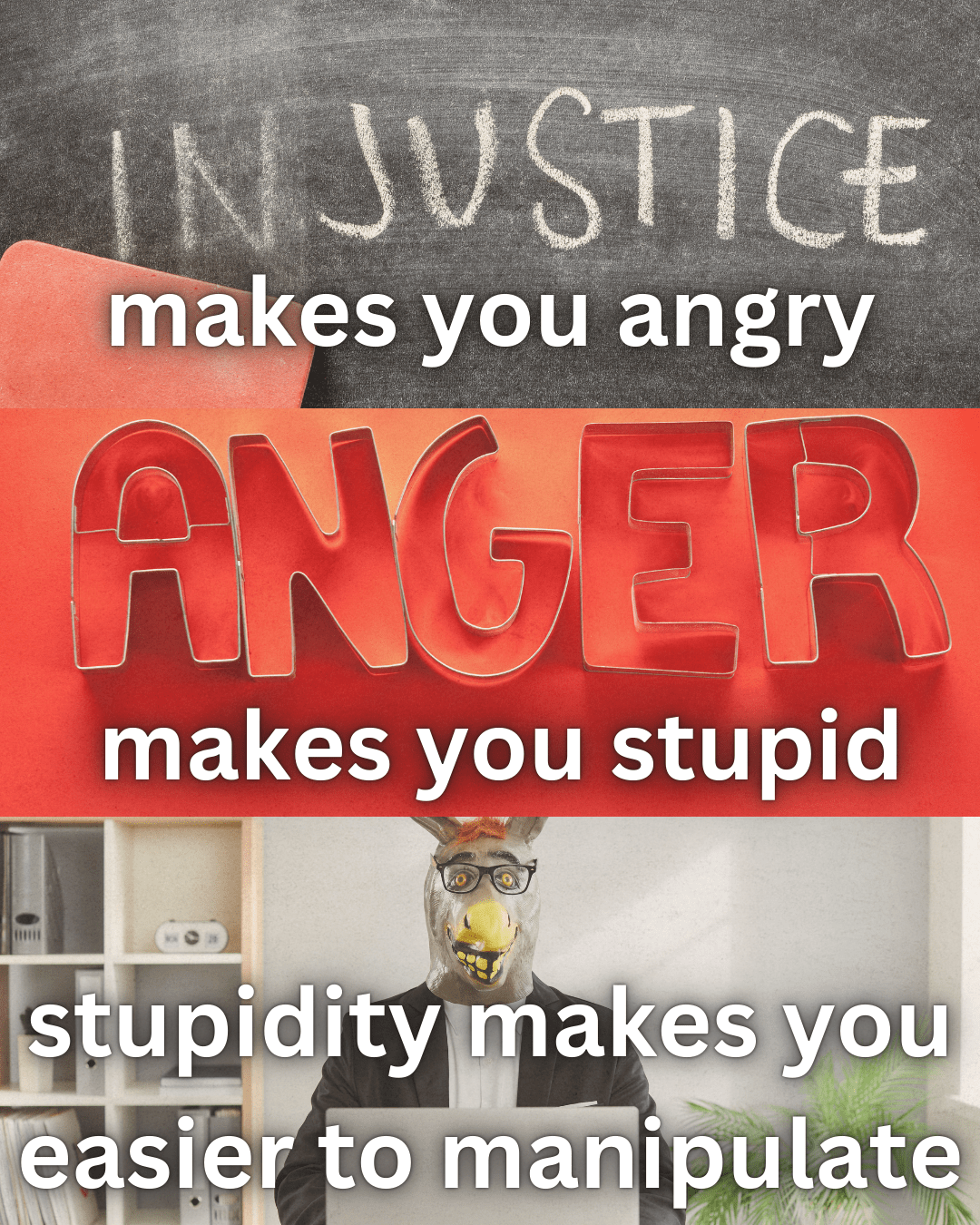
Unfortunately, the further we get away from the situation, the easier it is to manipulate us. Limited information means that people can flip our emotions with a timely anecdote or sentimental story. Advertisers know this and politicians know this. Anyone wanting to separate us from our money knows this. I read a quote recently that epitomizes one of the ways people are frequently manipulated:

Injustice makes you angry
Anger makes you stupid
Stupid means you’re easy to manipulate

I would add the following line to this quote, “Shame means you can’t admit when you were wrong“.

This is who we are as people in a nutshell. These statements represent the frailty of humanity. We’re emotional creatures and our emotions can lead us to behave in rash or irrational ways. The internet is the gasoline on every fire because of its reach and pervasiveness and it’s no different in this case.

But the internet didn’t invent this. History shows how common it is for monarchs, presidents and sultans to manipulate the will of the people to gain their support. When wars happen, they want people volunteering to send their sons off to die. Sometimes this involves promoting of real injustices and other times it means exaggerating or manipulating the facts to create maximum impact.

This used to mean the extreme use of words, as most people received their information via speeches and later newspapers. The “worst” something in history happened. The “greatest atrocity” happened. They gave a rousing speech to call us to arms.

Television meant that people could see the images of the injustice in their own homes, often carefully curated by the editors for the desired outcome. Now, everyone with a cellphone has the power to create a narrative and many are always ready. The right footage can then be shown around the world, stirring the hearts and minds of the populace in a desired direction. AI and deep fakes make manipulation even more possible.

Now, with the right footage and software, I can make any public figure say anything I want. Is it true? If you already disliked the figure, you probably aren’t waiting around to find out, as you’ve already reposted and forwarded something that supports your preconceived notions.

In the last few years, the social justice profiteering movement has grown by leaps and bounds. It is not unusual for national non-profits to report donations in the millions after an event draws viral social media attention to their cause. Good meaning people with big hearts make large donations to shady organizations with no or low accountability.

The most tragic recent example was a large movement that raked in over $90 million in a short period of time. Only about 1/3 of those funds were passed on to organizations engaged in trying to help with the problem. Most of the rest of the money was paid out to the founders and their relatives or to buy houses for the people running the organization. They were able to successfully use injustice to become multi-millionaires in a very short time. Not exactly what the donors thought they were giving to.

Everyone can be manipulated in the moment with the right issue that appeals to them. When we see something so awful that makes us feel immediately enraged, we’re in danger of being manipulated. Knowing this about ourselves is important. It’s okay not to immediately react, repost or respond. Taking the time to think about our emotions and how they might use them against us is an important step.

What is the solution? Coming back to where we began, real life is in your local community with people you know and can learn to trust. When you have a beef with your neighbor, at least it is based on actual experience and not just what someone told you to think. We should care about what is going on in the world, but we should also realize that there are many who will attempt to profit from world events, even the ones they might have caused.

Another consequence of this manipulation is the impact it has on our daily morale. People in power want you to think they are the answer to all of your problems. They want you living moment by moment, sucked into their realm of influence so you’ll believe every area of your life is tied into their control. If they succeed in this influence, then they succeed in making you believe that who is at the top of the power pyramid will either guarantee your misery or happiness.

That just isn’t true. If you find yourself feeling miserable after reading about what is going on in the headlines, I would encourage you to give them a pass the next time. All of my adult life, I’ve seen people of every political persuasion complaining about those in power. It has flipped back and forth with every election, but the people who live in this daily stream are rarely happy and the majority of things they’ve been told to fear never come true.

I’d encourage everyone to take a daily step back from the insanity of the online world. Take a deep look at the people around you. Get to know them better. Spend time together. Live life and laugh together. There is joy to be found in community. We tend to have a lot in common with the people in our towns and in our neighborhoods.

If you’re angry about something you’ve seen online. Take a moment. Stop and think. Make sure you understand the issue. Ask yourself, “what does the person showing this to me have to gain?” If you’ve realized you’ve been manipulated, admit you’re wrong and be careful not to trust that source again. Fakenews isn’t just a tool of the right or the left, but anyone who wants to use you for their benefit.

“Finally, brothers and sisters, whatever is true, whatever is honorable, whatever is just, whatever is pure, whatever is lovely, whatever is commendable, if there is any excellence, if there is anything worthy of praise, think about these things.”

Love & Respect – A Perfect Harmony

About eight years ago, we were preaching through the book of Ephesians at our Church. I was excited to tackle one of the passages that gets taken out of context the most: Ephesians 5:21-33. This is one of the longest passage in the Bible on marriage and when taken in context, it provides a beautiful picture of a wonderful union. Since today is Valentine’s Day, I wanted to revisit this topic. I’m fortunate to be a part of my own perfect union. Not perfect in that my wife and I always exemplify perfection in our own lives or towards one another, but we live within the bounds of this perfect aspirational form that God established, Christian marriage.

21 And further, submit to one another out of reverence for Christ.

22 For wives, this means submit to your husbands as to the Lord. 23 For a husband is the head of his wife as Christ is the head of the church. He is the Savior of his body, the church. 24 As the church submits to Christ, so you wives should submit to your husbands in everything.

25 For husbands, this means love your wives, just as Christ loved the church. He gave up his life for her 26 to make her holy and clean, washed by the cleansing of God’s word. 27 He did this to present her to himself as a glorious church without a spot or wrinkle or any other blemish. Instead, she will be holy and without fault. 28 In the same way, husbands ought to love their wives as they love their own bodies. For a man who loves his wife actually shows love for himself. 29 No one hates his own body but feeds and cares for it, just as Christ cares for the church.30 And we are members of his body.

31 As the Scriptures say, “A man leaves his father and mother and is joined to his wife, and the two are united into one.” 32 This is a great mystery, but it is an illustration of the way Christ and the church are one. 33 So again I say, each man must love his wife as he loves himself, and the wife must respect her husband.

The first verse here is usually skipped. People want to get right to verse 22 so they can complain about “wives submit to your husbands.” But if you skip over 21 then you fail to see that the passage is in the context of mutual submission, as in “submit to one another out of reverence to Christ.” Not because our spouse is so amazing, but because of who Christ is and what He’s done for us.

Mutual submission looks like this: I will leverage all that I have, my power, energy and resources for the benefit of my family. This is an amazing picture of sacrificial love. Someone who leads, loves and serves their family with their best interest in mind. Why do we do this? Not because they deserve it. Not because we are such great people, but out of “reverence for Christ”. We do it to show our respect and honor for Christ.

After it establishes the pattern of mutual submission, it lays out teaching for the wife. It says it right there in the verse, for wives. This passage doesn’t say, “Husbands, tell your wives this”. Rather, it is a message from God via Scripture for the wives. Now, this is a prickly verse, often misused, but what are these Godly women submitting to?

Picture a man like this: Imagine you’re married to a man who genuinely believes you are the most fantastic person on the planet. He’s crazy about you. You have no doubt that your happiness is his top priority. He listens when you talk. He honors you in public. To use an old-fashioned term, he “cherishes” you. He’s not afraid to make a decision. He values your opinions. He leads, but he listens. He’s responsible. He’s not argumentative. You have no doubt that he would give his life for you if the need arose. You never worry about him being unfaithful.

Now, who would have trouble following a man like that? It’s easy, perhaps natural, to submit to someone who genuinely has your best interest in mind. There’s no fear. No reason to resist. Conversely, anyone who has your best interest in mind has in effect submitted to you. That person has chosen to leverage him- or herself for your benefit, basically saying, “You first.”

Next, God does the same thing for husbands. He doesn’t tell wives, “Tell your husbands…”, no in a much better way, God has a message directly for the husbands. The message is this: How do you feel about your body? Do you feed yourself, take care of yourself? Then this is how you should treat your wife, who is now a part of you.

“The husband who plops himself down in front of the TV and orders his wife around like a slave has abandoned Christ in favor of Archie Bunker. Christ bound himself with a towel and washed the apostles’ feet. If you want to be a Christian husband, copy Jesus not Jabba the Hutt.” – John Piper

Even while he was on his knees washing their feet, no one doubted who the leader was. Nor should any Christian husband shirk his responsibility under God to provide moral vision and spiritual leadership as the humble servant of his wife and family. This is leading out of love. 

32 This is a great mystery, but it is an illustration of the way Christ and the church are one. 33 So again I say, each man must love his wife as he loves himself, and the wife must respect her husband.
Ephesians 5:32-33

The mystery is this. Christ and the Church don’t reflect marriage, marriage reflects Christ and the Church, with the Church submitting to the leadership of the one who wants nothing but the best for them and who will act only their best interest and Christ modeling that kind of sacrificial love. Man loves his wife as he loves himself and the wife respects her husband, thus the man gets what he was designed to need and the wife gets what she was designed to need.

This was God’s plan from creation. By creating a person like Adam, yet very unlike Adam, God provided the possibility of a profound unity that would otherwise have been impossible. There is a different kind of unity enjoyed by the joining of diverse counterparts than is enjoyed by joining two things just alike. When we all sing the same melody line, it is called “unison,” which means “one sound.” But when we unite diverse lines of soprano and alto and tenor and bass, we call it harmony, and everyone who has an ear to hear knows that something deeper in us is touched more by great harmony than by unison.

The sound of Christian marriage is like this sound of a beautiful harmony, 2 things that are the same, but different, coming into sync with one another. This doesn’t happen automatically, rather it happens over time as God uses our marriage and our spouse to hone us into His likeness. Helping us to grow closer to Him as we grow closer to one another.

History as a Legacy of Grace and Truth

For the past year, I’ve been writing my first historical fiction novel, the story of our family’s immigration from Alsace Lorraine in Europe to the plains of the United States. It’s been fascinating to not only learn about my family’s history, but the history of the time.

Making the decision that millions of people did, to leave their home and everything they knew for the opportunity to forge a new life on the other side of the world wasn’t easy and many suffered along the way, but the promise of opportunity drew people from all across Europe.

The Gantz’ family, who are the focus of the story, left their homes after Mathias Gantz fought in the French and Prussian War under Napoleon III. For 18 months, Mathias Gantz hauled ammunition to the battle front and brought back the wagon filled with the dead and wounded. When the war was over in 1871, Mathias Gantz made up his mind that anything would be better than living under such tyranny. He had heard of a new land–the home of the brave and the free.

The Hensley family, came much earlier, in the late 1620’s, long before the US would become a nation. James Hensley, of Norfolk, England would pack up his small family of his wife Sara and daughter Elizabeth and board a ship for Virginia, arriving sometime between 1627-1630. We don’t know much about their reasoning, but we know many left England during that time to pursue religious freedom.

The heritage of these two families lives on in the lives and faith of my own family. When we read about the past, we learn about the good and the bad, but if we take a step back we can see the result of a family’s legacy as they build something together, both with one another and with God. A lifetime pointed in a certain direction means something and it is possible for us to leave a lasting heritage that is far more valuable than any land or money we leave behind.

A German Bible, presented to my Great Grandparents, George and Dora Gantz at their wedding in 1902.

Mathias Gantz and his family were Lutherans who became a part of the German-speaking Baptist Church when they arrived in Kansas in 1883. What we know of their Christian heritage is their continued involvement in the church wherever they lived.

Picture of the baptism of my great grandfather, George Gantz, along with my aunt and other family friends

The faith of the Rev. G.W. Hensley and his wife, Polly is recorded in both their obituaries and in a wedding celebration. In the same year that George’s brother Samuel passed from this earth at the age of 53 in 1885, God was working in George’s life in a new way. George and Polly had been faithful servants as members of their local congregations, but at the age of 45, George would answer God’s call to be a preacher of the Gospel. Over the next 36 years, he would faithfully administer this call in the following communities: Pleasant Ridge, Fletchall, Brushy School House, Maloy, Sublet, New Harmony and Union Church, all in Missouri. During his ministry he was instrumental in leading scores of souls into the Kingdom of our Lord and Master. It was only declining health that led him to finally retire from service at the age of 81 in Grant City, MO.

In addition to their faithful service for the Gospel, George and Polly were notable for the blessing of being able to spend more than 67 years together in marriage before Polly’s passing. During that time “they had their joys as well as sorrows. Bereavements have visited their home, but they have found their source of comfort in Him who is able to keep that which they have committed to Him against that day.” At a celebration for their 63rd Anniversary, they counted 63 grand and great grandchildren and the following blessing was pronounced, “During their last days on earth may the richest of blessings abide with them and when their eyes shall close in death and the flush of health shall leaven their cheeks and the pulse cease to beat, may they both have abundant entrance into the city whose maker and builder is God.”

G.W. would finally say goodbye to his beloved Polly on January 3rd, 1928, when she would pass into the arms of her Savior at the age of 88. It was written of their marriage and parting that they, “had passed the 67th year of wedded life, a long, long time down the path of life they had walked side by side. And now in this world while the walk has ceased, yet we feel sure that journey has been taken up on the golden streets of the New Jerusalem and while Bro. Hensley will be lonely, yet like David of Old he can say I cannot recall but praise God I can meet her in the world where all tears and sorrow shall be passed away and no more farewells shall be spoken.” G.W would last but a few more years before joining his bride on those streets of gold. On March 14, 1931, at the age of 91, the Rev. George Washington Hensley, would finish his earthly journey. It was written about him that, “Brother Hensley lived and stood for a life of righteousness and truth, it mattered not when or where.” Their legacy would live on in their family and the many who found their faith in Jesus through their ministry to His Word.

We don’t write announcements like that anymore, but these are things worth remembering. We should know where we’ve come from, both as a people and as a nation. Learning about our history helps us to appreciate the difficulties that needed to be overcome for us to enjoy the benefits of life today.

In my own family history, I find a “perseverance of the saints” that reflects well on the Christian character of my ancestors. They came together and built faith and family. G.W. and Polly were married 67 years. His son, T.J., wouldn’t marry until the age of 31, but they were together for 50 years until his wife, Sarah’s passing. George and his wife, Dora were married for 55 years until Dora entered eternity.

These things matter and they are worth remembering. The novel I was determined to write is designed to be a good, and entertaining story, but it’s also a testimony to the grace and truth that are passed down through this heritage. I hope you’ll enjoy, Across the Shining Sea and the books that follow. They’re my own way of helping to preserve what is worth remembering from our family’s history.

The Remaking of the World by Andrew Wilson – Book Review

Andrew Wilson’s The Remaking of the World presents a compelling narrative that intertwines modernity with a biblical worldview, offering readers an intellectual history that reflects on the evolution of contemporary beliefs and values. Wilson’s exploration is not merely historical; it serves as a guide for navigating the complexities of today’s world, which he describes as “WEIRDER” — Western, Educated, Industrialized, Rich, and Democratic. The subtitle of the book is “How 1776 Created the Post-Christian West”, but the book expands beyond the bounds of the founding of America to examine greater themes across the world, especially in Europe.

Overview of Themes

Wilson’s book is structured around three central themes: gracefreedom, and truth. He argues that these themes have been pivotal in shaping modern society, particularly through the lens of evangelical Christianity. For instance, he highlights how the abolitionist movement in England was significantly driven by evangelical leaders who recognized the moral imperative of freedom for all individuals. He states, “The same century that gave rise to our modern world also gave rise to the modern evangelical movement,” emphasizing the intertwined nature of faith and social progress

Grace

In discussing grace, Wilson delves into the rich tradition of evangelical hymnody during the 18th century. He cites figures like John Newton and Charles Wesley, illustrating how their hymns emphasized God’s free grace available to sinful humans. This focus on grace not only nurtured personal transformation but also inspired collective action against societal injustices.

Freedom

Wilson’s treatment of freedom is particularly poignant as he connects it to historical movements for social change. He notes that “the campaign to abolish slavery was led largely by evangelicals,” showcasing how religious conviction can catalyze significant societal shifts. This historical context serves as a reminder of the potential for faith to drive positive change in a world often marked by conflict and division.

Truth

The theme of truth is explored through Wilson’s examination of philosophical discourse during the Enlightenment. He discusses Johann Georg Hamann, a lesser-known figure who defended religious truth amidst rising secularism. Wilson argues that Hamann’s work illustrates a crucial apologetic for faith in an increasingly skeptical world: “We must remember that truth is not merely an abstract concept but a relational reality rooted in divine revelation”

Structure and Style

Wilson’s writing is both accessible and thought-provoking. While he does not claim to be a historian by profession, his research is thorough and well-integrated into his narrative. The book flows logically from one theme to another, allowing readers to grasp complex ideas without feeling overwhelmed. His ability to weave personal anecdotes with historical analysis gives the text a relatable quality.

Conclusion

In The Remaking of the World, Andrew Wilson successfully articulates how our current cultural landscape has been shaped by historical events and theological insights. He does not provide a prescriptive solution to modern challenges but rather encourages readers to engage thoughtfully with their faith in light of history. As he poignantly remarks, “To help the church thrive in a WEIRDER world,” we must understand our past and its implications for our future. This book is essential reading for anyone seeking to comprehend the intersection of faith and modernity, making it a significant contribution to contemporary discussions on culture and spirituality.

Hope for the Future

2023 was a rough year. It began with the loss of my mother, and we experienced several more losses throughout the year. As we entered this year, I purposed to pray to grow in hope over the course of this year. Hope is a powerful force, as long as it is based on evidence. It is only as strong as what we put our hope in.

When we put our hope in weak and worthless things, our hope will wither and fail. This could be a person, a group of people or the latest and greatest thing in our lives, like a technology. People want to be seen as our hope. They promise a better plan or vision for the future. They tell us that if we put our trust in them, they will make our lives better.

They might provide what they promise, at least temporarily, but human hope is destined to fail. Political parties are corrupt. Men and women fall and even relying on yourself is only as good as your own ability to serve good purposes with consistency. When you put your hope in yourself, you end up with double discouragement of failing and only having yourself to blame.

During the Christmas season, it is common to think about the hope that the birth of Christ brings. We often forget that the coming of Christ was preceded by a 400-year period during which God appeared to be completely silent, with no prophets or revelation to His followers. None of us can understand what that might be like. We’re not good at waiting and even a delay of several months can seem like a long time.

By contrast, the followers of God had been steamrolled by one empire after another and were currently under Roman oppression. They were poor, powerless, and without many of the basic human rights that we would consider essential today. Into that darkness, God gave the light of Christ, a Savior almost entirely different from what most of them were waiting for. The book of Hebrews talks about this unique form of hope God was about to provide:

17 Because God wanted to show his unchangeable purpose even more clearly to the heirs of the promise, he guaranteed it with an oath, 18 so that through two unchangeable things, in which it is impossible for God to lie, we who have fled for refuge might have strong encouragement to seize the hope set before us. 19 We have this hope as an anchor for the soul, firm and secure. It enters the inner sanctuary behind the curtain.

Hebrews 6:17-19 (CSB)

This transformative hope was not in the sacrificial system. It “enters the inner sanctuary behind the curtain.” It isn’t like a human hope, it is “firm and secure.” The prophet Isaiah looked ahead to this event:

The people walking in darkness have seen a great light; a light has dawned on those living in the land of darkness.

Isaiah 9:2

This great light is not the light of Israel, not the light of a new coming earthly king. It is the light that is coming to guide them out of the darkness. It doesn’t lead them to follow a political party or an earthly hero. They are strongly encouraged to seize the hope that is set before them, which is a hope for eternity. That is the future Jeremiah promised as God’s prophet:

“For I know the plans I have for you”-this is the Lord’s declaration-“plans for your well-being, not for disaster, to give you a future and a hope.”

Jeremiah 29:11

This promise was given to God’s followers when they were in exile, imprisoned in a land that was not their own. True hope doesn’t ignore the realities of the pain of life, but is grounded in God’s promises. Our hope renews in Him. It renews in our ultimate hope, which is in a place where there are no more sorrows and tears.

God has answered my prayer to grow in hope this year. It didn’t happen all at once and it didn’t happen because everything went right this year, or better this year than the year before. My hope has grown because it is more aligned with God’s reality. The evidence is all around us. We can see His sovereignty in the spiritual transformation of people from death to life. We can know our future is secure and our present is known to Him. As we remember the birth of hope with the first Christmas, trust in the creator of hope. He is the anchor for our soul, firm and secure.

Live Not By Lies – Book Review

Rod Dreher’s Live Not By Lies serves as a clarion call for Christians in America to navigate the complexities of truth in an age marked by misinformation and ideological conformity. Drawing on historical examples, particularly from the Soviet Union, Dreher emphasizes the importance of discernment in recognizing and resisting the lies propagated by contemporary culture.

Understanding the Context

Dreher opens with a stark reminder of the totalitarian regimes that have sought to suppress truth. He writes, “The great lesson of the dissidents is that we must not live by lies” (Dreher). This statement encapsulates his central thesis: that Christians must cultivate a robust understanding of truth to withstand societal pressures that demand conformity to false narratives. He argues that just as Soviet citizens had to navigate a landscape rife with propaganda, modern Americans face similar challenges, albeit in different forms.

The Role of Community

One of Dreher’s key insights is the necessity of community in fostering truth. He asserts, “We need to be part of a community that speaks the truth to one another” (Dreher). This underscores the idea that individual discernment is often insufficient; it is through communal engagement and accountability that Christians can better navigate the murky waters of information. By surrounding themselves with like-minded individuals who prioritize truth, believers can fortify their understanding against misleading ideologies. Real life is lived in this kind of community, whether it is family, church or other regular gatherings.

Discernment in Information Consumption

Dreher also provides practical guidance on how Christians can discern true information from falsehoods. He emphasizes the importance of critical thinking and skepticism towards mainstream narratives, stating, “The first step in resisting lies is to question everything” (Dreher). This call for skepticism does not imply a blanket distrust of all information but rather encourages a more discerning approach to consuming news and media. By critically evaluating sources and seeking out diverse perspectives, Christians can develop a more nuanced understanding of current events. This section reminded me of a non-fiction version of the manipulation taking place in my latest novel, The Agency: DDD Inc.

Historical Lessons

Throughout “Live Not By Lies,” Dreher draws parallels between past totalitarian regimes and present-day America. He highlights how complacency can lead to complicity in falsehoods, warning that “the price of freedom is eternal vigilance” (Dreher). This historical context serves as both a cautionary tale and a source of inspiration for believers today. By studying the resilience of dissidents who stood firm against oppressive regimes, Christians can find motivation to uphold their values in the face of contemporary challenges.

Conclusion: A Call to Action

In conclusion, “Live Not By Lies” is more than just a critique of modern society; it is a call to action for Christians to actively engage with truth. Dreher’s blend of historical analysis and practical advice equips readers with the tools necessary for discerning true information amidst a sea of lies. As he poignantly states, “Truth is not merely what we believe; it is what we live” (Dreher). This powerful assertion reinforces the idea that living out one’s faith requires an unwavering commitment to truth, even when it is uncomfortable or unpopular.

For Christians grappling with misinformation and cultural pressures, Dreher’s work offers both guidance and encouragement. By fostering community, practicing discernment, and learning from history, believers can navigate today’s challenges with integrity and faithfulness.