
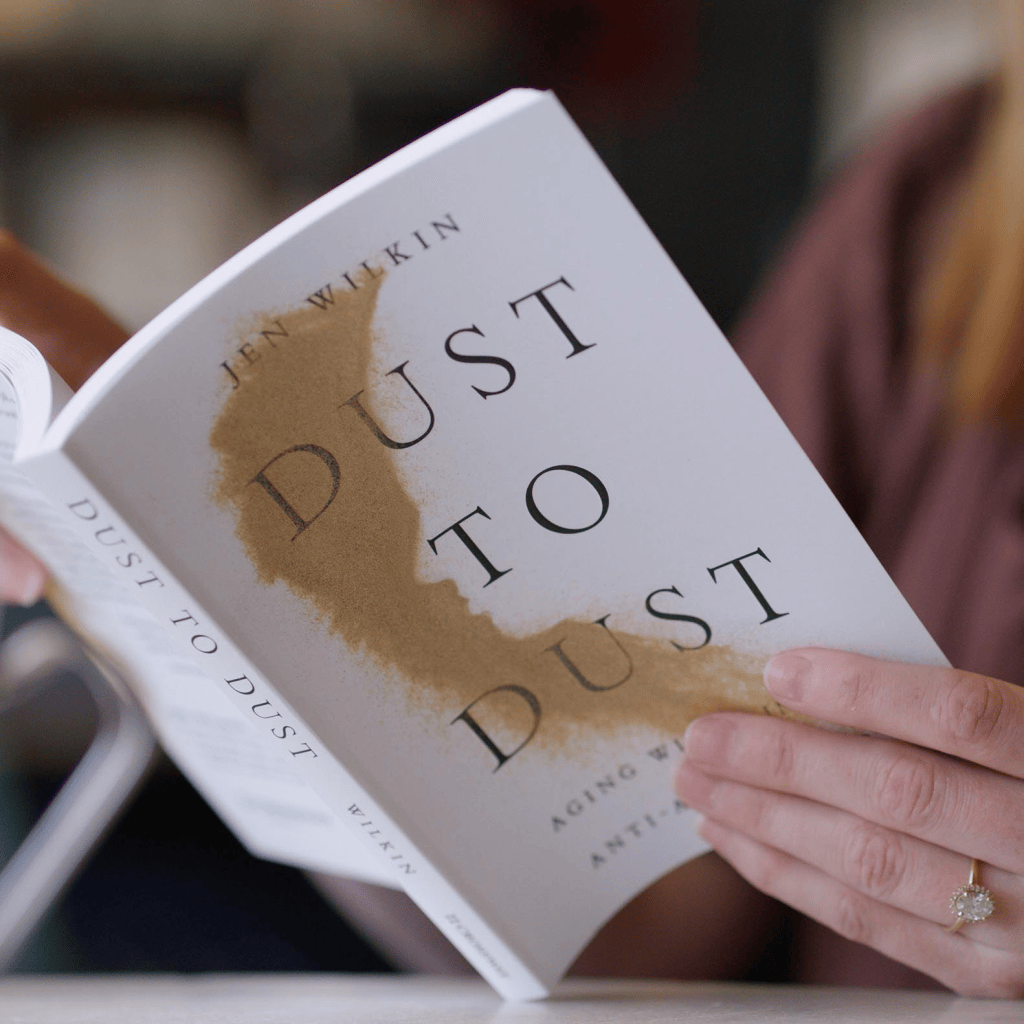
Jen Wilkin’s Dust to Dust: Aging Wisely in an Anti-Aging World is a clear-eyed, Scripture-shaped challenge to a culture that treats growing old as a problem to hide, postpone, or defeat. More than a book about later life, it is a book about learning to live faithfully through the entire arc God gives us—from youthful dependence to mature fruitfulness, and finally to the hope of resurrection.
Wilkin invites readers in every season of life to reject the assumption that aging necessarily means diminishing worth and instead to pursue the wisdom, humility, service, and eternal perspective that should deepen with the passing years.
The book’s central conviction
The title deliberately evokes Genesis 3:19: “for you are dust, and to dust you shall return.” That verse can sound bleak when removed from the broader biblical story. But Wilkin does not use human mortality to produce despair. She uses it to restore proportion.
Modern people are trained to believe that their bodies, productivity, attractiveness, independence, and influence must be preserved as long as possible. In that story, aging is an enemy because it exposes the limits we would rather deny. Wilkin offers another story: we are creatures, not self-made gods; our lives are gifts, not possessions; and our worth rests in being image bearers of God, not in retaining youthful capabilities.
That does not mean she romanticizes bodily decline, grief, dementia, bereavement, or the practical burdens of caregiving. The Christian view of aging is not stoicism. Death remains an enemy, and frailty is a reminder that the world is fallen. Yet the believer faces these realities in light of Christ’s death and resurrection. The body may weaken, but the Christian is not becoming less human, less visible to God, or less valuable to the church.
Wilkin’s distinctive contribution is her insistence that the second half of life should not be viewed merely as the sad reversal of the first. She uses the poetic idea of symmetry—the book’s publisher calls it a “chiastic” structure—to draw connections between the early and later stages of life. Dependence, for example, is not an embarrassment reserved for infancy and old age; it is a permanent condition of creatureliness before God.
Anti-aging versus biblical aging
The contrast at the heart of Dust to Dust is not between sensible health practices and neglect of the body. Scripture does not commend carelessness. Rather, it is between two rival accounts of what a human being is and what makes a life meaningful.
| Modern anti-aging story | Biblical vision |
| Aging is chiefly decline, loss, and irrelevance. | Aging can mean increasing wisdom, spiritual maturity, and opportunity for faithful witness. |
| Youthfulness is a measure of beauty and value. | Human dignity is inherent because every person bears God’s image. |
| The goal is to preserve autonomy for as long as possible. | The goal is faithful dependence on God and loving interdependence within family and church. |
| Frailty is shameful, inconvenient, or evidence that a person has become a burden. | Frailty calls forth honor, compassion, caregiving, patience, and the church’s covenantal responsibilities. |
| Death is a failure to be delayed or denied. | Death is grievous and unnatural, yet defeated decisively by Christ and followed by resurrection hope. |
| Life is measured by appearance, capacity, pleasure, and personal choice. | Life is measured by faithfulness to God, love of neighbor, wisdom, and hope in Christ. |
Wilkin’s contrast is especially useful because anti-aging culture is not limited to cosmetic procedures or advertising. It is a moral imagination. It appears whenever people assume that only the young, attractive, productive, technologically current, or economically independent deserve public attention. It appears when churches prize energy over wisdom, when families regard aging relatives chiefly as logistical problems, and when older believers internalize the lie that their useful years are over.
That is precisely why the book’s argument has congregational force. Titus 2 envisions older men and women as indispensable teachers in the body of Christ. Psalm 92 says that the righteous “still bear fruit in old age” (Psalm 92:14). Proverbs repeatedly links age with the possibility of wisdom, while also reminding readers that wisdom must be pursued rather than presumed (Proverbs 16:31; Job 12:12). Wilkin’s vision is not sentimental reverence for age; it is a call to become the kind of people whose years produce godliness.
What the book does well
Wilkin’s greatest strength is that she names the cultural lie without merely scolding readers for believing it. She recognizes that the fear of aging is often connected to real losses: health, mobility, vocation, beauty, income, companionship, and control. The book therefore offers more than a vague call to “age positively.” It directs readers toward a richer theological account of embodied life, limitation, caregiving, family, and the church.
- It is for younger readers as much as older ones. A book on aging can easily be marketed as a resource only for retirees. Wilkin instead presses young adults and middle-aged readers to ask what story is shaping their ambitions, their use of time, their view of their bodies, and their treatment of elders. Crossway explicitly presents the book as a resource for readers in their twenties, middle age, and beyond.
- It connects aging to a whole-life ethic. The logic is straightforward: if human dignity depends on youth, ability, or independence, then the very young, the disabled, the chronically ill, and the aged are all vulnerable to being treated as less valuable. A biblical doctrine of the image of God resists that hierarchy. The publisher specifically notes Wilkin’s attention to body image, honor for the elderly, family, caregiving, and a whole-life pro-life ethic.
- It locates value outside productivity. This is a needed corrective in an American culture that often confuses a person’s worth with earning power, efficiency, influence, or physical self-sufficiency. A bedridden saint remains an image bearer. An elderly widow who can no longer serve in visible ways has not ceased to matter to Christ’s church.
- It points toward resurrection rather than denial. Christianity does not finally answer anti-aging anxiety by telling people that the body does not matter. The body matters so much that Christ took on flesh, rose bodily, and promises the resurrection of His people. The Christian hope is not endless maintenance of a decaying body, but a redeemed and glorified body in the new creation.
A needed word to the church
One of the book’s implied questions is whether churches actually believe what they say about the sanctity and value of life. It is easy to affirm the dignity of every human being in doctrinal statements; it is more difficult to structure congregational life around that conviction.
A church shaped by Wilkin’s argument would do more than host a senior-adult luncheon. It would make room for older saints to pray, teach, counsel, testify, and disciple. It would equip members to care for aging parents rather than treating that work as an interruption to “real” ministry. It would visit the homebound, honor those with diminishing abilities, and resist the assumption that ministry belongs chiefly to the energetic and outwardly impressive.
This does not mean older Christians should be insulated from calls to repentance, growth, or service. Nor does it mean every older person has accumulated wisdom. But it does mean the church should reject a cultural pattern that sidelines people precisely when they may have the deepest perspective on suffering, faithfulness, regret, providence, and hope.
The book also speaks personally to those who feel surprised by the passing of time. Wilkin does not offer a technique for remaining young at heart. She offers something sturdier: the possibility of becoming wise. The difference matters. Youthfulness is temporary and cannot be recovered by effort, expense, or medical intervention. Wisdom, by God’s grace, may increase even as strength decreases.
Final assessment
Dust to Dust is a timely and pastorally valuable book for Christians living under the relentless pressure of anti-aging culture. Its central message is not that aging is easy or that bodily loss is unreal. Its message is that the world’s fear-driven story is too small. To age is not merely to lose; in Christ, it can be to deepen.
For readers shaped by the Bible’s affirmation of human dignity, the reality of bodily resurrection, the importance of family, and the ministry of the local church, Wilkin’s book offers an important application of familiar doctrine. It reminds us that every stage of life belongs to God, that no believer becomes disposable, and that the road from dust to dust is not the end of the story.
The modern world asks, “How can I stay young?” Wilkin asks the better question: “How can I become wise, faithful, and ready to meet the Lord?” That is the question Dust to Dust helps its readers answer.

