Quick Take
Stephen C. Meyer’s Return of the God Hypothesis: Three Scientific Discoveries That Reveal the Mind Behind the Universe, is not a light read. It is meant for those who love science and aren’t afraid to dive into the deep in order to engage with the topic. If that doesn’t describe you, I highly advise you skip the book and instead check out the recently released documentary, The Story of Everything, which was written by the same author.
About every ten years or so, I like to do a deep dive into the scientific evidence for creation, intelligent design and the existence of God. This started when I was a junior at the University of Oklahoma and has been a part of my life-long love of science, reason and the way they interact with faith. While this book wasn’t an easy read, I appreciate the author’s efforts to engage honestly with the topic, give his opponents a voice and address common objections before presenting his conclusions. Whether you’re a believer in God or not, if you’re someone who finds yourself on a similar quest for truth, I recommend this book as an essential part of your research. Hopefully, the summary below will pique your interest and let you evaluate if this is a book you are ready to engage with.
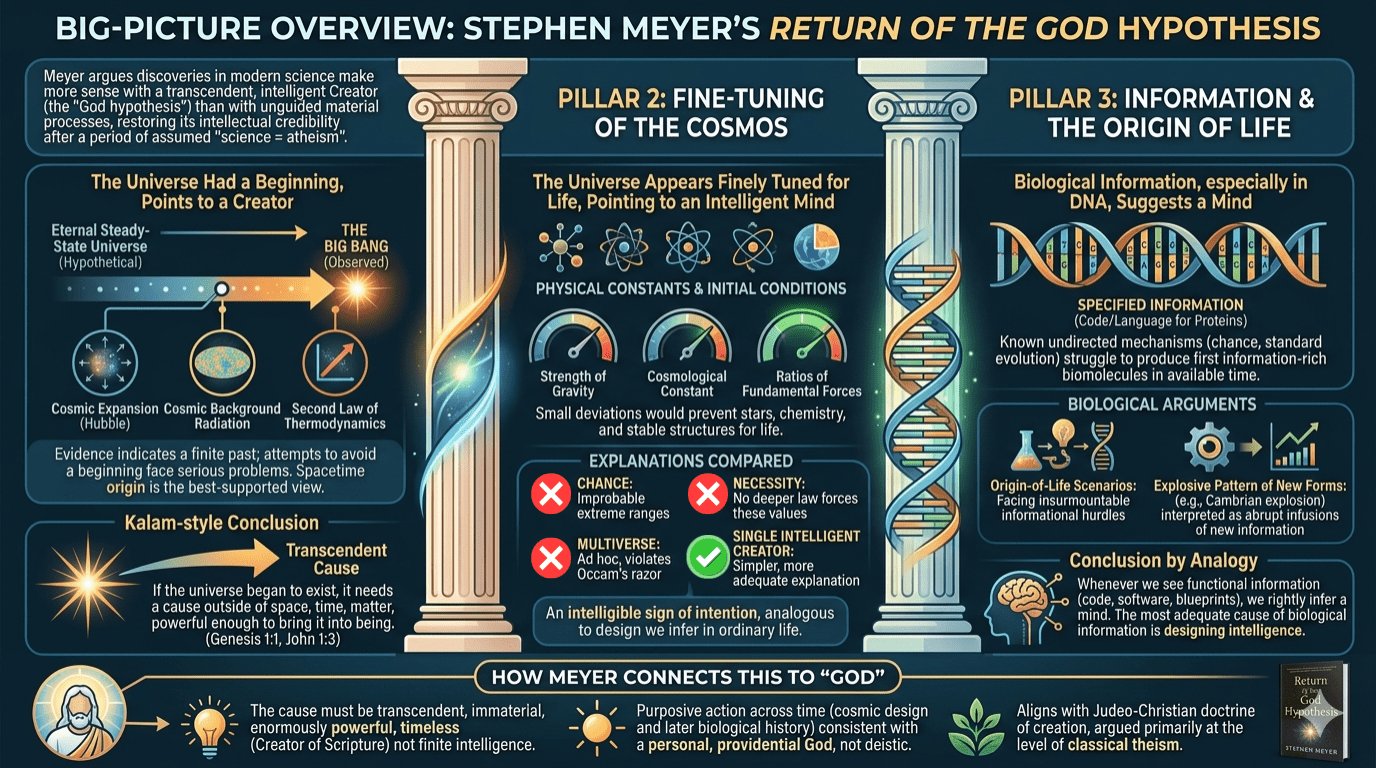
Big-picture overview
Meyer’s basic claim is that several major discoveries in modern science make more sense if there is a transcendent, intelligent Creator than if the universe is the product of unguided material processes. He calls this explanatory framework “the God hypothesis,” and argues that it has returned to intellectual credibility after a period in which many scientists assumed that “science = atheism.”
The book weaves together history of science, philosophy of explanation, and specific arguments from cosmology, physics, and biology. Meyer spends a lot of time contrasting theism with naturalism and with “designer of unknown identity,” and he contends that the evidence points specifically to a personal, conscious, transcendent God rather than to an impersonal force or multiverse.
To keep this manageable, it helps to see his case in three main pillars.
Pillar 1: The beginning of the universe
Meyer’s first pillar is that the universe had a beginning, and that this beginning is better explained by a Creator than by purely natural causes.
Key pieces in this part:
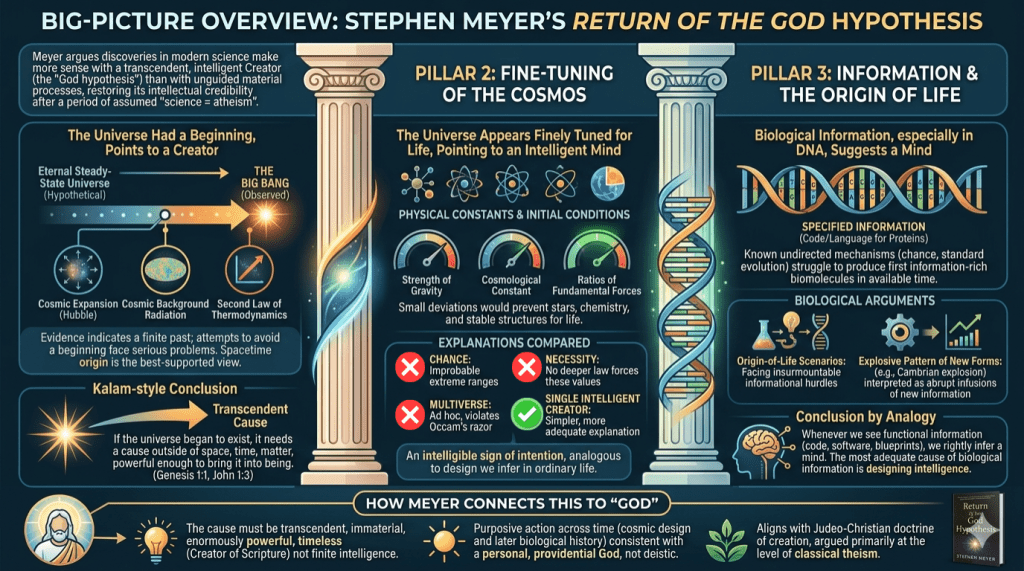
- He surveys the history from an eternal steady-state universe to the Big Bang, highlighting evidence for cosmic expansion (Hubble), cosmic background radiation, and the second law of thermodynamics as indicators of a finite past.
- He argues that any model trying to avoid a beginning (steady-state, oscillating universes, some inflationary models) faces serious scientific and philosophical problems, so that a genuine origin—of space, time, matter, and energy—is the best-supported picture.
From there, he draws a Kalam-style conclusion: if the universe began to exist, it needs a cause that is outside the universe, not bound by space, time, or matter, and powerful enough to bring it into being—which fits well with the biblical Creator. You can hear clear resonances with Genesis 1:1 and John 1:3 here.
Pillar 2: Fine-tuning of the cosmos
The second pillar is that the universe appears finely tuned for life in a way that points to an intelligent mind.
Core ideas:
- Meyer reviews examples of physical constants and initial conditions (strength of gravity, cosmological constant, ratios of fundamental forces, etc.) that must fall within narrow life-permitting ranges for complex life to be possible.
- He emphasizes that these parameters look “set” rather than random; small deviations would lead to universes with no stars, chemistry, or stable structures capable of supporting life.
He then compares candidate explanations:
- Chance: Improbable to an extreme degree, given the tight ranges involved.
- Necessity: There seems to be no deeper law that forces the constants to have the specific life-permitting values they do.
- Multiverse: Even if many universes exist, Meyer argues that postulating an enormous or infinite ensemble of unseen universes is ad hoc and violates Occam’s razor more than positing a single intelligent Creator.
His conclusion is that fine-tuning is an intelligible sign of intention, analogous (at a very different scale) to how we routinely infer design from finely arranged conditions in ordinary life, and that the God of classical theism is a simpler, more adequate explanation than a speculative multiverse.
Pillar 3: Information and the origin of life
The third pillar is about biological information—especially in DNA—and the origin and development of life.
Main points:
- Meyer builds on his earlier books to argue that DNA and other biomolecules contain large amounts of “specified information,” with nucleotide sequences that function like a code or language for building proteins and regulating cellular processes.
- He stresses that known undirected mechanisms (chance, necessity, standard evolutionary processes) struggle to produce the first information-rich biomolecules from simple chemistry in the time available on the early earth.
He brings in several lines of biological discussion:
- Origin-of-life scenarios (RNA world and others) and why he thinks they face insurmountable informational hurdles.
- The sudden appearance, or “explosive” pattern, of new forms and body plans in events like the Cambrian explosion and other radiations, which he interprets as abrupt infusions of new biological information.
From this, he argues by analogy with our uniform experience: whenever we see large amounts of functionally specified information (like coded language, software, or blueprints), we rightly infer a mind behind it. By parity of reasoning, he claims that the most adequate cause of biological information is a designing intelligence—which, in combination with the cosmological and fine-tuning evidence, he identifies with the personal God of theism.
How Meyer connects this to “God”
Meyer doesn’t stop at “some designer”; he tries to show that the cause must have attributes that align with the God of biblical theism.
He argues that:
- Because the cause of the universe brings space, time, and matter into being, it must be transcendent, immaterial, enormously powerful, and timeless (in at least some sense)—fitting the Creator of Scripture more naturally than a finite or embedded intelligence.
- Because the same cause appears to have both designed general cosmic conditions and later acted in biological history, it must be capable of intentional, purposive action across time, consistent with a personal, providential God rather than a deistic clockmaker.
He deliberately aligns this with the Judeo‑Christian doctrine of creation—though he argues primarily at the level of classical theism, not specifically for every distinctively Christian doctrine. You can see this as a kind of “general revelation” case: modern science, rightly interpreted, is a powerful confirmation that “the heavens declare the glory of God” (Psalm 19) and that “what can be known about God is plain” in the things that have been made (Romans 1).
All things were made through him, and without him was not any thing made that was made. John 1:3

