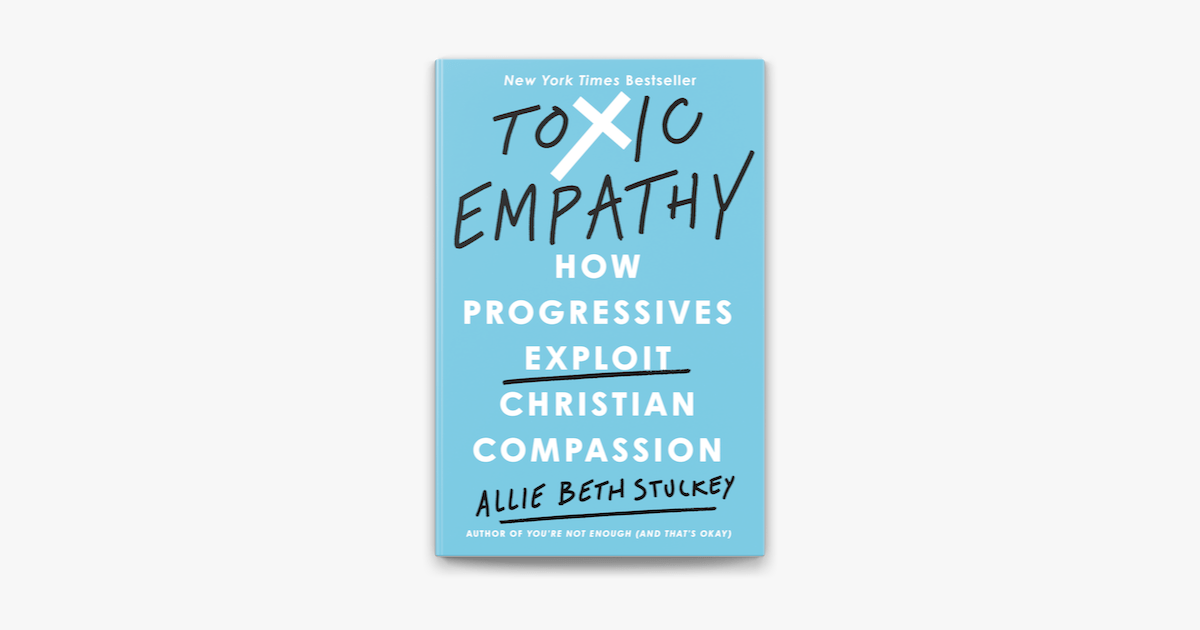
I read this book earlier this year and found it very helpful for Christians looking to give a thoughtful response as they engage with the topics covered. Here is a short review to give you a peek inside to those considering reading it.
Allie Beth Stuckey’s Toxic Empathy: How Progressives Exploit Christian Compassion is a provocative and timely critique of what she terms “toxic empathy” —a form of compassion that, she argues, has been weaponized by progressive activists to manipulate Christians into supporting policies contrary to biblical truth. Stuckey’s central thesis is not that empathy itself is inherently bad, but that it must be “submissive to love” as defined by Scripture, rather than feelings or cultural trends.
Stuckey structures her book around five contentious issues: abortion, gender, sexuality, immigration, and social justice. In each, she contends that progressives deploy emotionally charged slogans—“abortion is healthcare,” “love is love,” “no human being is illegal”—to present their positions as the only compassionate options, while discouraging critical moral inquiry.
Abortion
Stuckey devotes significant attention to abortion, arguing that “toxic empathy” focuses exclusively on the pregnant woman’s distress while ignoring the moral weight of the unborn child’s life. She writes:
“If you are so in her feelings that you are blinded to the other side of that moral equation, which is the life of the unborn child, well, then you’ve just made a calculation to affirm her choice in the name of empathy at the expense of the child whose life is being lost in abortion.”
She describes abortion procedures in graphic detail to underscore her point, asserting that “toxic empathy is a cancer. It is used to pressure women to undergo abortions and to convince everyone else that abortion is okay. It leads to the murder of the smallest, weakest, and most vulnerable children in horrifically gruesome ways.” Stuckey calls Christians to support legislation that protects unborn life and to offer real alternatives to abortion.
Gender and Sexuality
On gender and sexuality, Stuckey critiques the “love is love” mantra, arguing that it “lacks defined terms” and is designed to “tug on heartstrings and evoke an emotional response, not to engage critical thinking”. She insists that true compassion does not mean affirming every desire or identity, but rather upholding biblical standards of truth and love. She warns that “toxic empathy” can blind Christians to the long-term harms of uncritically affirming progressive views on gender and sexuality.
Immigration
Stuckey addresses immigration through the lens of slogans like “no human being is illegal,” contending that such mantras oversimplify complex moral and legal realities. She acknowledges the pain of those who seek a better life but argues that “true love…insists that children’s rights supersede adults’ desires,” advocating for policies that balance compassion with justice and order.
Social Justice
Stuckey is critical of the way “social justice” is framed in contemporary discourse, arguing that Christians must discern between biblical justice and ideologies that, in her view, exploit compassion for political ends. She cautions against conflating biblical love with uncritical acceptance of every social justice cause, urging believers to pursue “clarity to combat confusion, courage to combat cowardice, and compassion to combat callousness.”
Empathy vs. Love
A recurring theme is Stuckey’s distinction between empathy and biblical love. She writes, “[Empathy] must be submissive to love,” warning that unchecked empathy can “blind us to reality or morality”. She calls Christians to seek “truth in love,” grounding their compassion in biblical principles rather than cultural pressures.
Conclusion
Toxic Empathy is a forceful call for discernment in an age where compassion is often conflated with moral relativism. Stuckey’s challenge to submit empathy to the standards of biblical love, and her critique of progressive slogans, will resonate with readers concerned about the intersection of faith, culture, and politics. As she urges, “We must get the word out that TOXIC EMPATHY HURTS PEOPLE, and we, as believers, are called to LOVE”. I would recommend this book for anyone who loves people and engages regularly with those who often get sucked into toxic empathy. It is filled with helpful logical and Biblical arguments and illustrations.
 Seeing God
One thought on “Toxic Empathy by Allie Beth Stuckey – Book Review”